
“Sovereignty Is Not for Sale”: Britain, France, Germany and Canada Challenge Trump Over Greenland, Tariffs and Alliance Security
A widening dispute between President Donald Trump and several of America's closest allies has brought Greenland's sovereignty, international trade and the future of transatlantic security into an increasingly contentious diplomatic debate.
Britain, France, Germany and Canada have each challenged aspects of Trump's foreign-policy approach, while European governments have emphasized their support for Denmark's sovereignty and Greenland's right to determine its own future.
The disagreement has involved tariff threats, statements about territorial control and limited military activities in the Arctic. It has also exposed differences between Washington and allied capitals over how economic pressure should be used in international negotiations.
The central principle articulated by European and Canadian leaders is that Greenland's future cannot be decided through outside coercion. Greenland is a self-governing territory within the Kingdom of Denmark, and decisions about its political status belong to Greenlanders and the Danish constitutional framework.
That position has become a point of unity among governments that otherwise maintain different economic and security priorities.
Yet the dramatic description of a complete collapse of the international order goes further than the available evidence. NATO remains in operation, the United States continues to maintain extensive military and commercial relationships with European allies, and the governments involved have not collectively announced a comprehensive break with Washington.
What has occurred is a series of unusually public disagreements that have tested those relationships and raised questions about how far allied governments are prepared to resist American economic and diplomatic pressure.

The confrontation began with Trump's renewed interest in bringing Greenland under American control, a proposal he first raised during his initial presidency.
Trump has argued that Greenland's geographic position makes it essential to American national security. The island lies between North America and Europe, close to Arctic routes that are increasingly important for military surveillance, missile warning systems and strategic competition.
The United States already operates Pituffik Space Base in northwestern Greenland, an installation that supports missile warning, space surveillance and other defense missions.
Washington's interest also extends to Greenland's mineral resources and the prospect of increased Russian and Chinese activity in the Arctic.
Those considerations form the basis of Trump's stated security rationale. However, Denmark and Greenland have consistently maintained that security cooperation does not require transferring sovereignty to the United States.
The disagreement became particularly serious in January 2026, when Trump declined to rule out using force to obtain Greenland and threatened economic penalties against European countries resisting his proposals.
European governments responded by strengthening their diplomatic coordination and sending small military contingents to Greenland.
France, Germany, Britain, Sweden, Norway, Finland and the Netherlands participated in preparatory deployments associated with Arctic military activities.
The operation was not a large-scale mobilization for war against the United States. The deployments involved limited numbers of personnel, including reconnaissance teams and specialists, and were presented as part of preparations for expanded Arctic security exercises.
French officials said the initial deployment involved approximately 15 military personnel. Germany dispatched a small reconnaissance team, while other countries contributed personnel for planning and coordination.
The deployments demonstrated European willingness to participate more actively in Greenland's defense, while underscoring the difficult position facing NATO members responding to pressure from the alliance's largest military power.

The military activities prompted an economic confrontation.
On January 17, Trump announced plans to impose a 10% tariff on imports from eight European countries: Denmark, Norway, Sweden, France, Germany, Britain, the Netherlands and Finland.
The proposed duties were scheduled to begin February 1 and increase to 25% in June if the dispute over Greenland remained unresolved.
The president linked the proposed tariffs directly to European opposition to American acquisition of the island.
The announcement alarmed European officials because it threatened to use trade penalties against countries that were already American security allies.
British Prime Minister Keir Starmer described the proposed tariffs as wrong and said London would raise the matter directly with Washington.
French President Emmanuel Macron argued that Europe needed to defend its interests and discussed the possibility of using the European Union's anti-coercion instrument, a mechanism designed to respond to economic pressure from outside governments.
European Commission President Ursula von der Leyen called for a coordinated response, emphasizing that disagreements between allies should be resolved through diplomacy rather than escalating trade restrictions.
The dispute also exposed differences within Europe's political movements.
Some politicians generally sympathetic to Trump criticized the tariff threats, arguing that penalizing NATO partners would damage trade and weaken the alliance.
Other leaders urged restraint, warning that retaliatory measures could impose additional costs on European businesses and consumers.
The European Union considered possible countermeasures, but the situation changed before the threatened Greenland-related tariffs took effect.

On January 21, Trump announced a change in approach after meeting NATO Secretary General Mark Rutte at the World Economic Forum in Davos.
He said he would not impose the planned tariffs and ruled out military force to take control of Greenland.
Trump also described progress toward a framework agreement addressing Arctic security.
The announcement reduced immediate tensions and allowed diplomatic discussions to continue.
It did not mean the United States had acquired Greenland, nor did it establish that Denmark had agreed to sell the territory.
Instead, negotiations shifted toward military access, regional defense arrangements and cooperation among NATO partners.
Canadian Prime Minister Mark Carney also entered the debate, defending the sovereignty of Greenland and Denmark while urging middle powers to strengthen cooperation in an increasingly uncertain international environment.
Speaking during the Davos gathering, Carney warned that countries could no longer assume that established international relationships would always operate according to previous expectations.
His remarks reflected broader Canadian concerns about trade dependence, security relationships and the ability of smaller and middle-sized countries to preserve their autonomy.
But criticism of particular American policies should not be confused with Canada announcing an end to its relationship with the United States.
The two countries remain closely connected through trade, geography and defense arrangements, including the North American Aerospace Defense Command.
The significance of Carney's intervention was that he publicly defended territorial sovereignty and urged governments to develop greater resilience against economic coercion.

The most consequential development came several months later.
On September 22, Trump, Danish Prime Minister Mette Frederiksen and Greenlandic Prime Minister Jens-Frederik Nielsen signed a new Arctic security agreement at United Nations headquarters in New York.
The agreement updated the longstanding defense arrangements between Washington and Copenhagen and provided for a substantially expanded American military role in Greenland.
It allowed the United States to modernize and expand operations at Pituffik Space Base and establish additional defense areas at Narsarsuaq and Mestersvig, subject to implementation arrangements.
The agreement also addressed access for American military aircraft and vessels, restrictions on foreign military installations and screening of sensitive investments.
Crucially, the text explicitly reaffirmed the sovereignty and territorial integrity of the Kingdom of Denmark and recognized the Greenlandic people's right to self-determination.
That provision directly contradicts the suggestion that the agreement transferred Greenland's sovereignty to the United States.

The three governments presented the agreement in different political terms.
The White House emphasized that the United States had secured lasting military access and expanded authority to protect American security interests in the Arctic.
Denmark emphasized that the agreement preserved its sovereignty while strengthening NATO defense cooperation.
Greenland's government highlighted recognition of its right to determine its political future.
These interpretations are not necessarily mutually exclusive. The agreement can expand American military capabilities while preserving Greenland's constitutional status.
However, the precise language of the treaty is more important than the political descriptions surrounding it.
It does not make Greenland an American territory. It does not provide for a sale of the island. And it does not extinguish Greenlanders' right to self-determination.
The treaty also contains provisions intended to continue defense cooperation if Greenland eventually becomes independent, including arrangements concerning NATO membership and the assumption of existing defense obligations.
Those provisions raise significant long-term questions about how Greenland might exercise independence while maintaining security commitments.
They do not establish that Greenland has chosen independence or that a change in sovereignty has already occurred.
As of October 27, another important step remains outstanding.
The agreement was signed in September, but its entry into force depends on completion of parliamentary procedures in Greenland and Denmark.
Greenland's parliament began examining the agreement in October, with a second reading scheduled for November 3.
That means the treaty's signature and its full legal implementation should be distinguished when reporting on its current status.

The September agreement also changes how the January military deployments should be understood.
At the height of the crisis, European personnel arriving in Greenland were widely interpreted as a demonstration that Denmark would not face American pressure alone.
Those deployments were politically significant, but they were limited in scale and did not amount to a military confrontation between European forces and American troops.
The subsequent agreement shows that the dispute eventually moved into formal negotiations over Arctic defense.
This does not erase the diplomatic tensions that preceded it. European governments had openly challenged Trump's threats, and questions about trust within NATO remain part of the broader political debate.
But it does demonstrate that the parties continued negotiating and reached a signed arrangement rather than severing their security relationship.
The trade dimension requires similar precision.
The threatened Greenland-related tariffs were withdrawn in January. That does not mean broader tariff disputes between the United States and its trading partners have disappeared.
European and Canadian governments continue to face questions about trade diversification, industrial competitiveness, supply-chain resilience and dependence on American markets.
Some policymakers have advocated strengthening commercial relationships with other countries and increasing domestic industrial capacity.
Such efforts can be described as diversification or efforts to reduce strategic dependence. They do not, without additional evidence, establish that Britain, France, Germany and Canada have collectively or completely decoupled from the American economy.

The broader economic disagreement involves competing priorities.
Trump has argued that tariffs can protect American industries, encourage domestic investment and give Washington leverage in negotiations.
Critics of his approach argue that tariffs can raise costs for importers and consumers, disrupt supply chains and invite retaliation against American exports.
The effects depend on the goods involved, the level of the duties, exchange rates, business responses and whether trading partners negotiate exemptions or retaliate.
For European governments, the challenge is to protect domestic economic interests while maintaining access to one of the world's largest consumer markets.
For Canada, the issue is especially significant because of the depth of cross-border manufacturing, energy and agricultural trade.
For the United States, retaliatory measures could affect exporters and companies that rely on imported components.
These economic considerations help explain why governments have often combined strong diplomatic criticism with continued negotiations.

The Greenland dispute has also highlighted a structural challenge within NATO.
The alliance was established to provide collective defense against external threats. Its members are not accustomed to confronting territorial demands from another member, particularly the United States.
European governments have therefore faced the difficult task of defending Denmark's sovereignty without undermining the military cooperation they consider essential to their own security.
The January deployments illustrated that dilemma.
The September agreement offered a different approach: expanding American military access through negotiated arrangements while explicitly recognizing Denmark's territorial integrity and Greenland's self-determination.
Whether that arrangement provides a durable foundation for cooperation will depend on implementation, parliamentary approval and the conduct of the governments involved.
The Arctic itself will remain strategically important regardless of the outcome.
Changes in sea ice, growing interest in mineral resources and increased military activity have brought greater international attention to the region.
Greenland occupies a geographically significant position for North Atlantic surveillance and missile defense, making it relevant to both American and European security planning.
At the same time, Greenland is home to communities with their own political institutions, economic priorities and aspirations.
Its future cannot be reduced solely to the strategic interests of outside powers.

That is why the voices of Greenland's elected leaders are central to the story.
Prime Minister Jens-Frederik Nielsen has repeatedly emphasized that Greenland's political future belongs to its people.
During discussions with American representatives earlier in 2026, he stated that self-determination was not negotiable, while also expressing willingness to maintain constructive cooperation with Washington.
The position distinguishes opposition to an imposed change of sovereignty from opposition to American military cooperation.
Greenland can reject becoming part of the United States while participating in agreements intended to strengthen regional security.
That distinction became a foundation of the September treaty.
The dispute also offers a broader lesson about diplomatic rhetoric and actual government decisions.
Statements describing a complete breakdown of the international order may capture the intensity of political disagreement, but they can obscure developments that move in a different direction.
The European deployments occurred in January. Trump's tariff reversal followed days later. Months of negotiation then produced a trilateral security agreement in September.
By October, Greenlandic lawmakers were reviewing that agreement.
Those developments are not evidence of an uninterrupted escalation toward military confrontation. They describe a serious diplomatic crisis followed by negotiation and an effort to establish a new security framework.
The relationship between Washington and its allies remains subject to disagreement over trade, defense spending and foreign policy, but the Greenland agreement is an example of continued institutional cooperation.
The immediate question is now how the treaty will be implemented and whether the governments involved can maintain the distinction between expanded military access and territorial sovereignty.
For Denmark and Greenland, the central concern is preserving constitutional rights and political self-determination.
For Washington, the stated objective is strengthening its ability to defend North America and protect strategic interests in the Arctic.
For European allies and Canada, the challenge is to uphold territorial sovereignty while maintaining effective security cooperation with the United States.
The most important development is therefore not a supposed declaration of war between former allies or an irreversible collapse of NATO.
It is that a dispute involving tariff threats, territorial demands and military deployments ultimately produced a negotiated agreement that expands American defense access while expressly recognizing Greenland's right to determine its own future.
The sovereignty dispute was real. The European deployments were real. The tariff threats were real. But the latest documented outcome is a signed Arctic security agreement—not the collapse of the transatlantic alliance.
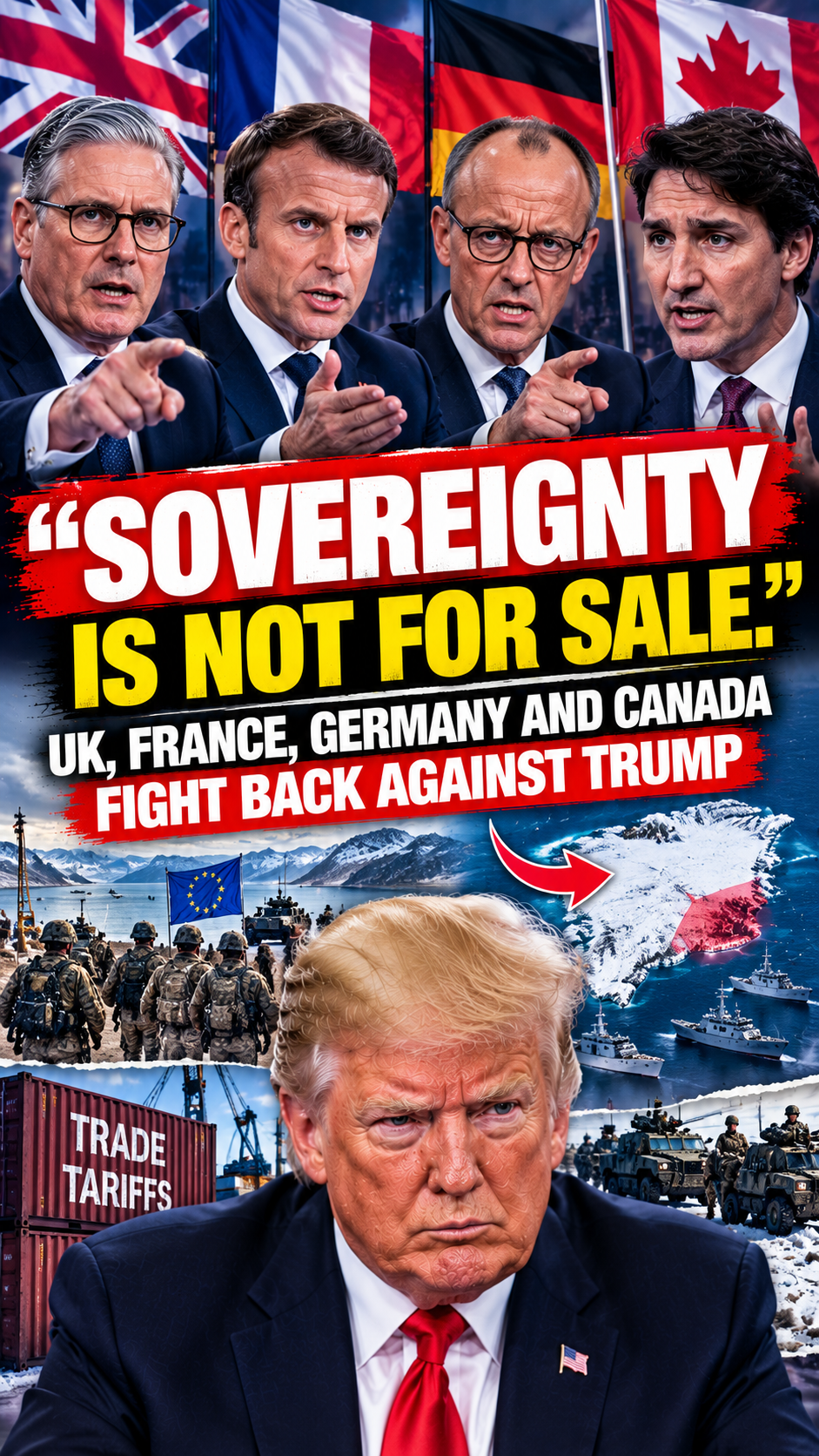
Editorial clarification: The supplied cover is a composite political illustration. It should not be treated as a photograph of a joint military confrontation. The European troop deployments described here took place in January 2026, while the United States, Denmark and Greenland signed a new security agreement on September 22. As of October 27, parliamentary procedures for bringing that agreement into force remain relevant.
Comments (0)
Loading comments...
May You Like

DAVENPORT AIRBNB HORROR — 40 OF 50 TEENS TEST POSITIVE FOR DRUGS SUPPLIED BY THE HOST'S MOM!










Popular Posts





