
STAGE STUNT ACCIDENT — MID-AIR HORROR!
Jesus Actor Soars Far Above the Crowd in Terrifying Easter Parade Mishap: What Really Happened?
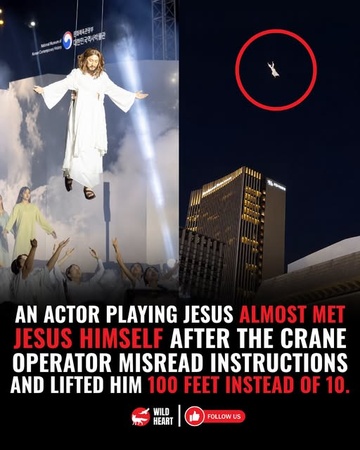
A dramatic Easter performance in South Korea has captured international attention after an actor portraying Jesus Christ was lifted high above a cheering crowd during a reenactment of the Ascension. What was intended to be a theatrical religious moment turned into an unexpected spectacle when the performer continued rising until he appeared as a tiny figure against the night sky.
The extraordinary footage has spread rapidly across social media, prompting a mixture of laughter, disbelief, and concern about the safety of the performer. As the actor ascends above the surrounding buildings, spectators below watch the scene unfold, while the camera struggles to keep the distant figure in view.
The incident took place during an Easter celebration in Seoul on April 4, 2026. The event featured a dramatic presentation of the Christian story of Jesus Christ, including the moment when he ascends into heaven following his resurrection. The production used a crane and a suspended harness to create the illusion of the performer rising above the audience.
At first, the scene appeared to be proceeding as planned. Dressed in a long white robe, the actor extended his arms as he rose into the air, recreating a familiar image from Christian religious art. The crowd below provided a striking backdrop, with lights illuminating the stage and the surrounding area.
However, the performer continued climbing far beyond the height spectators appeared to expect. Instead of remaining close to the stage, he rose toward the upper portions of nearby buildings, eventually becoming a small white figure suspended against the dark sky.
The unexpected height transformed the performance into a potentially dangerous situation. A theatrical effect designed to last only a short time had become a highly visible aerial incident, raising questions about the equipment, operating procedures, and communication among the event's organizers.
As the footage circulated online, a particular explanation quickly gained popularity: the crane operator had allegedly misread instructions and lifted the actor approximately 100 feet instead of the intended 10 feet. Although this version has been repeated widely, the precise nature of the alleged mistake has not been independently established by the strongest available reporting.
Some posts also claimed that the actor fainted while suspended high above the ground. However, those claims remain unverified. The widely shared footage alone does not establish whether the performer lost consciousness, experienced a medical emergency, or remained fully aware throughout the incident.
Reports about the event have described the performer reaching approximately 30 meters above the ground, although exact measurements have not been conclusively established. That would place him roughly ten stories above street level, an extraordinary height for a theatrical effect taking place above a public gathering.
The episode has also generated questions about whether the crane malfunctioned, whether the operator continued lifting because of a communication problem, or whether environmental conditions contributed to the unexpected ascent. Some reports have suggested a combination of operating error and strong winds, but the precise technical explanation remains unclear.
Regardless of the cause, the incident highlights the importance of safety precautions during live performances involving suspended actors. Crane operations require trained personnel, clear communication, reliable equipment, and carefully defined lifting limits. A mistake involving height can quickly turn a dramatic visual effect into a serious emergency.
Harnesses and suspension systems can reduce certain risks, but they do not eliminate the dangers of working high above the ground. Performers may face unexpected swinging, wind exposure, equipment stress, and difficulties communicating with ground crews. Even when a person remains securely attached, an uncontrolled ascent can create substantial physical and psychological strain.
The event also raises questions about the responsibility of organizers who plan elaborate public spectacles. Before a performer is lifted over a crowd, safety teams should establish maximum operating heights, emergency stop procedures, reliable communication channels, and a clear plan for bringing the person safely back to the ground.
The popularity of the video has added another dimension to the story. Online audiences have responded with jokes about the actor being sent directly to heaven, while others have described the moment as an accidental recreation of the very religious event the performance was meant to portray. The humor has helped the footage spread far beyond its original audience.
Yet the jokes have also prompted criticism from people who believe the situation should be treated primarily as a safety concern. For viewers watching the actor disappear into the sky, the spectacle may seem almost comical. For the person attached to the crane, however, an unexpected rise of that magnitude could be frightening and potentially dangerous.
The incident demonstrates how social media can transform a local event into a global talking point within hours. Short clips, dramatic images, and sensational captions often attract attention faster than detailed explanations. As a result, an incident that is genuinely striking can become mixed with unverified claims about what caused it or how the people involved reacted.
That is particularly important when a viral caption includes precise measurements or claims about someone losing consciousness. Such details can appear authoritative even when they originate from anonymous posts rather than verified accounts. Responsible reporting requires distinguishing what the footage visibly shows from what remains unknown.
The religious setting has also contributed to the video's widespread appeal. The Ascension is an important event in Christian belief, traditionally commemorating Jesus Christ's return to heaven after his resurrection. A modern performance attempting to represent that moment already carries strong visual symbolism, making an unexpected ascent especially memorable to viewers.
For event organizers, the episode may serve as a reminder that spectacle should never take priority over safety. Large public celebrations often combine theatrical effects, music, lighting, and complex machinery to create unforgettable experiences. Those elements require careful coordination, especially when performers are suspended above spectators.
The available reports indicate that the actor came through the incident without a reported injury. Nevertheless, a safe outcome does not remove the need to understand what happened. A thorough review of the equipment, operating procedures, and communication systems would help determine whether changes are needed to prevent similar incidents at future events.
Ultimately, the image of a performer dressed as Jesus rising far above a Seoul crowd has become one of the internet's most unexpected viral moments. But behind the jokes lies a serious question about the risks of live entertainment and the responsibility of those who control the machinery.
The most important lesson is not whether the actor accidentally reached a height worthy of the biblical story he was portraying. It is whether every reasonable precaution was taken to protect him. Until the precise cause of the incident is established, claims about a specific instruction-reading mistake or the actor fainting should be treated cautiously. What remains clear is that a planned theatrical ascent became an extraordinary spectacle—and a reminder that even the most carefully staged performances can take an unexpected turn.
Comments (0)
Loading comments...
May You Like

1,000+ MILITARY FAMILY RECORDS BREACHED, 200+ MILITARY SITES AT RISK!

WWE BRONSON REED DEAD AT 38, STIMULANTS DETECTED, $10M INSURANCE PAYOUT FROZEN!











Popular Posts



