
Sunny Hostin Claim Links Black Americans’ Access to Cars and Licenses to Slavery’s Legacy
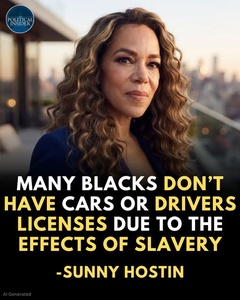
NEW YORK — Television host and legal analyst Sunny Hostin has drawn renewed attention after arguing that voter identification requirements can disproportionately affect Black Americans and other voters who lack government-issued identification.
Hostin’s Argument
Hostin made the comments while discussing voter identification requirements, arguing that some lower-income and older Americans do not own cars or hold driver’s licenses.
She connected those modern identification barriers to historical restrictions that prevented Black Americans from exercising voting rights, describing them as a “vestige” of post-slavery laws.
Hostin also argued that women can encounter identification problems after marriage when names differ across passports, birth certificates and other official documents.
Her broader argument was that stricter identification requirements could create additional obstacles for eligible voters, potentially reducing participation among groups that already face practical barriers.
What Hostin Said
The remarks circulated after a discussion involving voter registration and identification requirements, with Hostin arguing that voting rules should not create unnecessary administrative obstacles for eligible citizens.
She said that people without cars or driver’s licenses could face particular difficulties obtaining or presenting identification, although a driver’s license is not the only form of identification accepted under many voting systems.
The specific comments have subsequently been cited by supporters and opponents of voter-identification requirements as part of the broader national debate over access and election administration.
The Historical Context
There is clear historical evidence that Black Americans faced systematic barriers to voting after the Civil War, including literacy tests, poll taxes and other discriminatory practices.
The National Archives notes that these restrictions significantly limited Black voter registration and political participation across parts of the South before federal voting-rights protections were strengthened.
The Voting Rights Act of 1965 prohibited discriminatory voting practices and outlawed literacy tests, representing a major federal intervention against racial barriers to voting.
However, the historical restrictions documented by federal authorities were generally different from contemporary voter-identification requirements, which are primarily justified by states as election-administration measures.
How Many Americans Lack Cars?
Transportation data shows that vehicle access is not universal, although the situation has changed substantially over decades.
The U.S. Department of Transportation reported that approximately 16% of African American households lacked access to a vehicle in 2024, compared with more than 43% in 1970.
also found that 21% of Black adults said they seldom or never drive a car, compared with 7% of White adults in its 2024 survey.
Those figures demonstrate a racial difference in driving patterns, but they do not establish that slavery itself is the direct reason individual Americans today lack vehicles or driver’s licenses.
Identification Goes Beyond Driver’s Licenses
Driver’s licenses are only one form of government identification, and many states allow voters to use other documents depending on their election rules.
A Government Accountability Office review found that identification ownership varies across racial and ethnic groups, while the costs and requirements for obtaining identification differ significantly between states.
The federal review also found mixed evidence regarding voter-ID laws and turnout, with different studies reaching different conclusions about their effects.
The Current Political Debate
The debate has intensified around federal proposals seeking to impose additional identification and citizenship-documentation requirements for federal elections.
The proposed SAVE America Act would require documentary proof of citizenship for voter registration and establish a nationwide photo-identification requirement for voting in federal elections.
Supporters describe such measures as safeguards intended to ensure that only eligible citizens participate in federal elections.
Opponents, meanwhile, argue that additional documentation requirements could create unnecessary barriers for eligible voters who have difficulty obtaining specific identification or citizenship documents.
FactCheck.org reported that election experts have disagreed over the potential scale of those effects, while noting that some voters could face additional registration or voting difficulties.
What the Evidence Shows
Research does not provide a single universally accepted conclusion about the electoral consequences of voter-identification requirements.
A major Government Accountability Office review found that studies examining turnout produced mixed results, with some finding no statistically significant effect and others identifying decreases.
The same review found evidence that certain voter-ID changes in Kansas and Tennessee were associated with larger turnout declines among African American registrants during the 2012 election.
However, the agency cautioned that those findings were specific to the states and election period studied and should not automatically be generalized nationwide.
A Complicated Policy Question
The dispute therefore involves two competing concerns: preventing administrative or eligibility problems in elections while ensuring that lawful voters can participate without unnecessary obstacles.
Hostin’s remarks emphasize the second concern, particularly for communities that may have lower rates of vehicle ownership or access to particular identification documents.
Supporters of voter-ID policies emphasize the first concern and argue that identification requirements can provide an additional verification mechanism at elections.
The evidence indicates that the practical consequences depend heavily on the precise identification rules, available alternatives, costs, registration procedures and assistance provided by individual states.
What Happens Next?
The national debate is likely to continue as federal and state lawmakers consider different approaches to voter identification, citizenship verification and election administration.
For Hostin, the issue connects contemporary voting rules with the broader history of racial discrimination in American elections.
For critics of her argument, historical voting restrictions and modern identification requirements represent different legal and administrative questions that should not automatically be treated as equivalent.
The available evidence supports a more limited conclusion: identification access differs across demographic groups, while research on voter-ID laws has produced mixed findings about their effects on participation.
Ultimately, the debate centers on how election systems can verify voter eligibility while maintaining practical access for citizens who may not possess commonly used forms of identification.
Comments (0)
Loading comments...
May You Like

Obama Steps Back Into the Political Spotlight as Democrats Target Trump’s

OBAMA STUNS ON INSTAGRAM: MESSAGE MARKING 34-YEAR MILESTONE SPARKS A BUZZ













