Supreme Court Blocks Trump Administration’s Mail-Ballot Restrictions Ahead of Midterms


8
- President Donald Trump’s administration suffered a major legal setback after the U.S. Supreme Court refused to let the Postal Service enforce new restrictions on mail-in ballots before November’s midterm elections.
- The ruling preserves existing mail-voting procedures while legal challenges continue, preventing the administration from implementing requirements that critics warned could create confusion and potentially disenfranchise voters.
- Trump’s administration had asked the Supreme Court to lift a lower-court order blocking the Postal Service rule, arguing that the changes were necessary to protect election integrity and prevent fraud.
- The regulations followed a March executive order from Trump targeting mail voting, an issue he has repeatedly criticized despite sometimes using mail ballots himself, according to Reuters reporting.
- Under the proposed system, states would have faced new requirements involving voter lists, federally approved envelopes, and unique barcodes for ballots sent through the postal system.
- Opponents argued that the federal government lacked authority to impose several of those requirements because states traditionally administer elections, while election officials also warned about the limited implementation timeline.
- Boston-based U.S. District Judge Indira Talwani previously blocked enforcement, finding that the administration’s rule likely raised constitutional problems and could not realistically be implemented before the November election.
- The First U.S. Circuit Court of Appeals later declined to suspend Talwani’s order, allowing the restrictions to remain blocked while the Supreme Court considered the administration’s emergency request.
- On September 14, the Supreme Court rejected the administration’s request, leaving the lower-court injunction in place and preventing the Postal Service from enforcing the disputed requirements during the midterm election.
- Justices Samuel Alito and Clarence Thomas dissented, arguing that the administration was likely to succeed in its broader legal challenge and should therefore have been allowed to proceed.
- Justice Brett Kavanaugh indicated that the Postal Service might possess some relevant authority, but practical concerns surrounding implementation before the election weighed heavily against allowing the rules to take effect.
- A separate federal judge, Carl Nichols, also blocked the administration’s mail-ballot rule, delivering another setback as courts increasingly scrutinize the federal government’s attempt to reshape election procedures.
- Nichols, who was appointed by Trump, concluded that important portions of the regulation exceeded Postal Service authority and could make voting by mail more difficult for some Americans.
- All 50 states permit some form of mail voting, while election systems differ considerably across the country, making nationwide changes especially complicated so close to a major federal election.
- Voting-rights organizations and Democratic-led states challenged Trump’s policy, warning that new technical requirements could invalidate legitimate ballots or create barriers for voters who depend on absentee and mail voting.
- The administration has defended its approach as an election-security measure, arguing that federal oversight could help protect the postal system and reduce opportunities for fraudulent voting.
- Critics counter that widespread voter fraud is extremely rare and say the new requirements could create greater risks by disrupting established procedures that state election officials have already prepared for November.
- The legal battle comes as Republicans attempt to retain control of Congress in the November 3 midterm elections, making election administration an increasingly important political and constitutional issue.
- The Supreme Court decision does not resolve every question surrounding Trump’s broader election policies, but it prevents the disputed mail-ballot requirements from taking effect during this year’s midterm voting.
- The ruling marks a significant confrontation between the Trump administration and the courts, while leaving states in control of existing mail-voting procedures as Americans prepare for the November elections.
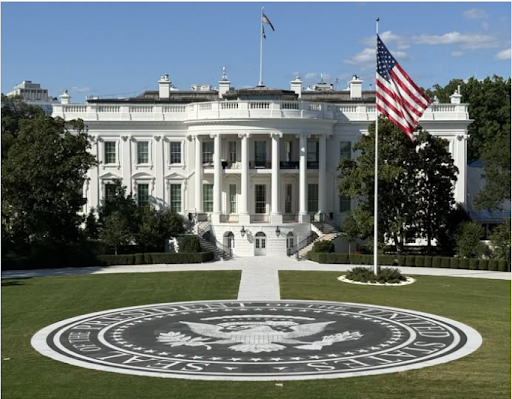
Image note: The uploaded White House photograph is treated only as an illustrative visual and is not used as evidence for the timing, location, or circumstances of the reported Supreme Court decision.
Comments (0)
Loading comments...
May You Like

Shocking news from Ohio: an unexpected development ahead of Trump's rally
Oct 5, 2026•US Politics

TRUMP’S OHIO WARNING UNDER THE SPOTLIGHT
Oct 5, 2026•US Politics
TRUMP HIT WITH 26 ARTICLES OF IMPEACHMENT
Oct 5, 2026•US Politics