Supreme Court Hands Trump Major Election Win — SAVE Voter Verification Database Cleared to Operate
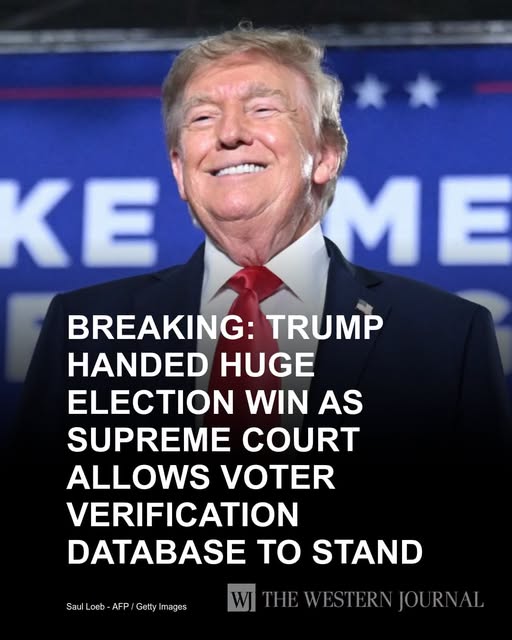
The U.S. Supreme Court ruled Friday that the Trump administration can move forward with its expanded SAVE database program, a sweeping voter verification system designed to help states identify non-citizens on voter rolls. The 6-3 decision marks a significant victory for President Trump’s election integrity agenda — but critics warn it could result in thousands of eligible citizens being wrongly purged from voter rolls just weeks before the midterm elections.
WASHINGTON – The Supreme Court cleared the way Friday for the Trump administration to use a controversial federal database to verify voters’ citizenship status, delivering a major legal win to the president’s aggressive push to overhaul the nation’s election system.
The 6-3 ruling lifted a lower court order that had blocked the use of the modified Systematic Alien Verification for Entitlements system, or SAVE, which the Department of Homeland Security expanded last year to include Social Security data and allow states to conduct bulk searches of voter registrations .
The decision, issued just 39 days before the November 3 midterm elections, represents one of the most consequential Supreme Court rulings on election law in years — and a significant vindication of Trump’s executive order “Preserving and Protecting the Integrity of American Elections,” signed in March 2025 .
What the Ruling Does
The Supreme Court’s unsigned order pauses a June ruling by U.S. District Judge Sparkle Sooknanan, who had blocked the modified SAVE system on the grounds that it violated federal privacy laws and threatened the voting rights of American citizens .
The majority found that a 1996 immigration law explicitly authorizes DHS to obtain citizenship and immigration information from other federal agencies, and that the federal government has “an obligation to respond” to states seeking to verify voter citizenship .
“The order below prevents the Federal Government from using the program it believes is best suited to the task,” the majority wrote .
The ruling noted that the National Voter Registration Act prohibits systematic voter purges within 90 days of a federal election, which limits the immediate impact of the decision before the midterms . However, states can still conduct individualized checks of voters’ citizenship status during this period .
What Is the SAVE System?
The SAVE program was created in 1986 as a tool to help government agencies verify the immigration status of individuals applying for public benefits .
In April 2025, DHS announced a comprehensive overhaul of the system, eliminating fees for database searches and permitting users to search using Social Security numbers and conduct bulk searches rather than individual record checks .
The modified system now includes records of U.S.-born citizens, and for the first time allows states to cross-reference voter registration lists against federal immigration and Social Security data on a mass scale .
According to court filings, at least 67 million voter registrations have been scanned through the program since the expansion .
DHS General Counsel James Percival praised the ruling: “This decision is a victory for election integrity. American elections are for Americans. The Trump Administration and the Department of Homeland Security will use every tool at our disposal to secure our elections” .
The Dissent: A Warning About Disenfranchisement
Justice Ketanji Brown Jackson, joined by Justices Sonia Sotomayor and Elena Kagan, issued a sharp dissent, arguing that the majority focused only on the government’s purported harms while disregarding the risks to lawful voters .
“The harm caused by burdening or disenfranchising even a few lawful voters outweighs the nonexistent harm that the Government experiences when it is prevented from taking an action that it likely lacks the authority to take,” Jackson wrote .
Jackson noted that the database’s underlying data is unreliable — Social Security records often contain stale citizenship information, particularly for naturalized citizens who may have been flagged as non-citizens based on outdated records .
“States will at most conduct individualized voter-roll maintenance using the modified SAVE system ahead of the November elections,” she wrote. “In my view, however, the harm caused by burdening or disenfranchising even a few lawful voters outweighs the nonexistent harm” .
Documented Errors Fuel Concerns
Critics point to concrete evidence that the SAVE system has already produced errors.
In Travis County, Texas, election officials investigated 97 voters flagged by SAVE as apparent non-citizens and found that at least 10% — and likely up to 21% — were actually U.S. citizens .
One newly naturalized citizen had her voter registration revoked without her knowledge, while two others had to provide proof of citizenship to remain on the rolls because of SAVE system errors .
The League of Women Voters, the lead plaintiff in the case, called the ruling “profoundly disappointing” and warned that it “puts millions of Americans at risk of being unlawfully targeted by the administration’s unreliable voter purge database” before the midterms .
“However, this case is not over,” the group said in a statement. “The D.C. district court ruled that the expanded SAVE program violated multiple laws. We will be doing everything in our power to protect Americans’ voting and privacy rights” .
The Broader Election Integrity Battle
The SAVE ruling is the latest in a series of emergency-docket decisions shaping the rules for the 2026 midterms.
Earlier this month, the Supreme Court blocked a Trump administration rule that would have restricted mail-in voting procedures, with Justice Brett Kavanaugh writing that applying the new regulations so close to the election would be “arbitrary and capricious” .
The court also rejected a Republican effort in Missouri to redraw a Kansas City-based congressional district held by a Democrat .
But Friday’s ruling handed the administration a critical win on its core election integrity priority — a goal Trump has pursued relentlessly since returning to office, despite research showing that non-citizen voting is exceptionally rare and already illegal .
The administration has also dispatched Department of Justice election monitors to polling sites across the country, and the Republican National Committee has organized its own expansive observation program focused on voting equipment and machine operations .
Senate Democratic Whip Dick Durbin condemned the ruling: “The Supreme Court just allowed the Trump Administration to weaponize an unreliable database against Americans’ fundamental right to vote less than six weeks before a consequential midterm election” .
What Happens Next
The case, Department of Homeland Security v. League of Women Voters, will now return to the lower courts for further litigation .
The Supreme Court also indicated it will separately consider whether the 90-day ban on systematic voter purges applies to removals targeting non-citizens — a question with potentially enormous implications for future elections .
For now, states can use the SAVE system to conduct individualized citizenship checks ahead of the November elections. Whether those checks result in wrongful removals of eligible voters — or achieve their stated goal of preventing non-citizen voting — will likely be determined in the months and years to come.
The Bottom Line:
| What the ruling does | What it doesn’t do |
|---|---|
| Lifts block on expanded SAVE database | Does not resolve underlying legality |
| Allows individualized voter checks | Prohibits systematic purges within 90 days of election |
| Gives Trump administration a win on election integrity | Does not prove widespread non-citizen voting exists |
For readers sharing the viral graphic claiming a “huge election win”: the Supreme Court’s decision is real and significant — but it is a temporary emergency order, not a final ruling on the merits. The legal battle over the SAVE database continues, and the true impact on the midterm elections remains to be seen.
Comments (0)
Loading comments...
May You Like

South Korea–Ukraine Rift Deepens Over North Korean POW Transfer as PURL Draws New Scrutiny

South Korea–Ukraine Rift Deepens Over North Korean POW Transfer as PURL Draws New Scrutiny