
Supreme Court Rejects Trump Administration’s Attempt to Restrict Mail-In Voting
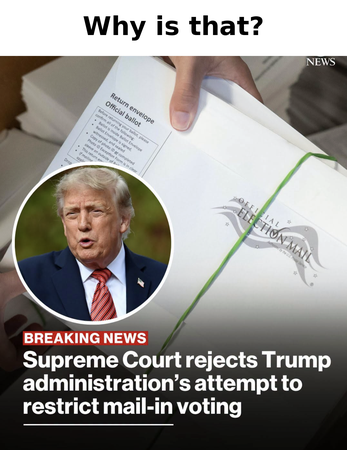
WASHINGTON — September 15, 2026 — The U.S. Supreme Court has dealt a major setback to President Donald Trump’s effort to tighten federal control over mail-in voting, refusing to allow the U.S. Postal Service to enforce new restrictions before the 2026 midterm elections.
The decision leaves existing state mail-ballot procedures in place as voting is already getting underway in parts of the country. The administration’s proposed system would have required states to submit lists of voters receiving mail ballots and comply with new USPS-approved envelope and barcode requirements.
The ruling is an important victory for states and voting-rights groups that argued the changes came too close to Election Day and could cause otherwise valid ballots to be rejected.


Caption: The U.S. Supreme Court in Washington, where justices rejected the Trump administration’s request to revive new mail-ballot restrictions before the 2026 midterms.
What Did the Supreme Court Decide?
The court's order was relatively brief, but its practical impact is significant.
The justices declined the Trump administration's request to suspend a lower-court injunction that had prevented USPS from enforcing the new requirements.
In other words, the Supreme Court did not allow the new system to take effect for the upcoming midterm elections.
The majority indicated that the administration was unlikely to prevail on the merits of its challenge to the lower court's order. Justices Samuel Alito and Clarence Thomas dissented. Justice Brett Kavanaugh agreed that the restrictions should not take effect for the midterms, while signaling that he could view the underlying legal questions differently in a future case.
The Key Point
This was not necessarily a final ruling on every legal question surrounding Trump's mail-voting policy.
Instead, the immediate question before the court was whether the administration could enforce the new USPS rules while the broader litigation continued.
For the 2026 election, the answer is no.


Caption: The ruling keeps the challenged mail-ballot requirements blocked while the underlying legal dispute continues.
What Was Trump Trying to Change?
The dispute stems from a March executive order directing the federal government to take a more aggressive role in regulating mail-in ballots.
The administration's subsequent USPS rules would have required states to submit information about voters receiving mail ballots through a federal portal.
The plan also called for standardized envelope requirements and USPS-approved barcodes.
Under the proposed system, ballots that did not meet the federal requirements could potentially be rejected or prevented from moving through the mail system.
That was one of the most controversial aspects of the plan.
Election administration in the United States is traditionally carried out largely by states and local governments. Critics argued that the Trump administration was attempting to use federal control over the Postal Service to impose requirements that effectively changed how states conduct elections.


Caption: The proposed federal system would have introduced new USPS requirements for ballot envelopes and voter information submitted by states.
Why Did Federal Courts Block the Rules?
The Trump administration's proposal quickly became the subject of multiple lawsuits.
A federal judge in Massachusetts previously issued an injunction preventing USPS from enforcing the new rules.
Then, on September 13, U.S. District Judge Carl Nichols in Washington, D.C., issued another preliminary injunction blocking implementation of the administration's plan. Nichols is a Trump appointee.
The courts focused heavily on the timing.
Mail ballots were already being sent to voters in states including Alabama, North Carolina and Wisconsin, while other states were preparing to begin their own mail-ballot distribution.
Election officials argued that changing the rules at that stage could create confusion and make it difficult for states to comply without disrupting the election.
The Washington judge warned that without an injunction there was an increased risk that otherwise valid absentee and mail ballots would not be counted.
The Whistleblower Warning
The legal fight intensified after a whistleblower raised concerns about the technical system the Postal Service would use to implement the new requirements.
According to reports, the proposed federal portal was not yet fully operational, while the administration was seeking to implement the new requirements on a tight election timetable.
The whistleblower warned that technical problems could potentially result in large numbers of ballots being rejected.
The USPS Office of Inspector General subsequently announced that it would conduct an independent review of those allegations.
That issue became especially important because election officials were already preparing ballots under existing state systems.


Caption: Election workers have been preparing and processing mail ballots under state procedures as the legal battle over the federal USPS rules continues.
The Administration Says the Rules Are About Election Security
The Trump administration has defended the restrictions as a measure intended to improve election security.
Officials have argued that USPS has broad authority to regulate mail and that the federal government should be able to ensure that election mail is properly identified and handled.
The administration has also repeatedly argued that stronger controls are necessary to prevent fraud.
But opponents say there is a crucial distinction between protecting election mail and allowing the federal government to determine which ballots states may send.
Federal courts have so far been unwilling to allow the new system to be imposed immediately before the midterms.
Mail Voting Is Already a Major Part of American Elections
The stakes are substantial because mail voting is no longer a marginal part of the American electoral system.
Nearly one-third of votes were cast by mail in the 2024 presidential election, according to the Associated Press. Several states rely heavily on mail voting, while some conduct elections almost entirely through the mail.
That means even a relatively small procedural change can have enormous consequences if implemented nationwide shortly before Election Day.
Election officials have argued that voters need predictable rules and enough time to understand how ballots should be requested, completed and returned.
A last-minute federal change could force states to alter materials, instructions, software and ballot-processing procedures simultaneously.


Caption: Mail voting allows eligible voters to cast ballots without appearing at a polling location, making consistent procedures especially important during the election period.
Trump Has Long Criticized Mail-In Voting
The Supreme Court fight also fits into Trump's long-running political battle over voting by mail.
Trump has repeatedly criticized mail voting and has falsely linked the practice to widespread election fraud surrounding the 2020 presidential election.
However, major studies and election investigations have found that large-scale fraud involving mail ballots is extraordinarily rare.
The administration insists its current proposal is about election integrity rather than eliminating mail voting.
Critics argue that the restrictions would make it harder for voters to use a legal method of casting their ballots and would shift too much election authority from the states to the federal government.
What the Supreme Court Decision Means for November
For voters, the immediate consequence is relatively straightforward.
States can continue using their existing mail-ballot procedures for the 2026 midterms.
They do not have to suddenly replace their systems with the Trump administration's proposed federal USPS framework.
That provides election officials with greater certainty at a critical moment.
The decision is particularly important in states where mail ballots are already being distributed.
Washington Secretary of State Steve Hobbs said the ruling allows officials to continue preparing for a secure election without having to overhaul their systems to meet what he described as unrealistic federal requirements. Arizona officials also welcomed the ruling. Utah's Republican lieutenant governor said the decision would allow the state's election to proceed normally.


Caption: USPS workers handle election-related mail as states continue operating under their existing mail-ballot procedures.
But the Legal Battle May Not Be Over
The Supreme Court's decision does not necessarily end the broader dispute over federal authority.
The administration could continue challenging the lower-court rulings, and the underlying cases may eventually require courts to decide whether USPS actually possesses the authority to impose the proposed requirements.
Justice Kavanaugh's separate position could also become significant in future litigation. Although he agreed the restrictions should remain blocked for the 2026 election, he indicated that the legal question surrounding USPS authority could be viewed differently outside the immediate election context.
That means Monday's decision should not necessarily be interpreted as the Supreme Court permanently rejecting every aspect of Trump's broader effort to change mail voting.
It is, however, a clear ruling that the administration cannot impose the contested system on states for this year's midterm elections while the current injunctions remain in place.
THE BOTTOM LINE
The headline is accurate in its central point: the Supreme Court has rejected Trump's attempt to revive the new mail-in voting restrictions before the 2026 midterms.
But the legal nuance matters.
The court did not permanently settle every constitutional and statutory question surrounding Trump's election-related executive order. Instead, it refused to remove the lower-court injunctions that currently prevent USPS from enforcing the new requirements.
For voters, the practical result is much clearer:
The 2026 midterm mail-voting process will continue under existing state procedures rather than the Trump administration's proposed new federal USPS system.
And with ballots already being mailed in several states, the Supreme Court's decision removes one of the biggest sources of uncertainty hanging over the 2026 election.
Comments (0)
Loading comments...
May You Like

OBAMA STUNS ON INSTAGRAM: MESSAGE MARKING 34-YEAR MILESTONE SPARKS A BUZZ

Obama Steps Back Into the Political Spotlight as Democrats Target Trump’s













