
Susan Sarandon Says Pro-Palestine Views Are Costing Her Hollywood Roles
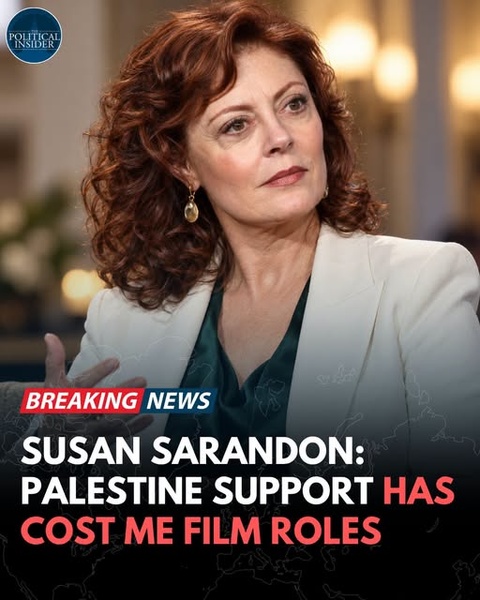
VENICE, Italy — Oscar-winning actress Susan Sarandon says her outspoken support for Palestinians and criticism of Israel’s actions in Gaza continue to have professional consequences, claiming that she has recently lost film opportunities because some talent agencies are still discouraging producers from hiring her.
Sarandon made the comments during a press conference at the 2026 Venice Film Festival, where she was promoting The Echo Chamber, a new Italian-Belgian film directed by Andrea Pallaoro. Her remarks have reignited a broader debate over political expression, alleged blacklisting and the increasingly polarized relationship between Hollywood and the Israel-Palestine conflict.
Sarandon Says She Is Still Losing Roles
Speaking to reporters in Venice, Sarandon said that the professional consequences of her political views had not ended.
She said she had recently had films “taken away” because, according to her, some agencies were still telling filmmakers not to hire her.
Sarandon characterized the situation as a problem within the industry's “power structure,” while saying she felt considerably more welcomed by audiences and filmmakers outside the United States.
The actress also argued that public attitudes toward the Israel-Palestine conflict have changed significantly since the beginning of the Gaza war in 2023.
She said she believed more Americans had become aware of the scale of U.S. financial and political support for Israel and that the public conversation surrounding Palestine had changed.
However, she maintained that those changes had not necessarily reached the most powerful parts of the entertainment industry.
Her 2023 Controversy Remains a Turning Point
Sarandon's latest comments come three years after a controversy that had a direct impact on her professional relationships in Hollywood.
In 2023, she participated in pro-Palestinian demonstrations in New York following the Hamas attack on Israel and made comments that were widely criticized as insensitive toward Jewish people.
She subsequently apologized for the wording of her remarks and said she did not intend to minimize the suffering or discrimination experienced by Jewish people.
United Talent Agency dropped Sarandon as a client later that year. Her departure from the agency became one of the most visible examples of the professional consequences faced by prominent Hollywood figures who publicly criticized Israel during the early months of the Gaza war.
Sarandon has remained politically outspoken despite the controversy.
She has continued to advocate for Palestinian rights and has publicly supported calls for a ceasefire.
A New Film Became an Example of the Divide
Sarandon's appearance in The Echo Chamber has given her an opportunity to work on an international production despite the difficulties she says she has encountered in Hollywood.
The film, directed by Pallaoro and featuring Sarandon alongside Luca Marinelli and Alicia Vikander, is competing for the Golden Lion, the top prize at the Venice Film Festival.
Sarandon specifically thanked Pallaoro for casting her despite what she described as warnings from people in the industry.
According to Sarandon, the director chose not to follow those warnings.
The film therefore became more than another acting credit for the veteran performer. It also became an example she used to illustrate the difference between the opportunities available to her internationally and those she says remain restricted in parts of the American entertainment business.
Is Sarandon Being “Blacklisted”?
Sarandon's comments have generated headlines describing her as being “blacklisted” by Hollywood.
But there is an important distinction between Sarandon's account of what has happened to her and an independently established industry-wide blacklist.
The actress says agencies have discouraged producers from hiring her. That is a serious allegation, but public evidence does not establish a formal, coordinated Hollywood-wide blacklist against Sarandon.
What is documented is that she lost representation from UTA in 2023 and has publicly described subsequent difficulties finding some American film opportunities. She has also continued to appear in movies, including The Fabulous Four, The Six Triple Eight, Nonnas and now The Echo Chamber.
That distinction is important because political disagreements inside Hollywood do not automatically amount to a formal industry ban.
Hollywood Is Increasingly Divided Over Palestine
Sarandon's experience comes amid a much broader political fight inside the entertainment industry.
Thousands of actors, filmmakers, writers and other film professionals have taken positions on the war in Gaza and Palestinian rights.
In 2025, more than 5,000 members of the global film community signed a pledge organized by Film Workers for Palestine calling for a boycott of Israeli film institutions they said were connected to the country's policies toward Palestinians.
The campaign itself generated fierce opposition. More than 1,200 entertainment figures associated with Creative Community for Peace condemned the pledge, arguing that it unfairly targeted Israeli filmmakers and risked crossing into antisemitism.
The dispute demonstrates how deeply political the film industry has become around the Israel-Palestine conflict.
For some artists, speaking publicly is an essential exercise of free expression. For critics, some rhetoric about Israel and Zionism can cross into antisemitism or unfairly target Jewish people.
The boundary between legitimate political criticism and discriminatory rhetoric has become one of the most contentious issues in the entertainment industry.
Public Opinion Is Also Changing
Sarandon's argument that public attitudes have shifted is not entirely without evidence.
Recent polling has shown declining American support for Israel's government and increasing sympathy for Palestinians compared with earlier stages of the Gaza conflict.
That does not mean that Americans have reached a consensus on the conflict. Views remain sharply divided according to political affiliation, age and other demographic factors.
But the changing public debate helps explain why Sarandon believes the cultural environment is different from 2023, even as she argues that parts of Hollywood remain resistant to her political position.
A Career Built on Political Activism
Sarandon is no stranger to political controversy.
Throughout her career, she has frequently used her celebrity platform to advocate on issues ranging from war and human rights to social justice and U.S. politics.
She won the Academy Award for Best Actress for Dead Man Walking and became internationally known through films including Thelma & Louise, The Rocky Horror Picture Show, Bull Durham and The Witches of Eastwick.
Her willingness to publicly discuss controversial political issues has long been part of her public identity.
That history makes her latest comments less surprising — but potentially more consequential in an entertainment industry where political disputes increasingly affect relationships between performers, agencies, studios and audiences.
What the Viral Graphic Gets Right — and What It Leaves Out
The viral graphic accompanying the story says:
“Susan Sarandon: Palestine support has cost me film roles.”
Unlike many viral celebrity quotes, the central claim is substantially supported by recent reporting.
Sarandon did publicly say at Venice that she had recently lost movie opportunities and that agencies were still telling people not to hire her. Multiple outlets, including Reuters, reported the remarks.
However, the graphic leaves out important context.
It does not explain the 2023 controversy that led to UTA dropping Sarandon, her subsequent apology, the fact that she has continued working, or the distinction between alleged industry pressure and a formally documented Hollywood blacklist.
Most importantly, Sarandon's claim describes her experience and allegations about industry behavior. It should not automatically be interpreted as proof that every major Hollywood studio has collectively banned her.
The Bigger Question: Can Hollywood Separate Art From Politics?
Sarandon's comments raise a question that extends well beyond one actress.
How much should political speech affect an actor's professional opportunities?
Hollywood has historically rewarded, punished and sometimes embraced performers who take controversial political positions. But the debate surrounding Israel and Palestine has become particularly sensitive because it intersects with questions of antisemitism, Islamophobia, free speech, war, human rights and the enormous political influence of the American entertainment industry.
Sarandon clearly believes that her activism has come at a professional price.
Yet her continued work — particularly her prominent role in an international film competing at Venice — also demonstrates that her career has not disappeared.
For Sarandon, the issue appears less about whether she can work at all and more about where she can work, who is willing to hire her and how much political conformity she believes exists within Hollywood's most powerful institutions.
As the debate over Gaza continues, her experience is likely to remain part of a much larger argument over whether speaking out on one of the world's most divisive political issues should carry professional consequences in the film industry.
Comments (0)
Loading comments...
May You Like

Shocking news from Ohio: an unexpected development ahead of Trump's rally

Obama Steps Back Into the Political Spotlight as Democrats Target Trump’s
Jack Smith Defends His Integrity as Trump Investigations Face Renewed Political Firestorm













