
Ted Cruz: “Sharia Law Has No Place in America”
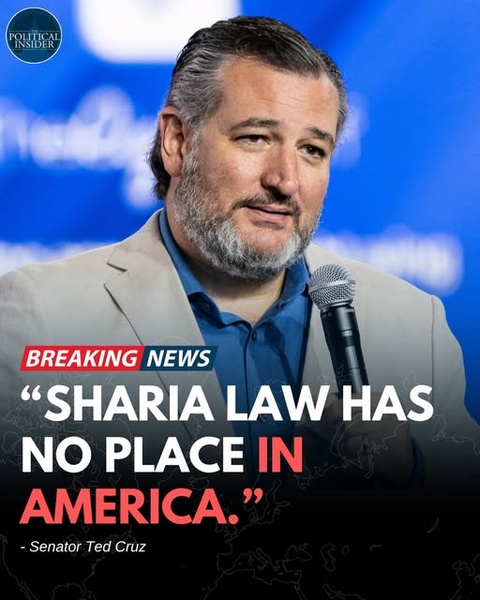
DALLAS — Sen. Ted Cruz used the Republican Party’s first-ever midterm convention to deliver a forceful warning about what he described as a growing alliance between Islamists and the political left, declaring that “Sharia law has no place in America” and arguing that Islamic law is incompatible with the U.S. Constitution.
Cruz made the remarks Thursday, Sept. 10, during the final night of the Republican midterm convention in Dallas, where Republicans sought to energize their base ahead of the Nov. 3 elections. His speech placed religion, immigration, political ideology and national security at the center of the GOP’s closing midterm message.
The Texas senator's comments were part of a broader attack on several Democratic figures, including New York City Mayor Zohran Mamdani, Michigan Senate candidate Abdul El-Sayed and Texas Senate candidate James Talarico.
Cruz Says Sharia Law Conflicts With the Constitution
Cruz's most prominent declaration came after he described what he called a “new and dangerous red-green alliance” between communists and Islamists.
“Sharia law has no place in America,” Cruz said. He added that he considers Sharia law “fundamentally inconsistent with the Constitution” and urged Americans to oppose it.
The statement quickly became the centerpiece of his speech and was subsequently amplified by Republican political organizations and conservative media.
Cruz connected his argument to examples of what he characterized as abuses committed under Islamist movements, including restrictions on women, violence against religious and sexual minorities, honor killings and terrorist attacks.
His remarks were not presented as a narrowly focused discussion of U.S. constitutional law. Instead, they formed part of a much broader political argument that Cruz says Democrats are increasingly tolerating or embracing political movements fundamentally opposed to American institutions.
Cruz Targets Mamdani and Other Democratic Candidates
Cruz specifically invoked Mamdani, who became mayor of New York City, while arguing that Americans should be concerned about the ideological direction of the Democratic Party.
He also singled out Abdul El-Sayed, a Michigan Democratic Senate candidate, accusing him of saying he had an “obligation” to comply with Sharia law.
Cruz similarly attacked political commentator Hasan Piker and Texas Senate candidate James Talarico, portraying their positions as evidence of a broader ideological movement within the Democratic Party.
Cruz ultimately acknowledged that not every Democrat shares the views he was criticizing, but argued that Democratic leaders are unwilling to confront what he described as radical elements within their coalition.
The speech therefore went beyond criticism of Sharia law itself and became a broader attack on what Cruz portrayed as a coalition of socialism, communism and Islamism.
What Is Sharia Law?
Sharia is a broad Islamic religious and ethical tradition derived from sources including the Quran and the teachings and practices associated with the Prophet Muhammad.
It is not a single uniform legal code applied identically across all Muslim communities.
Muslims around the world interpret and practice Islamic principles in different ways, ranging from personal religious observance to systems in which governments incorporate elements of Islamic jurisprudence into civil or criminal law.
In the United States, religious communities may follow their own religious beliefs and practices, but American courts operate under the Constitution and U.S. law.
That distinction is important because the viral graphic accompanying Cruz's remarks can make his statement appear to refer to a specific new policy or law. In reality, his comment was a political declaration made during a campaign speech, not the announcement of a new federal prohibition on Sharia.
The Constitution Already Establishes the Supreme Legal Framework
The United States Constitution establishes federal law and constitutional protections as the governing legal framework for the country.
The First Amendment also protects the free exercise of religion while prohibiting the government from establishing an official religion.
That means Americans are free to practice Islam, Christianity, Judaism and other religions, provided their conduct remains subject to generally applicable laws.
Cruz's statement therefore should be understood primarily as a political and ideological argument, rather than evidence that Sharia law is currently replacing or competing with the U.S. Constitution as the legal authority of the country.
Republicans Put Islamism at the Center of Their Midterm Message
Cruz's speech came as Republican leaders increasingly used the convention to portray Democrats as vulnerable to radical political movements.
Other Texas Republicans also addressed the issue.
Texas Gov. Greg Abbott said during the convention that he wanted to “fully ban Sharia law” in Texas, while Cruz focused on the alleged connection between Islamism and progressive political movements.
The rhetoric reflects a broader shift in Republican campaign messaging ahead of the midterms, with immigration, national security, political extremism and cultural identity increasingly intertwined.
The Republican convention itself was designed to resemble a presidential-style political spectacle rather than a traditional midterm gathering. President Donald Trump addressed the convention, while Vice President JD Vance and other senior Republicans used the event to rally voters for November.
Critics Warn Against Conflating Islam With Islamism
Cruz's comments have also generated concern among critics who argue that political leaders should distinguish between Islam, a major world religion, and Islamism, a broad term generally used to describe political ideologies seeking to organize government or society around particular interpretations of Islam.
That distinction matters because criticism of Islamist movements does not automatically justify treating ordinary Muslim religious practice as a political threat.
The debate has become especially sensitive as Muslim candidates have become increasingly visible in American politics.
Mamdani, a Muslim Democrat, has become a particular target of Republican criticism, while El-Sayed's Senate campaign in Michigan has also drawn intense attention because of his background and political positions.
KERA reported that the Dallas convention placed Texas Republicans' increasingly aggressive rhetoric about Islam on the national stage.
Cruz's Message Fits a Larger Election Strategy
The timing of Cruz's remarks was significant.
The Republican Party is attempting to hold its congressional majorities in the November midterms, while Trump has sought to frame the election as a referendum on his presidency and the direction of the country.
At the Dallas convention, Republicans repeatedly described Democratic candidates as socialists, communists or extremists. Cruz's speech expanded that argument by adding Islamism to the list of movements he says threaten American constitutional values.
The strategy is designed to make the election about more than taxes, health care or economic policy.
It is also an attempt to persuade voters that the election represents a choice over American identity and the future direction of the country.
A Controversial Speech in an Increasingly Polarized Campaign
Cruz's remarks came just one day before the 25th anniversary of the Sept. 11 terrorist attacks, a historical reference he explicitly incorporated into his speech.
He linked the attacks of Sept. 11, 2001, with his broader argument about Islamist extremism and political violence. He also invoked the assassination of conservative activist Charlie Kirk, which occurred one year earlier, as evidence of what he described as an increasingly dangerous political environment.
That combination made the speech particularly charged.
While Cruz framed his argument as a defense of constitutional freedom and American values, critics argue that broad attacks on Islam or Muslim political figures risk turning legitimate debate about extremist movements into a wider campaign against Muslims.
The distinction between those two positions is likely to remain a major point of controversy as the midterm campaign intensifies.
No New Federal “Sharia Ban” Has Been Announced
Despite the dramatic wording of the viral graphic, Cruz did not announce a new federal law banning Sharia law.
His statement was made during a political speech and represented his position that Sharia law should not govern the United States.
The more consequential question is therefore political rather than legal: how far will Republicans go in making Islamism, Muslim political candidates and cultural identity central issues in the 2026 elections?
With the midterms approaching, Cruz's speech demonstrates that the Republican campaign is increasingly willing to make those questions part of the national debate.
For Democrats, the challenge will be to respond to concerns about extremism and national security without allowing legitimate criticism of political movements to become generalized attacks on an entire religious community.
For Republicans, the calculation is different: Cruz and other party leaders are betting that warnings about radicalism, immigration and political ideology will motivate conservative voters to turn out in November.
And with control of Congress at stake, the fight over what constitutes a threat to American values is becoming one of the defining cultural battles of the 2026 midterm campaign.
Comments (0)
Loading comments...
May You Like
OBAMA STEPS BACK INTO THE POLITICAL SPOTLIGHT

South Korea–Ukraine Rift Deepens Over North Korean POW Transfer as PURL Draws New Scrutiny














