
Texas Court Fight Over Greg Abbott’s Communications With Elon Musk Raises Questions About Government Transparency
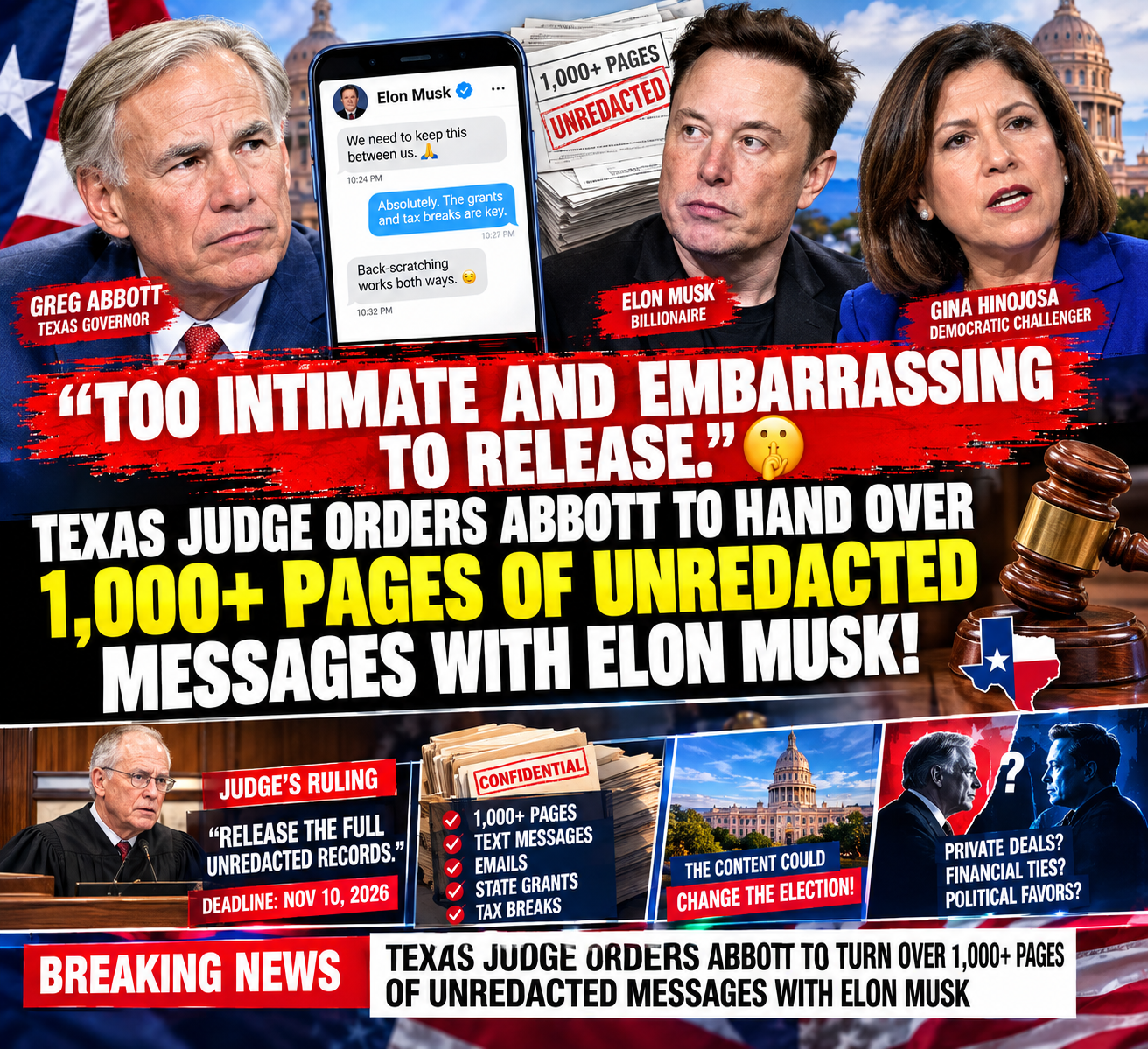
The central story in this image is real, but several important details need correcting. A Travis County judge ruled that Texas state Rep. Gina Hinojosa could inspect more than 1,000 pages of unredacted communications involving Gov. Greg Abbott’s office and Elon Musk. However, the ruling did not order the records to be released publicly. Abbott appealed, and an appeals court subsequently paused the order, potentially delaying Hinojosa’s access until after the November 3 election.
The image’s suggestion that the messages contain secret deals or political favors is not an established finding. Those are questions raised by the dispute, not conclusions proved by the court.
Texas Court Fight Over Greg Abbott’s Communications With Elon Musk Raises Questions About Government Transparency
Texas Politics | October 28, 2026
1. Judge’s ruling puts Abbott–Musk communications under renewed scrutiny
A legal dispute over communications between Texas Gov. Greg Abbott and billionaire entrepreneur Elon Musk has become a major political story just days before the November 3 election.
On October 26, Travis County District Judge Catherine Mauzy ruled that Abbott’s office must allow Democratic gubernatorial candidate and state Rep. Gina Hinojosa to inspect more than 1,000 pages of previously redacted communications involving Musk and his companies. Hinojosa had sued after the governor’s office refused her request to inspect the records in her capacity as a legislator.
The ruling did not establish that the communications contained wrongdoing. Instead, it addressed whether Hinojosa had a legal right to review the records for legislative purposes under Texas law.
The case has attracted attention because Musk’s businesses have substantial operations in Texas and have received state support, while Musk has also contributed to Abbott’s political campaigns.
2. The records span more than 1,300 pages
The communications were originally gathered after The Texas Newsroom requested records from Abbott’s office in 2025. The governor’s office eventually provided 1,374 pages, but nearly all were heavily redacted, leaving only around 200 pages substantially readable. Many of the visible portions contained limited information or material that was already public.
The records relate to communications involving Musk, his companies, and the governor’s office. The issues identified in reporting and Hinojosa’s legal filings include state grants and tax incentives, broadband expansion, public beach access, and data-center development.
Hinojosa argues that examining the unredacted documents could help her understand how state decisions affecting major businesses were made. The contents of the withheld portions, however, have not been fully disclosed, so it would be premature to draw conclusions about what they reveal.
3. Why Abbott’s office withheld the communications
The dispute began with the governor’s office invoking several exceptions to Texas public-records disclosure requirements. Those included protections for certain legal discussions, policymaking processes, economic-development information, and material officials characterized as “intimate and embarrassing.”
The Texas attorney general’s office previously permitted much of the material to remain confidential. When the records were eventually produced in 2025, large sections were blacked out. SpaceX also argued that releasing certain communications could harm its competitive position.
The governor’s office has maintained that it complies with the Texas Public Information Act and releases information that is not legally exempt from disclosure. In the current case, Abbott’s representatives have argued that Hinojosa’s lawsuit misuses her role as a state legislator for political purposes.
The legal question is whether the specific statutory rights Hinojosa invokes entitle her to inspect the records despite the confidentiality claims.
4. The judge’s order did not mean the messages would become public
One of the most important distinctions in this case is between allowing a legislator to inspect records and releasing those records to the general public.
Judge Mauzy’s order addressed Hinojosa’s ability to examine the unredacted communications for legislative purposes. It did not authorize her to publish confidential material or make the entire collection available to anyone who requested it. The order also allowed Abbott’s office to require a confidentiality agreement.
That means the image’s headline about handing over “1,000+ pages” can give readers the wrong impression if they interpret it as a court-ordered public release.
The underlying records remain subject to applicable confidentiality rules. Any further public disclosure would depend on the legal status of the documents and the outcome of the continuing dispute.
5. Abbott appealed, and the order has now been paused
The legal situation changed after the initial ruling. Abbott’s office appealed, and on October 27 the Texas Court of Appeals for the Fifteenth District paused the order requiring access to the communications. The pause means Hinojosa may not be able to inspect the records before Election Day, depending on how the appeal proceeds.
Abbott’s spokesperson, Andrew Mahaleris, characterized the lawsuit as a politically motivated stunt and argued that Hinojosa was using her official position to generate campaign headlines. Hinojosa, by contrast, says she is exercising a legislator’s legal right to inspect records relevant to government oversight.
A further hearing was scheduled for November 2 to address the dispute, including Abbott’s challenge to the trial court’s authority and Hinojosa’s request for additional relief. The appeals court’s pause means the original access deadline should not be treated as a deadline that remains in effect.
6. Hinojosa says the records could shed light on state benefits for Musk’s companies
Hinojosa has argued that the correspondence could help clarify the relationship between state officials and Musk’s businesses, particularly where government grants, tax incentives, or public contracts are involved.
The lawsuit describes communications concerning broadband deployment and other state matters. It also points to political contributions and economic incentives involving Musk’s companies. These issues have prompted questions about how Texas evaluates applications for public support and how officials document their dealings with major private-sector businesses.
But allegations in a lawsuit are not the same as judicial findings. The ruling granting access did not determine that any grant, tax break, or contract was improperly awarded, nor did it establish a quid pro quo between campaign contributions and state decisions.
The documents may provide additional context if access eventually occurs, but their significance cannot be established before their contents are examined.
7. The reported “have his back” exchange attracts attention
One element highlighted in coverage of Hinojosa’s lawsuit is an alleged exchange in which Musk asked Abbott whether he would “have his back,” with Abbott reportedly responding, “I said 100%.” The filing also links the exchange to subsequent corporate paperwork involving SpaceX’s reincorporation in Texas.
The exchange has become a focal point because it raises questions about the nature of the relationship between a powerful business leader and a governor whose administration makes decisions affecting that leader’s companies.
Nevertheless, the wording alone does not establish that the two men agreed to an improper arrangement. Understanding the meaning of the exchange would require its full context, the surrounding communications, and evidence about any government action associated with it.
The unredacted records have not been made generally available, and the court proceedings have not established that the exchange proves misconduct.
8. The case unfolds in the final week of the Texas governor’s race
The dispute has become politically significant because Hinojosa is challenging Abbott in the November 3 gubernatorial election. The timing has prompted the governor’s office to accuse her of pursuing the records for campaign purposes, while Hinojosa argues that the documents are relevant to her responsibilities as a legislator and to public accountability.
The timing also limits the practical window for inspection. Hinojosa’s current legislative term is scheduled to end in January 2027, and she has argued that delays diminish the time available to use the information for legislative work. The appeals court’s pause adds uncertainty about whether she will be able to review the material before voters go to the polls.
The case illustrates a broader tension in election-year politics: the public interest in understanding government decisions can collide with disputes over confidentiality, legal procedure, and the motives of political opponents.
9. The bottom line: A records-access battle, not proof of a secret deal
The Abbott–Musk dispute raises legitimate questions about transparency, the handling of government records, and how public officials interact with companies receiving state support. A judge initially ruled that Hinojosa could inspect more than 1,000 pages of unredacted communications, but Abbott appealed and an appeals court paused that order.
The image’s suggestion that the court ordered the full records released to the public is misleading. The original order concerned Hinojosa’s access for legislative purposes, and confidential information was not authorized for general publication. The claims that the messages prove secret deals or political favors remain unsubstantiated by the court ruling.
The next developments depend on the appeals process and the scheduled hearing. If Hinojosa ultimately gains access, the contents may help clarify the interactions between Abbott’s office and Musk’s businesses. Until then, the central facts are the dispute over access, the reasons officials gave for withholding the records, and the unresolved legal questions surrounding disclosure.
Comments (0)
Loading comments...
May You Like

WWE BRONSON REED—INSPIRED—SUDDEN COLLAPSE, MYSTERIOUS STIMULANTS, DEAD AT 38!

1,000+ MILITARY FAMILY RECORDS BREACHED, 200+ MILITARY SITES AT RISK!

STAR DIED AT 38, $10M LIFE INSURANCE INCREASED JUST 30 DAYS BEFORE WWE BRONSON REED'S DEATH!










Popular Posts


