
The "417-3 Big Gift" Is Not What the Viral Image Claims — Here's What Actually Happened
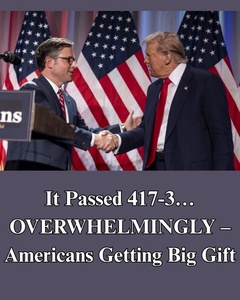
The viral image of Trump and Johnson shaking hands carries a caption promising Americans a "big gift" from a 417-3 vote. That vote was real. The "gift" was not.
WASHINGTON – The photo shows President Donald Trump and House Speaker Mike Johnson locking hands against a backdrop of American flags. The text below it reads: "It Passed 417-3... OVERWHELMINGLY – Americans Getting Big Gift."
The 417-3 vote is real . But it has nothing to do with Trump's signature legislation, and the "gift" it promised has already been blocked.
What the 417-3 Vote Actually Was
On September 16, 2026, the U.S. House of Representatives passed the Ratepayer Protection Act by a vote of 417-3 . The bill, led by Representatives Gabe Evans (R-Colo.) and Kathy Castor (D-Fla.), would require state utility regulators to consider standards ensuring that large electricity customers — specifically AI data centers consuming 100 megawatts or more — pay the full incremental cost of the infrastructure needed to serve them, rather than passing those costs on to ordinary ratepayers .
In plain language: if a tech company builds a massive data center in your community and the local grid needs expensive upgrades to handle the power demand, that company should pay for it, not you.
The bill had overwhelming bipartisan support. 211 Republicans and 206 Democrats voted yes . Only three progressive Democrats opposed it: Summer Lee of Pennsylvania, Delia Ramirez of Illinois, and Rashida Tlaib of Michigan .
The vote reflected intense public pressure. An AP-NORC poll released the same week found that 84% of Americans are concerned about data centers affecting electricity prices . A Gallup survey from earlier in the year found 70% of Americans oppose data centers being built in their communities, including nearly half who are strongly opposed .
What Happened Next
The bill went to the Senate. On September 29, 2026, Senate Democrats blocked it.
The procedural vote was 57-43, falling short of the 60 votes needed to begin debate . Only four Democrats crossed party lines: Maggie Hassan of New Hampshire, Amy Klobuchar of Minnesota, and Jon Ossoff and Raphael Warnock of Georgia .
Senate Minority Leader Chuck Schumer called the bill "a fraud" and "toothless," arguing that it only required regulators to consider making data centers pay, rather than mandating it .
"I can sum up the shortcomings of the Republican data center bill with one word: optional," Schumer said on the Senate floor .
Senator Martin Heinrich (D-N.M.) had previously blocked the bill from passing by unanimous consent on September 17, saying it "fails to make AI data centers pay their fair share" .
So the "big gift" is not in Americans' hands. It is stalled in the Senate, and senators are now leaving Washington for the campaign trail .
The Image Is Misleading
The viral image pairs the Trump-Johnson handshake with the 417-3 vote, implying that this was a Trump-driven legislative victory. That framing is misleading for several reasons.
First, the Ratepayer Protection Act was not a Trump administration priority in the way that the "One Big Beautiful Bill" was. It was a targeted, bipartisan effort led by Evans and Castor, with Senator Jon Husted (R-Ohio) carrying the Senate companion .
Second, the bill has not become law. The viral caption says "Americans Getting Big Gift" — present tense. But the Senate blocked it. Americans are not getting anything yet. Even if it had passed, the bill would not take full effect for two years .
Third, the 417-3 vote was about data center electricity costs, not about tax cuts, border security, or any of the other issues Americans typically associate with Trump's legislative agenda.
Trump did sign a "Ratepayer Protection Pledge" in March 2026 — a voluntary agreement with major tech companies committing to cover the full cost of energy infrastructure for new data centers . The Ratepayer Protection Act would have codified key elements of that pledge. But the pledge was voluntary. The bill would have made it harder to ignore. And the bill is now blocked.
Comments (0)
Loading comments...
May You Like


South Korea–Ukraine Rift Deepens Over North Korean POW Transfer as PURL Draws New Scrutiny

Shocking news from Ohio: an unexpected development ahead of Trump's rally












