
The “Business Bait”: Could Trump’s Russia Deals Become a New Path to a Ukraine Peace Agreement?
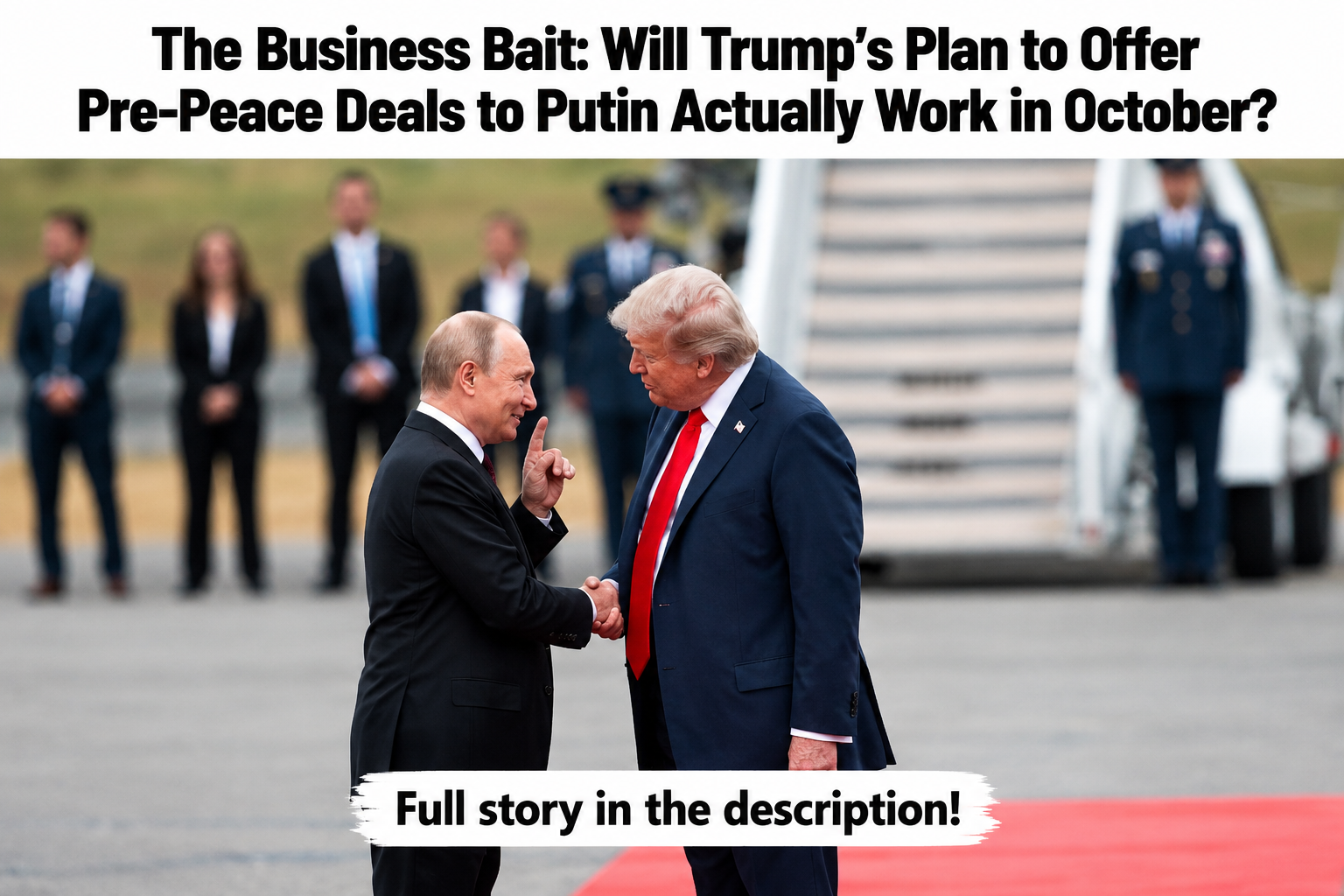
WASHINGTON — Sept. 18, 2026 — The Trump administration is considering an unusual addition to its effort to end the Russia-Ukraine war: economic agreements with Moscow that could move forward even before a comprehensive peace settlement is reached.
According to reporting by The New York Times, U.S. officials are weighing whether separate business arrangements with Russia could demonstrate Washington’s willingness to rebuild economic relations and create incentives for Russian officials to support negotiations. The reported discussions involve possible cooperation in areas such as energy and investment, although no specific agreement has been announced and the approach has not become established U.S. policy.
The idea comes just weeks after President Donald Trump’s special envoys Steve Witkoff and Jared Kushner met Russian President Vladimir Putin in Moscow and Ukrainian President Volodymyr Zelenskyy in Kyiv in an effort to restart stalled peace talks.
At the same time, Congress has advanced a major new sanctions package against Russia, creating a striking contrast: Washington is simultaneously discussing possible economic engagement with Moscow while preparing additional economic pressure.
That tension could become one of the defining issues surrounding the next round of Russia-Ukraine diplomacy.


What Is the “Business Deal Before Peace” Idea?
For much of Trump's current effort to end the war, the basic sequence has been relatively straightforward:
ceasefire or peace framework first, economic normalization later.
The newly reported approach would potentially reverse that sequence.
Instead of waiting for a comprehensive settlement, Washington could pursue limited economic agreements with Moscow first, using them as evidence that a broader U.S.-Russia relationship could eventually return if Russia makes progress toward ending the war.
According to the reporting, supporters of the idea inside the administration believe that economic cooperation could demonstrate that the United States is serious about rebuilding relations with Russia and potentially encourage figures around Putin to favor a diplomatic settlement.
The precise deals under consideration have not been publicly disclosed.
That is important because the phrase “business deals” can encompass everything from limited commercial agreements to much larger arrangements involving energy, investment, infrastructure or natural resources.
There is currently no confirmed package showing exactly what Washington is prepared to offer.
Trump Previously Said Business Would Wait Until the War Was Settled
The reported idea is notable partly because it would represent a change from Trump's earlier public position.
Ahead of his 2025 meeting with Putin in Alaska, Trump said Russia wanted economic cooperation with the United States but that Washington would not pursue such business until the war was settled. The New York Times reporting cited by other outlets says the administration is now examining whether some economic agreements could happen before a comprehensive settlement.
Trump has nevertheless repeatedly talked about Russia's economic potential and the possibility of rebuilding commercial ties.
On Sept. 2, he said he wanted to meet Putin again when the two sides were ready for a peace agreement and argued that improved U.S.-Russia relations could be positive for business.
The latest proposal would therefore not necessarily mean abandoning the goal of peace first. Rather, the reported theory is that economic engagement itself could become one of the tools used to encourage movement toward peace.
What Kinds of Deals Could Be on the Table?
The details remain unclear, but several areas have already appeared in discussions between Moscow and Washington.
Energy
Russia remains one of the world's largest energy producers.
A future relaxation of restrictions on Russian energy exports could have major consequences for global oil and gas markets, although sanctions and geopolitical considerations would make such an arrangement highly complicated.
The Kremlin has already linked economic normalization to sanctions.
When Moscow responded to Trump's proposed energy-infrastructure truce on Sept. 15, Kremlin spokesman Dmitry Peskov welcomed the concept but also called for additional measures, including the removal of sanctions affecting Russia.
Investment
American companies could eventually explore opportunities in Russia if sanctions were relaxed and legal restrictions changed.
Investment could become particularly important because it would provide a visible demonstration that Washington was moving from confrontation toward economic normalization.
Arctic projects
The Arctic has also emerged as a potential area of U.S.-Russian economic interest.
Russia controls a huge portion of the Arctic coastline and possesses major natural-resource reserves. The United States, meanwhile, has strategic and commercial interests in Arctic shipping, energy and minerals.
Industrial and commercial cooperation
Other areas could involve specific industries or companies, but no comprehensive U.S.-Russia commercial package has been publicly announced.
The Kremlin has confirmed that economic issues and potential “major mutually beneficial Russian-American projects” were discussed when Putin met Witkoff and Kushner on Sept. 5.


Why Would Washington Consider Economic Incentives?
The theory behind the approach is relatively straightforward.
If Russia believes that ending the war could unlock significant economic benefits, Moscow might have more incentive to negotiate.
A U.S. official cited in the New York Times reporting said business agreements could demonstrate that Washington genuinely wants a new relationship with Moscow and could potentially encourage Russian figures who favor improved relations with the United States.
In diplomatic terms, that would turn economic access into a carrot alongside sanctions as the stick.
But there is an obvious counterargument.
If the United States offers Moscow meaningful economic benefits before Russia agrees to end the war, Washington could give up some of the leverage that sanctions currently provide.
That disagreement reportedly exists inside the administration itself. Some officials see economic incentives as a way to encourage peace, while others warn that concessions made too early could weaken pressure on Moscow.
The Sanctions Contradiction Is Becoming Hard to Ignore
The timing is particularly significant.
On Sept. 17, the Kremlin warned that a new U.S. sanctions package would make a Russia-Ukraine peace agreement harder to achieve.
The House has passed legislation targeting Russian officials, financial institutions, energy revenues and the so-called shadow fleet of tankers used to evade sanctions. The legislation would also give Trump authority to impose tariffs of up to 100% on countries that continue buying Russian energy under specified circumstances.
Russia has described the measures as unfriendly actions that could complicate negotiations.
Ukraine, by contrast, sees sanctions as a way to increase the cost of continuing the war and strengthen its negotiating position. The Associated Press reported that Kyiv welcomed the sanctions package while noting that its eventual impact would depend heavily on how aggressively Washington implements it.
This creates two simultaneous tracks for U.S. policy:
Pressure: Increase sanctions and economic costs for Moscow.
Incentives: Explore whether economic normalization could encourage Russia to negotiate.
How those tracks interact could become crucial in the weeks ahead.
Kushner and Witkoff Are Already Carrying Economic Ideas Into the Talks
The business angle did not emerge in isolation.
Witkoff and Kushner's Sept. 5 meeting with Putin lasted more than three hours.
The White House said the envoys discussed “substantive plans for next steps” toward ending the war. The Kremlin said the Americans presented several ideas for possible avenues toward a settlement.
The following day, the envoys traveled to Kyiv to meet Zelenskyy.
The White House documented the Moscow-to-Kyiv trip as part of the administration's effort to continue dialogue with both sides.
U.S. officials described the discussions as constructive, but no breakthrough was announced.
Zelenskyy subsequently said the Americans had brought forward ideas worth continuing to discuss.
The central disagreements, however, remained unresolved.


October Talks Could Put the Economic Question to the Test
Ukraine is preparing for another possible round of trilateral negotiations involving Ukraine, Russia and the United States in October, according to Ukrainian presidential office chief Kyrylo Budanov.
Reuters reported that Kyiv is preparing for the talks, while possible locations mentioned by Zelenskyy include Turkey, the United Arab Emirates and Switzerland. Moscow has said it does not rule out renewed negotiations, although the Kremlin has cautioned that details remain unsettled.
The U.K. House of Commons Library similarly reported that a further trilateral round was expected in October, while noting that the precise arrangements remained unclear. It also highlighted territory and future security guarantees as the two major unresolved issues.
If economic incentives become part of the U.S. strategy, October could provide a venue for testing whether they can actually influence the negotiations.
The Territorial Dispute Remains the Biggest Barrier
No amount of potential business cooperation changes the fundamental disagreement over Ukrainian territory.
Russia continues to demand control over areas of eastern Ukraine that Moscow claims as Russian territory.
Ukraine has rejected demands that it withdraw from Ukrainian-controlled territory in the Donbas.
Reuters reported that the status of Ukrainian-held areas in the Donbas remains the central obstacle to resuming trilateral negotiations.
This is why a business arrangement alone would not constitute a peace agreement.
At most, economic cooperation could become one component of a larger negotiating framework involving:
- Territorial arrangements
- Security guarantees
- Ceasefire mechanisms
- Sanctions
- Reconstruction
- Prisoner exchanges
- Energy infrastructure
- Black Sea shipping
- Long-term economic relations
Each of those issues would require separate negotiations.
Could Economic Deals Be Offered as a “Peace Dividend”?
This is perhaps the most consequential possibility.
Instead of presenting business cooperation simply as a reward after peace, Washington could use it as a conditional incentive.
For example, future economic agreements could theoretically be linked to measurable steps such as:
A verified ceasefire
An agreement on energy infrastructure
A prisoner exchange
A longer-term peace framework
Security arrangements for Ukraine
Implementation of a territorial agreement
Nothing in the public record establishes that these exact conditions have been adopted by the administration.
But the broader concept — linking economic normalization to diplomatic progress — fits the incentive-based approach now being discussed.
Russia Has Its Own Economic Motives
Moscow has substantial reasons to pursue economic normalization with Western countries.
The Russian economy has remained functional despite sanctions, but it faces significant pressure from wartime spending, high interest rates, labor shortages and restrictions on access to Western technology and capital.
The Associated Press reported on Sept. 18 that Russia's wartime economy is showing signs of longer-term strain, even as elevated energy revenues provide some support. Military spending has contributed to a larger budget deficit, while reserves and investment capacity face pressure.
That does not mean Russia is on the verge of economic collapse.
It does mean that the prospect of renewed access to Western investment, technology and markets could carry considerable value for Moscow.
For U.S. negotiators, that potential value is precisely what could make economic incentives useful.
But There Is a Major Risk: Giving Russia Benefits Too Early
The alternative interpretation is much less favorable to the strategy.
If Moscow receives tangible economic benefits before making major concessions on Ukraine, Russia could have less incentive to compromise.
Critics of the approach argue that sanctions exist partly to create bargaining leverage.
Relaxing that pressure prematurely could therefore reduce Washington's ability to influence Russian decision-making.
The House of Commons Library noted that the Trump administration's latest diplomatic push has not yet produced agreement on the central questions of territory and security. It also noted that it remains unclear whether the U.S. presented genuinely new proposals or revived elements of frameworks discussed in late 2025 and early 2026.
That uncertainty makes the sequencing of economic incentives particularly important.
Ukraine Could Also Be Affected by Any U.S.-Russia Business Agreement
Any major American economic arrangement with Moscow would not exist in a vacuum.
Kyiv would have to consider whether the arrangement strengthened or weakened its negotiating position.
Ukrainian officials have repeatedly emphasized that any settlement needs credible security arrangements.
During the September meetings with Witkoff and Kushner, Zelenskyy discussed security and economic guarantees, air-defense requirements and support for Ukraine as another difficult winter approached.
For Kyiv, the question would therefore be broader than whether Russia receives economic benefits.
It would be whether those benefits are connected to concrete Russian commitments toward ending the war.
The “Business Bait” Theory Has Another Dimension
The headline in the image calls the potential strategy “business bait.”
That phrase is an interpretation, not an official description of U.S. policy.
But it captures the underlying diplomatic logic: Washington could potentially use the promise of economic normalization to make a postwar relationship with the United States more attractive to Moscow.
The concept resembles a traditional negotiating formula:
Pressure + incentives + conditionality.
The difficulty is determining the correct balance.
Too much pressure can make compromise politically difficult for the other side.
Too many incentives can reduce the motivation to compromise.
The Trump administration now appears to be exploring where that balance might lie.
Trump Has Said He Wants Business With Russia — But Timing Matters
Trump has repeatedly spoken about the economic potential of Russia.
During a Sept. 2 exchange with reporters, he said he wanted to establish better relations with Russia and described the prospect as potentially beneficial for business. At the same time, he said he wanted a summit with Putin when the parties were ready for a peace agreement.
That distinction between eventual economic normalization and immediate business agreements is at the heart of the current story.
If the administration proceeds with limited agreements before a final peace settlement, it would represent a different sequencing of those goals.
Europe Will Also Have a Stake
European governments are unlikely to view U.S.-Russia economic normalization only through a commercial lens.
European countries remain directly affected by Russia's war, sanctions, energy policy and security environment.
The possibility of renewed Russian energy access is particularly sensitive.
Reuters reported Sept. 18 that Russian economic adviser Kirill Dmitriev and leaders of Germany's Alternative for Germany party are planning discussions for 2027 that could include the possibility of restoring Russian gas supplies to Germany if a Russia-Ukraine peace framework is eventually reached. The report also notes strong criticism from German political figures who oppose renewed dependence on Russian energy.
That illustrates how any U.S.-Russia economic reset could eventually intersect with a much larger European debate about energy and security.
The Energy Issue Is Becoming More Urgent
The economic consequences of the war are no longer limited to Russia and Ukraine.
Global fuel markets have been affected by the combination of the Ukraine war, sanctions, disruptions in other regions and attacks on energy infrastructure.
Reuters reported Sept. 18 that U.S. diesel prices had exceeded $6 per gallon, while European diesel prices had also reached extraordinary levels amid global refining and supply disruptions.
Trump has increasingly connected the war and energy markets in his public comments.
That creates another possible motivation for Washington to explore an agreement involving Russian energy.
But it also complicates the policy.
Any relaxation of restrictions on Russian energy could have consequences for sanctions policy, European security and Ukraine's negotiating position.
What the Viral Image Gets Right — and What It Leaves Out
The image asks whether Trump's plan to offer “pre-peace deals” to Putin could work in October.
There is a factual basis for the underlying story, but several details require qualification.
What is supported by current reporting:
- The Trump administration is reportedly considering economic agreements with Russia before a comprehensive peace settlement.
- Energy and investment are among the areas discussed in reporting.
- Witkoff and Kushner have been conducting shuttle diplomacy between Moscow and Kyiv.
- The envoys discussed economic issues and possible Russian-American projects with Putin.
- Ukraine is preparing for possible trilateral negotiations in October.
- Russia and Ukraine remain far apart over territory.
- The U.S. Congress has advanced additional sanctions against Russia.
- Moscow says additional U.S. sanctions could make peace negotiations more difficult.
What remains uncertain:
- The exact business agreements under consideration.
- Whether Trump has personally approved a specific economic package.
- Whether Moscow would receive any benefits before making concrete concessions.
- Whether Ukraine would support such arrangements.
- Whether economic incentives would actually change Russia's negotiating position.
- Whether any agreement will be announced during October talks.
Most importantly, there is no confirmed U.S.-Russia “pre-peace deal” at this point.
What Happens Next?
Several developments could clarify the strategy over the next few weeks.
1. The October trilateral talks
If Moscow, Kyiv and Washington agree on a date and location, the next round could reveal whether the diplomatic process has actually moved beyond preliminary discussions.
2. Trump's decision on the sanctions bill
The administration will have to decide how aggressively to implement the new sanctions framework passed by Congress. That decision could affect Washington's leverage over Moscow.
3. Any announcement on U.S.-Russia economic cooperation
Even a limited agreement in energy, investment or another commercial sector would provide a clearer indication of how Washington intends to use economic incentives.
4. The Zelenskyy-Trump discussions
A meeting between Trump and Zelenskyy around the U.N. General Assembly could provide another opportunity to discuss the U.S. negotiating framework.
5. Russia's response
Ultimately, the strategy depends on Moscow's willingness to exchange economic normalization for concrete steps toward ending the war.
Comments (0)
Loading comments...
May You Like

South Korea–Ukraine Rift Deepens Over North Korean POW Transfer as PURL Draws New Scrutiny
OBAMA STEPS BACK INTO THE POLITICAL SPOTLIGHT

South Korea–Ukraine Rift Deepens Over North Korean POW Transfer as PURL Draws New Scrutiny













