
The Claim That Suddenly Put Trump’s Epstein Story in a New Light — Then Came the Walkback
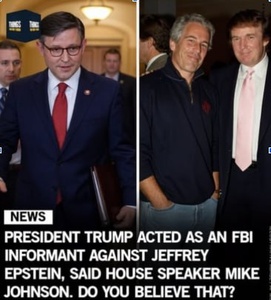
WASHINGTON — A striking claim by House Speaker Mike Johnson briefly changed the conversation around Donald Trump and Jeffrey Epstein. But within days, Johnson acknowledged he may have used the wrong words.
The Remark That Set Off the Story
In September 2025, Johnson told CNN that Trump had been an “FBI informant” who had tried to help bring down Epstein.
Johnson made the comment while defending Trump against renewed criticism over his handling of the Epstein files and the president's characterization of the controversy as a political “hoax.”
The statement immediately attracted attention because being an FBI informant generally implies a formal or documented relationship with federal investigators.
Yet Johnson did not provide documentation showing that Trump had formally served in such a role.
Johnson Quickly Changed His Explanation
Three days later, Johnson substantially walked back the claim.
Speaking to reporters on September 8, he said he was unsure whether “FBI informant” had been the correct terminology and explained that he was referring to statements made by an attorney representing Epstein victims.
Johnson said he had not personally been present during the events he was describing.
He instead pointed to reports that Trump had expelled Epstein from Mar-a-Lago and had been willing, according to accounts cited by Epstein victims' representatives, to assist authorities.
What Johnson Said He Meant
Johnson's revised explanation was considerably narrower than his original statement.
He said he was referring to the idea that Trump had been willing to help law enforcement investigate Epstein, rather than asserting that Trump had formally operated as an FBI informant.
CNN reported that Johnson characterized Trump as someone who had been willing to help authorities pursue Epstein more than a decade earlier.
That distinction became central to the controversy.
There is a significant difference between providing information to law enforcement and having an official confidential-source or informant relationship with the FBI.
What Public Evidence Shows
Available public reporting has not established that Trump was formally an FBI informant in the Epstein investigation.
The Washington Post reported that Johnson backed away from his original assertion, while no public documentation confirming Trump's alleged FBI informant status was presented.
The Associated Press likewise reported Johnson's clarification without establishing that Trump had actually held such a designation.
That means the viral image's wording should not be treated as an established fact.
There Was, However, a Relationship With Epstein
Trump and Epstein knew each other socially during the 1990s and early 2000s.
Trump has acknowledged knowing Epstein and has said that he eventually banned him from Mar-a-Lago.
The Washington Post reported that Trump had said he expelled Epstein from the club, while the circumstances and timing surrounding their falling-out have been discussed in subsequent reporting.
Their previous social relationship is documented separately from the unverified claim that Trump formally cooperated with the FBI as an informant.
A Police Chief's Account Also Became Relevant
Another piece of the story concerns former Palm Beach police chief Michael Reiter.
According to reporting on FBI interview material, Reiter told investigators that Trump contacted him in 2006 and expressed concern about Epstein's behavior.
That account has been cited as evidence that Trump communicated information or concerns to law enforcement, but it does not by itself establish that Trump was an FBI informant.
The distinction between communicating with police and holding a formal FBI informant status remains important.
Why the Difference Matters
An FBI informant is not simply someone who has spoken to investigators.
Confidential human sources can have formal relationships with the FBI, operate under specific procedures and provide information to agents as part of investigations.
Consequently, describing someone as an “FBI informant” carries a much more specific meaning than saying that person once provided information to law enforcement.
Johnson's subsequent clarification effectively acknowledged that distinction.
The Claim Emerged During a Larger Epstein Dispute
Johnson made his original statement amid renewed congressional pressure for the release of Epstein-related records.
The issue had become politically contentious as lawmakers debated what information the government should disclose and how much of the investigative material should become public.
Johnson was attempting to defend Trump while arguing that the controversy surrounding the files had been politically distorted.
His informant comment unexpectedly created a new factual question instead.
Trump Has Rejected Other Epstein-Related Claims
Trump has repeatedly denied wrongdoing connected to Epstein and has disputed various allegations and interpretations surrounding their relationship.
More recently released FBI interview records have included allegations concerning Trump's interactions with Epstein, but Reuters reported that those allegations could not be independently verified and that the White House rejected them as baseless.
Those allegations should therefore be distinguished from documented facts about Trump's social relationship with Epstein and from Johnson's separate informant claim.
The Epstein Files Remain a Separate Question
The controversy over whether Trump was an FBI informant should not be confused with the broader question of what the government knows about Epstein.
Federal agencies have released substantial quantities of Epstein-related records, while lawmakers and others have continued demanding additional disclosure.
The existence of additional records, however, does not itself establish the truth of every allegation or claim contained within them.
Johnson's Words Became Part of the Evidence Debate
The episode illustrates how quickly a single statement from a senior government official can become part of a much larger political narrative.
Johnson initially appeared to offer a potentially significant new detail about Trump's relationship with federal investigators.
His later clarification substantially narrowed that assertion and left the original claim without publicly presented documentary support.
Other Republicans Also Repeated the Claim
Johnson was not the only Republican figure associated with the informant characterization.
The Washington Post reported that Rep. Nancy Mace also described Trump as an FBI informant who had spoken with federal authorities about Epstein.
However, public repetition of a claim does not independently verify it.
No publicly cited FBI record in the reporting examined here establishes that Trump had an official informant designation.
What the Original Image Gets Right
The image is based on a real statement made by Mike Johnson.
He really did say in September 2025 that Trump “was an FBI informant” in connection with Epstein.
That part of the story is documented by multiple news organizations, including CNN, the Associated Press and The Washington Post.
What the Image Leaves Out
The crucial missing part is what happened afterward.
Johnson walked back the terminology and said he was referring to Trump's reported willingness to help authorities rather than necessarily claiming a formal FBI informant relationship.
That qualification fundamentally changes how the original headline should be interpreted.
The Broader Record Remains Complicated
The available record establishes several separate facts: Trump knew Epstein socially, Trump has said he expelled Epstein from Mar-a-Lago, and accounts exist of Trump communicating concerns about Epstein to law enforcement.
Those facts do not, on their own, establish that Trump formally worked as an FBI informant.
The public evidence should therefore be separated into documented interactions, allegations and political claims rather than treating them as interchangeable.
Why the Story Keeps Returning
The Epstein case continues to generate intense interest because it involves wealthy and influential people, years of investigative records and unresolved questions about what authorities knew and when.
Every new document or public statement can therefore revive earlier claims.
But the history of the “FBI informant” statement provides a useful example of why individual claims require context — particularly when the person making the claim later qualifies it.
What Happens Next?
Any definitive confirmation that Trump served as an FBI informant would require documentary evidence or an authoritative disclosure establishing such a relationship.
As of the reporting reviewed here, that evidence has not been publicly established.
So the striking part of this story is not simply what Mike Johnson said — it is how quickly his own explanation changed. The “FBI informant” claim is real as a quote, but the underlying assertion remains unverified.
Comments (0)
Loading comments...
May You Like

OBAMA STUNS ON INSTAGRAM: MESSAGE MARKING 34-YEAR MILESTONE SPARKS A BUZZ

TRUMP’S OHIO WARNING UNDER THE SPOTLIGHT

Shocking news from Ohio: an unexpected development ahead of Trump's rally












