The Day a Mother Shot Her Daughter's Killer Six Times in Court — The True Story of Germany's 'Revenge Mother'
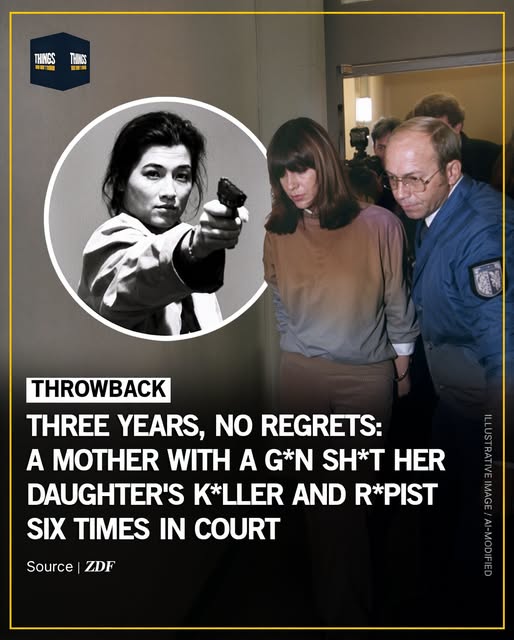
In March 1981, a mother walked into a German courtroom, pulled out a gun, and fired eight shots at the man accused of raping and murdering her 7-year-old daughter. Six bullets struck him. He died instantly. But the story behind the shooting is more complex — and more tragic — than most people know.
LÜBECK, West Germany – March 6, 1981, was supposed to be the third day of the trial against Klaus Grabowski, a 35-year-old butcher accused of the rape and murder of 7-year-old Anna Bachmeier . But just before the proceedings began, Anna's mother, Marianne Bachmeier, entered the courtroom, reached into her coat pocket, and pulled out a .22-caliber Beretta pistol .
She fired eight shots at Grabowski's back. Six bullets hit him. He died on the courtroom floor .
Her words after the shooting, recorded during her trial, were chilling: "I did it for you Anna" .
The Crime That Shattered a Family
On May 5, 1980, 7-year-old Anna Bachmeier had argued with her mother and decided to skip school. By the end of that day, she had disappeared . Her neighbor, Klaus Grabowski, a convicted sex offender who had served prison time for previous child sexual crimes, had abducted, sexually assaulted, and strangled her with his fiancée's tights . He then stuffed her body in a cardboard box and dumped it near a canal .
Grabowski was arrested the same night after his fiancée reported him . He confessed to the murder but claimed he had not sexually assaulted Anna — instead, he argued that the 7-year-old had tried to "extort" him by threatening to tell her mother he touched her . This claim sparked outrage across Germany and would later become a key factor in Marianne's decision to take the law into her own hands .
The case had already been controversial before the shooting. Grabowski had voluntarily undergone castration in 1976 after previous convictions for sexual offenses against children. But a court later approved hormone treatments that restored his sex drive — a decision that would draw sharp criticism after Anna's murder .
The Courthouse Shooting
On the third day of Grabowski's trial in Lübeck's District Court, Marianne Bachmeier smuggled a small pistol into the courtroom. When she saw Grabowski — her back to her — she stood up, drew the weapon, and fired eight shots . Six bullets struck him. He collapsed and died instantly in the courtroom .
Witnesses described a chaotic scene. Bachmeier lowered the gun, did not attempt to flee, and reportedly said, "I aimed for his head, I hope he is dead" . According to prosecutor Klaus-Dieter Schulz, who handled her interrogation, Bachmeier told investigators she hadn't acted for revenge. Instead, she said she wanted to prevent Grabowski from publicly defaming her daughter through his testimony .
The Trial of Marianne Bachmeier
Bachmeier was initially charged with murder. But as her trial unfolded, the prosecution dropped that charge . The case became a national sensation in West Germany, with intense public debate over vigilantism and the justice system's handling of sex offenders .
During her trial, Bachmeier testified that she had brought the gun to court but hadn't intended to kill Grabowski until she heard he planned to "malign" her dead child in court. She said she then "saw visions of Anna" and fired "as if in a dream" .
Her lawyer argued for acquittal on grounds of diminished responsibility . The prosecution called for an eight-year sentence . But on March 2, 1983, the court found Bachmeier guilty of manslaughter (not murder) and unlawful possession of a firearm. She was sentenced to six years in prison .
She served just over three years and was released in 1985 .
The Story Behind the Headlines
The public's sympathy for Bachmeier was not universal. As the trial progressed, reports emerged about her troubled past — and some German media outlets began to question her narrative .
Bachmeier was born on June 3, 1950, in Sarstedt, West Germany, the daughter of a former Waffen-SS soldier. She grew up in an unstable household, was physically abused by her stepfather, and was forced to leave home as a teenager . At age 16, she gave birth to her first child, whom she gave up for adoption. At 18, she became pregnant with a second child — after being raped — and also gave that child up . Anna, her third child, was the one she chose to raise .
In court, psychologists testified that Bachmeier had been "unstable" and "an easy catch for men" due to her traumatic childhood. They described Anna as having become her mother's "friend and advisor." For Bachmeier, the court heard, "killing Anna was like killing Bachmeier herself" .
That darker context — her previous children, the complex mother-daughter dynamic — led some Germans to see her differently. A poll at the time found that 28% thought the six-year sentence was appropriate, 27% thought it was too harsh, and 25% thought it was too lenient .
The Viral Video Mistake
This story has resurfaced repeatedly on social media, often accompanied by a dramatic video of a woman firing a gun in a courtroom. But that video is not real footage of the shooting .
The widely shared clip is actually from "Der Fall Bachmeier – Keine Zeit für Tränen" (The Bachmeier Case – No Time for Tears) , a 1984 German television film based on the true story. Austrian actress Marie Kolbin played Marianne Bachmeier . The film dramatized the event but was not a recording of the actual courtroom shooting .
What Happened to Marianne Bachmeier
After her release from prison in 1985, Bachmeier married a man and moved with him to Nigeria, where he taught at a German school in Lagos. The couple later divorced in 1990 .
She spent her final years caring for the dying in a hospice in Sicily before being diagnosed with pancreatic cancer. She returned to Lübeck and died on September 17, 1996, at age 46 .
She was buried alongside her daughter Anna at Lübeck's Burgtor Cemetery . In 2016, the joint grave was leveled after the 20-year burial period expired .
The Legacy
Marianne Bachmeier's story remains one of the most famous cases of vigilantism in modern German history . It forced the country to confront uncomfortable questions:
-
When does the legal system fail victims so badly that they feel justice is impossible?
Should a grieving mother be punished for killing a confessed child rapist?
What is the line between justice and revenge?
These questions have no easy answers. But 40 years later, Bachmeier's story continues to resonate — and the viral images claiming to show it keep the debate alive.
| What the Viral Graphic Suggests | What Actually Happened |
|---|---|
| The video shows the real shooting | The video is from a 1984 film |
| The mother acted purely for revenge | She said she acted to stop Grabowski from defaming Anna |
| She killed with six bullets | She fired eight shots; six hit and killed Grabowski |
| She was charged with murder | She was convicted of manslaughter and served 3 years |
The story of Marianne Bachmeier is one of grief, rage, and a mother's desperate act of justice — a moment captured not in grainy courtroom footage, but in the enduring memory of a nation forever shaken by what happened on March 6, 1981.
Comments (0)
Loading comments...
May You Like

Russian Drone Strikes Kyiv Bridge as German Chancellor Arrives in Ukraine

Shocking news from Ohio: an unexpected development ahead of Trump's rally

Jack Smith Defends His Integrity as Trump Investigations Face Renewed Political Firestorm