
Ditching Washington? The Economics Behind the EU’s Historic Invitation to Canada
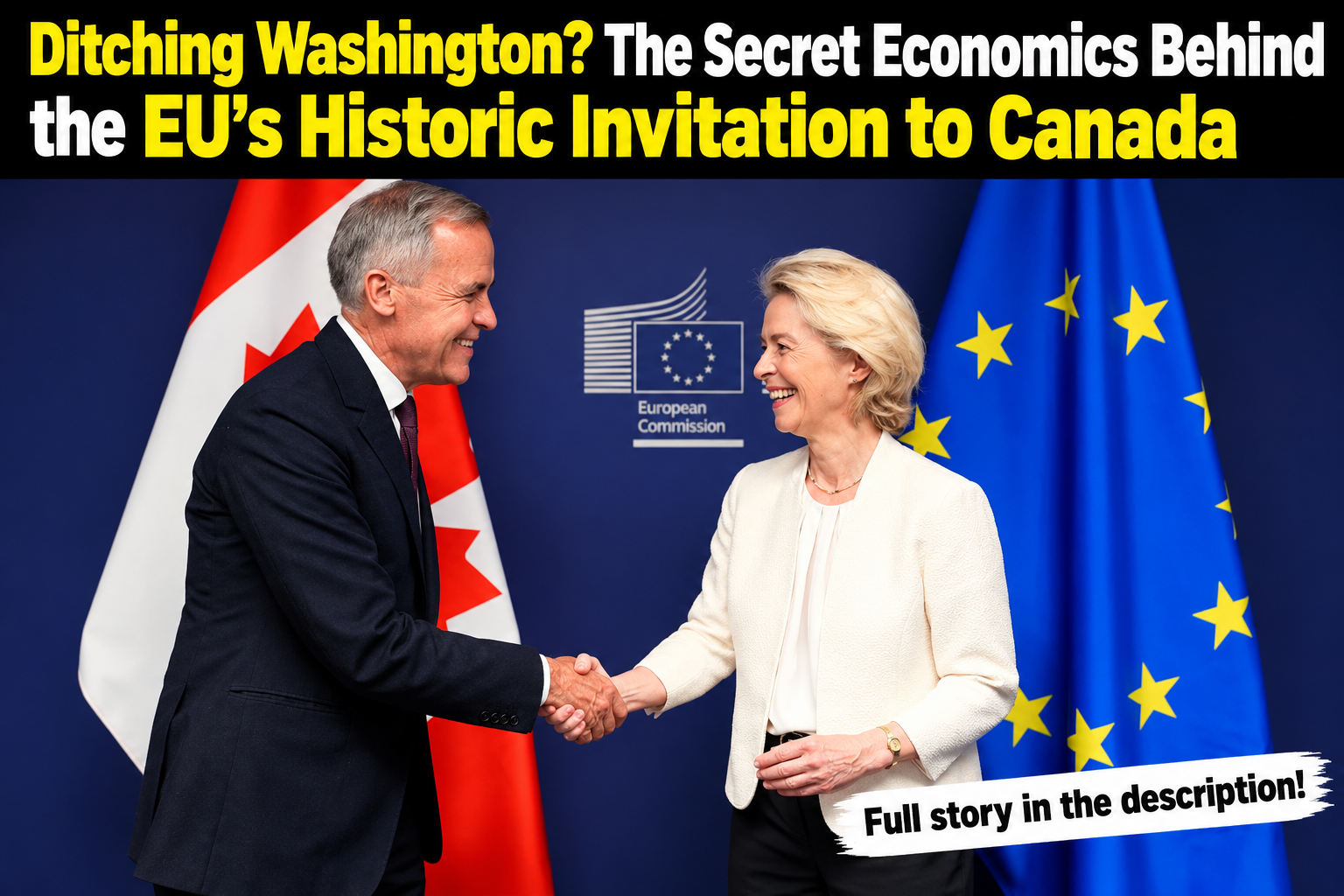
The European Union has opened a new and unprecedented chapter in its relationship with Canada, with European Commission President Ursula von der Leyen proposing that Canada become the bloc’s first “associate member.”
The proposal came on September 16, 2026, as Canadian Prime Minister Mark Carney stood alongside European leaders in Strasbourg and promoted a deeper Canada-EU partnership spanning trade, energy, critical minerals, technology and defense.
The move comes as Canada’s relationship with the United States has become more difficult under President Donald Trump. But the economics suggest something more complicated than Canada simply “ditching Washington”: Ottawa is attempting to reduce its dependence on the U.S. market while building additional trading and security options in Europe and elsewhere.


A proposal the EU has never made before
Von der Leyen used her annual State of the European Union address to propose that Canada become the EU's first associate member.
The concept is not the same as full EU membership.
Canada would not become an EU member state with voting rights in EU institutions, and the proposal does not mean Canada would automatically enter the European single market.
Instead, the idea is intended to create a much deeper institutional relationship between Canada and the EU in areas including:
- Trade and investment
- Defense and security
- Energy
- Critical minerals
- Artificial intelligence
- Advanced technology
- Supply-chain security
- Research and education
The exact legal structure remains unresolved. Reuters reported that EU treaties currently contain no established legal framework for “associate membership,” meaning all 27 member states would need to agree on how such an arrangement would work.
That makes September 16 more of a political opening than a completed agreement.
Why Canada is looking toward Europe now
The timing is closely connected to Canada's changing economic relationship with the United States.
The U.S. remains by far Canada's largest trading partner. Reuters reported earlier this month that about 66.35% of Canadian exports went to the United States in July, although the share had fallen to roughly 68% year-to-date from 73% previously.
That dependence has become more consequential as Washington and Ottawa have imposed tariffs and other trade restrictions on each other's goods.
Canada's government has therefore been pursuing a broader strategy: increase the number of markets available to Canadian companies rather than relying so heavily on one destination.
Carney's government has set a goal of doubling Canada's non-U.S. exports over the next decade.
That does not mean eliminating U.S. trade.
It means giving Canadian businesses more alternatives.


Europe already represents a significant market
Canada is not starting from zero.
The economic relationship is already governed largely by the Comprehensive Economic and Trade Agreement, or CETA.
CETA has been provisionally applied since September 21, 2017. According to Canada's government, bilateral merchandise trade reached approximately C$134 billion in 2025, more than 77% above the 2016 pre-CETA level.
Canada's broader trade statistics also show that commerce with Europe has been expanding.
In 2025, Canadian exports to Europe and Central Asia increased by approximately 30%, while two-way merchandise trade with the region reached about C$214.8 billion, according to Global Affairs Canada.
For the EU specifically, Canadian exports increased 23.4% in 2025, with particularly strong growth in products including mineral fuels and oils, aluminum and oilseeds.
That gives the new political initiative an existing economic foundation.
Critical minerals may be one of the biggest reasons
One of the most important pieces of the emerging Canada-EU relationship is critical minerals.
Canada possesses significant resources relevant to modern industrial supply chains, while Europe wants to reduce vulnerabilities associated with concentrated supplies of strategic materials.
The two sides have already been working on cooperation involving critical minerals and economic security.
Canada's government says cooperation with the EU has expanded into critical minerals, energy, defense and advanced technology.
The EU, meanwhile, is facing its own concerns over dependence on external suppliers, particularly China.
Von der Leyen highlighted the importance of securing raw materials in her September 16 address and announced plans for a European mechanism focused on critical raw materials.
This creates a straightforward economic complement:
Canada has resources and energy.
Europe has capital, technology and a huge consumer market.
The political proposal is an attempt to connect those strengths more closely.
Defense is another major piece of the puzzle
The relationship is also moving beyond trade.
Canada became the first non-European country able to participate in the EU's SAFE defense financing program, according to Canada's government. The arrangement allows Canadian defense companies to participate in projects under the European initiative.
Canada and the EU also have a Security and Defence Partnership.
In early September, Canadian Foreign Minister Anita Anand and EU foreign-policy chief Kaja Kallas highlighted progress in defense-industrial cooperation, critical minerals, economic security and negotiations toward a Canada-EU digital trade agreement.
That means the relationship is becoming broader than simply:
Canada sells Europe commodities.
It is increasingly about:
technology + defense + minerals + energy + supply chains + trade.


The digital economy could become another major pillar
Ottawa and Brussels are also negotiating a Canada-EU digital trade agreement.
The negotiations were formally launched earlier this year, with both sides seeking greater regulatory cooperation and more predictable conditions for digital commerce.
That matters because a deeper Canada-EU relationship would not necessarily be limited to physical goods.
It could eventually cover areas such as:
- Digital services
- Artificial intelligence
- Data governance
- Cybersecurity
- Advanced manufacturing
- Research partnerships
Von der Leyen specifically identified AI and technology as areas where Europe and Canada could deepen cooperation.
But “ditching Washington” goes too far
This is perhaps the most important correction to the image's headline.
Canada is not leaving the North American economic system.
The United States remains Canada's largest export market by a very large margin, and Canadian supply chains remain deeply integrated with American manufacturing, energy and transportation networks.
Even Canada's strategy of diversification acknowledges this reality.
Carney's government is seeking more options, not an immediate replacement for the American market. Reuters described the strategy as an effort to reduce economic reliance on the United States while recognizing that the U.S. still takes the majority of Canadian exports.
The distinction is important.
Canada could increase European trade substantially and still remain economically intertwined with the United States.
Why Europe is interested in Canada
The relationship is not simply about what Canada wants.
Europe has its own reasons to deepen the partnership.
The EU is seeking reliable sources of:
- Critical minerals
- Energy
- Industrial inputs
- Defense equipment
- Advanced technologies
- Secure supply chains
Canada offers many of those resources while also being a long-standing NATO ally.
Canada's government describes the EU as a trusted partner with shared values, while the EU has emphasized cooperation with Canada on energy, raw materials, security and technology.
The geopolitical environment is also changing.
Europe is dealing simultaneously with Russia's war against Ukraine, competition with China, uncertainty surrounding U.S. trade policy and pressure to strengthen its own defense-industrial capacity.
That makes Canada a potentially useful partner without requiring Canada to become an EU member state.
The biggest obstacle: what does “associate member” actually mean?
This is still the unanswered question.
The EU has never established a standard legal category of associate membership.
Reuters reported that the proposal currently lacks a clear legal framework and would require approval from all 27 EU member states.
There are therefore several issues that would have to be negotiated:
Market access:
How much additional access would Canadian companies receive?
Regulation:
Would Canada have to adopt portions of EU regulations without having a vote in creating them?
Mobility:
Could Canadians eventually receive expanded rights to work, study or live in Europe?
Defense:
How deeply could Canadian companies participate in European defense procurement?
Institutions:
Would Canada have a formal role in EU discussions without becoming a member state?
Legal status:
What treaty or agreement would actually create the relationship?
Those questions could take considerable time to resolve.


Canada has already been preparing for this shift
The September 16 proposal did not appear out of nowhere.
Canada's government has spent months expanding contacts with European governments.
In March, Ottawa said CETA was being used as the foundation for deeper cooperation and launched negotiations on digital trade.
In June, Canada and the European Commission expanded cooperation in aerospace, aluminum, graphite and economic security.
In September, Canada's foreign minister attended an informal meeting of EU foreign ministers — the first time a Canadian foreign minister had participated in that format.
Canada has also intensified bilateral relationships with individual European countries.
For example, Ottawa said two-way merchandise trade between Canada and Poland had doubled since CETA's provisional application began in 2017, while Canadian defense exports to Poland reached C$216.8 million in 2025.
So the latest announcement is better understood as the next step in a strategy already underway.
The October summit could be the next major test
The next important milestone will be the Canada-EU Summit scheduled for October 29-30 in Canada.
Canadian and European officials are expected to continue discussions over trade, investment, defense, critical minerals, digital policy and the broader strategic relationship.
The summit could provide more clarity about what the proposed associate-member relationship would actually contain.
Until then, the headline should be treated as a description of a major diplomatic proposal — not a completed alliance or economic divorce from the United States.
What the viral image gets right — and what it leaves out
What it gets right
The central event is real.
Ursula von der Leyen has proposed that Canada become the EU's first associate member, and the proposal is explicitly aimed at deepening cooperation across trade, defense, energy, technology and strategic supply chains.
Mark Carney is also actively pursuing a deeper Canada-EU relationship as part of a broader effort to diversify Canada's economic partnerships.
What it leaves out
Canada is not joining the EU.
The proposal is for a new form of association, not full membership.
The arrangement does not yet exist as a finalized legal framework.
All 27 EU countries would need to agree to whatever structure is eventually negotiated.
The U.S. remains Canada's dominant trading partner.
The latest trade data still show that most Canadian exports go to the United States.
Canada-EU trade is already substantial.
CETA has been in place provisionally since 2017, with bilateral merchandise trade reaching C$134 billion in 2025.
The EU also has economic reasons to want Canada closer.
The relationship is not simply Ottawa looking for somewhere else to trade; Europe is seeking secure supplies of energy, minerals, technology and defense capabilities.
So, is Canada really “ditching Washington”?
The current evidence points to diversification rather than abandonment.
Canada is trying to make its economy less dependent on a single foreign market while maintaining the enormous trade relationship it already has with the United States.
The EU proposal could eventually give Canada deeper access to European markets and cooperation in strategic industries. But the details of associate membership remain unresolved, and the economic relationship with Washington remains far larger.
The significance of September 16 is therefore less about Canada choosing Europe instead of America and more about Canada trying to create more than one center of economic and strategic gravity.
If the proposal develops into a concrete agreement, it could become one of the most consequential changes in Canada's external economic strategy in decades.
For now, however, it is an ambitious proposal — not a completed realignment.
Suggested SEO Setup
SEO Title:
EU Invites Canada to Become First Associate Member as Carney Seeks Trade Diversification
Alternative Headline:
Ditching Washington? Why the EU Wants Canada as Its First Associate Member
Meta Description:
The EU has proposed making Canada its first associate member as Mark Carney seeks deeper trade, defense, energy and technology ties with Europe.
Slug:eu-canada-associate-member-carney-trump-trade
Category:
World News / Canada / International Trade
Tags:
Mark Carney, Ursula von der Leyen, Canada, European Union, EU, Donald Trump, Canada EU Relations, CETA, Trade Diversification, Critical Minerals, NATO, European Parliament
Comments (0)
Loading comments...
May You Like

gfnhgmnghnmfgnbvvvvvvvvv

Jack Smith Defends His Integrity as Trump Investigations Face Renewed Political Firestorm

OBAMA STUNS ON INSTAGRAM: MESSAGE MARKING 34-YEAR MILESTONE SPARKS A BUZZ













