“The Federal Government Doesn't Have Standing”: Inside the Federal Court Ruling That Blocked Trump’s Preemptive Strike on Alaska’s Senate Election
“The Federal Government Doesn't Have Standing”: Inside the Federal Court Ruling That Blocked Trump’s Preemptive Strike on Alaska’s Senate Election
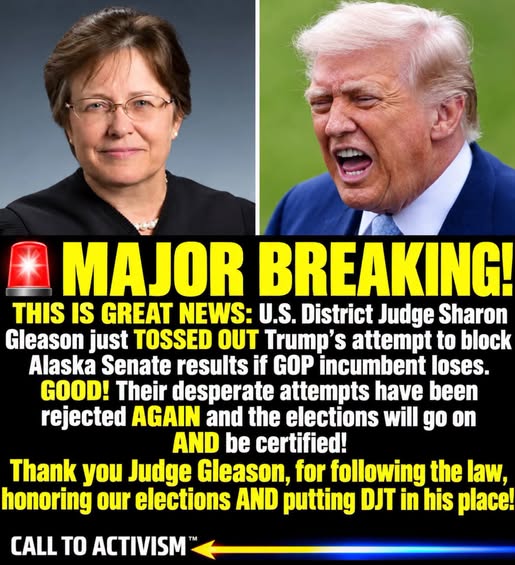
The image is designed to feel like a victory lap: a stern portrait of U.S. District Judge Sharon Gleason beside a red-faced, shouting Donald Trump, under a flashing “MAJOR BREAKING!” banner. The text declares that Gleason “just TOSSED OUT Trump’s attempt to block Alaska Senate results if GOP incumbent loses,” adding, “GOOD! Their desperate attempts have been rejected AGAIN and the elections will go on AND be certified!”
The post, which has circulated widely across social media in the final hours before the 2026 midterms, points to a very real and legally significant development. On Sunday, November 1, 2026—just two days before Election Day—Chief Judge Sharon Gleason of the U.S. District Court for the District of Alaska dismissed a highly unusual lawsuit filed at President Donald Trump’s direction. The suit had sought to preemptively block the certification of Alaska’s U.S. Senate race if the Republican incumbent, Senator Dan S. Sullivan, lost by a narrow margin.
But the full story is more complex than a simple partisan victory. It is a story about the limits of federal power, the sanctity of the secret ballot, and a bizarre electoral coincidence involving two candidates with nearly identical names that nearly upended one of the most consequential Senate races in the country.
The Verdict: A Real Ruling, But a Narrow Legal Question
Unlike many viral political headlines, this one is grounded in a genuine and significant judicial decision. Judge Gleason did, in fact, dismiss the lawsuit. She did, in fact, rule that the federal government lacked standing. And she did, in fact, express grave concerns about how the government’s proposed remedy would work.
But it is important to be precise about what the ruling did and did not do. Gleason did not rule on the merits of whether the election was being conducted fairly. She did not find that the Trump administration was acting in bad faith. She did not declare that the election results would be certified regardless of what happens. Instead, she ruled on a narrow but fundamental legal question: Does the federal government have the right to sue a state over how it runs its elections? Her answer was no.
The Lawsuit: A Preemptive Strike
The lawsuit, filed last month by the Justice Department at President Trump’s direction, was unprecedented in both its timing and its logic. It asked the court to block Alaska’s election officials from certifying the results of the Senate race if Senator Sullivan lost—but only if a specific scenario unfolded.
The problem was a name. Alaska’’s ranked-choice ballot included two candidates named Dan Sullivan: the Republican incumbent, Senator Dan S. Sullivan, and a retired teacher from Petersburg named Daniel J. Sullivan, who was not affiliated with any political party. The Justice Department argued that if the incumbent lost, it would be because voters confused the two men—and that those voters who selected the retired teacher might have actually intended to vote for the senator. The suit demanded an investigation into whether voters who chose Daniel J. Sullivan actually meant to vote for Dan S. Sullivan, and it sought to segregate those ballots so they could be examined.
Legal observers gave the case little chance of succeeding from the start, given that the U.S. Constitution places control over elections in the hands of the states, not the federal government. The Justice Department cited the preamble of the National Voter Registration Act as its legal basis, but the argument was widely seen as a stretch.
The Ruling: Standing, Secrecy, and the Sanctity of the Ballot
Judge Gleason’s ruling, released Sunday morning, was a decisive rejection of the government’s case. She found that the Justice Department did not have legal standing to bring the lawsuit against the state of Alaska, its Division of Elections director, and its election boards.
But she went further. Even if the federal government had standing, she wrote, the remedy it sought would be unworkable and unconstitutional. The government had provided “no workable plan” for how it proposed to segregate ballots cast for Daniel J. Sullivan and then conduct a “court-ordered unspecified ‘investigation’ of those ballots in a manner that would preserve voter secrecy”.
“Clearly, if this Court were to order that certain ballots will be segregated and subject to a future and as yet unspecified investigation by law enforcement, it would likely result in voter ‘confusion and consequent incentive to remain away from the polls,’” Gleason wrote. “Such late-breaking changes to the election rules are strongly disfavored.”
She also noted the obvious practical problem: “The absence of any explanation from the United States as to how its requested relief could redress its alleged injury while simultaneously maintaining the secrecy of the ballot is telling.” The right to a secret ballot, she concluded, is a core principle of American democracy.
The Political Backdrop: A Race That Could Decide the Senate
The ruling landed in the middle of one of the most closely watched Senate races in the country. Alaska’s Senate contest, in which Democratic former U.S. Representative Mary Peltola is trying to unseat Senator Sullivan, is considered one of the handful of races that could determine which party controls the Senate. The presence of a similarly named third-party candidate on the ballot had already made the race a headache for Republicans, who feared that Daniel J. Sullivan could act as a spoiler.
The controversy deepened in late October when The New York Times reported that Peltola’s campaign staff and a national Democratic group had allegedly helped recruit the Petersburg Sullivan to run as a potential spoiler. The Peltola campaign has long denied any such effort. After the story was published, the Justice Department sent a “surge” of federal investigators to Alaska to investigate the allegations, and state Republican officials launched their own inquiries. Legal experts said the revelations did not appear to reflect unlawful behavior.
The Reaction: An Appeal and a Vow to Fight On
The Justice Department wasted no time in signaling that it would not accept the ruling. A spokesperson said Sunday that the Trump administration would appeal the decision, arguing that “Alaskan voters deserve a fair election, not to be misled in an attempt to rig outcomes.”
The ruling was the latest in a series of legal setbacks for the Trump administration’s efforts to intervene in state election processes in the final days of the midterms. Just days earlier, a federal appeals court had rejected a Justice Department demand that California election officials set aside ballots from 20,000 people the administration claimed could be noncitizens. And a federal judge in California had imposed an emergency order restricting the Justice Department and the Department of Homeland Security from demanding that election officials in any state segregate ballots, purge voter rolls, or halt ballot processing.
For his part, Senator Sullivan sought to project calm. In an interview on CNN’s State of the Union on Sunday, he said he would accept the election results, win or lose. “I’m confident the people of Alaska will make their voices heard,” he said.
The Bottom Line
The viral graphic is right about one thing: Judge Gleason did throw out the Trump administration’s lawsuit. But the story is not as simple as a partisan victory. It is a case about the fundamental structure of American federalism—about whether the federal government can preemptively override a state’s election procedures because it fears the outcome might be unfair. Judge Gleason said no. The Constitution, she ruled, does not give the federal government that power.
The appeal will now move forward, and the legal battle over Alaska’s Senate race may continue well beyond Election Day. But for now, the ruling stands as a reminder that even in an era of intense political pressure and unprecedented legal maneuvering, the courts remain a check on the power of the executive branch—and that the right to a secret ballot is not a technicality, but a cornerstone of democracy.
📸 Suggested Images
-
The Ruling: A photo of the federal courthouse in Anchorage, Alaska, with a caption noting that Chief Judge Sharon Gleason issued the decision on Sunday, November 1.
The Candidate: A photo of Senator Dan Sullivan (R-Alaska) on the campaign trail, with a caption explaining the unusual ballot situation involving his name and that of Daniel J. Sullivan.
The Legal Battle: A split image of the Justice Department seal and the Alaska Division of Elections seal, illustrating the constitutional clash between federal and state authority.
The Stakes: A map of the United States highlighting Alaska and the handful of other Senate battlegrounds, with a caption noting that the race could determine control of the chamber.
Comments (0)
Loading comments...
May You Like

TRUMP SAYS HE COULD HAVE WON VIETNAM IN A WEEK — HISTORY HAS A FEW QUESTIONS