
The Federal Reserve raises interest rates — the health of the US economy
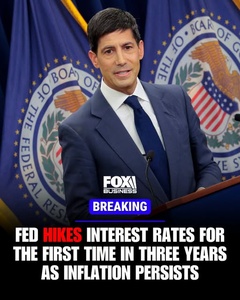
WASHINGTON — The Federal Reserve raised its benchmark interest rate on September 16 for the first time in more than three years, responding to persistent inflation and renewed economic pressures.
A Major Policy Shift
The Federal Open Market Committee unanimously approved a quarter-point increase, moving the federal funds target range from 3.50%-3.75% to 3.75%-4.00%.


The decision marked the Fed’s first rate increase since July 2023, ending a period in which policymakers had largely relied on holding rates while monitoring inflation and economic growth.
Federal Reserve Chair Kevin Warsh said inflation remained too high for policymakers to conclude that price pressures were moving toward the central bank’s 2% objective quickly enough.
The Fed’s latest statement said economic activity was expanding at a solid pace, while domestic spending remained resilient and productivity growth continued to support the economy.
Why Inflation Remains A Concern
Recent inflation data strengthened expectations for the September decision. U.S. consumer prices accelerated in August, partly reflecting a renewed increase in gasoline prices after earlier declines.
Energy costs have become particularly important because renewed fighting in the Middle East has pushed crude oil and gasoline prices higher, creating another source of inflationary pressure.
The Fed is also watching other sources of price pressure, including tariffs and strong investment in artificial-intelligence infrastructure, which has contributed to higher prices for some technology-related equipment.
At the same time, consumer spending has remained relatively strong. Government data showed retail sales increased 1.2% in August from July, suggesting households continued spending despite persistent affordability concerns.
More Rate Increases Possible
The September decision may not represent the end of the tightening cycle. Federal Reserve projections indicated that policymakers expect another increase before the end of 2026.
Sixteen of the 18 officials who submitted economic projections indicated at least one additional rate increase could be appropriate this year, while four anticipated two further increases.
However, the projections are not guarantees. Future decisions will depend on incoming inflation, employment, economic-growth and financial-market data, as well as developments affecting energy prices and global trade.


What It Could Mean For Consumers
Higher benchmark rates can eventually increase borrowing costs across the economy, affecting products such as credit cards, automobile loans and some mortgages, although the immediate impact varies by financial product.
For households carrying variable-rate debt, higher interest rates can increase monthly expenses, while savers may benefit from stronger yields on certain deposits and other interest-bearing accounts.
Mortgage rates do not move directly with the federal funds rate, but expectations surrounding Federal Reserve policy can influence broader financial-market yields and, consequently, housing borrowing costs.
Businesses may also face higher financing costs, potentially influencing investment decisions, hiring plans and expansion projects if borrowing becomes more expensive over an extended period.
Markets React To The Decision
Financial markets reacted quickly after the announcement. The dollar strengthened, while U.S. stocks initially moved lower as investors absorbed the prospect of additional monetary tightening.
Gold prices also fell more than 1% following the decision, as higher interest rates and a stronger dollar reduced the appeal of holding non-yielding bullion.
The policy shift comes during an unusually complicated economic environment, with inflation remaining elevated while geopolitical tensions, energy prices and investment spending create additional uncertainty.
Tension With The White House
President Donald Trump has repeatedly argued for lower interest rates, but the September decision demonstrated that the Federal Reserve continues making monetary-policy decisions independently.
Warsh, who was nominated by Trump, nevertheless emphasized the importance of returning inflation toward the Fed’s 2% target and said policymakers needed stronger evidence of sustained price stability.
For Americans, the central question now is whether higher interest rates can bring inflation down without unnecessarily weakening economic activity, particularly as households continue facing elevated everyday costs.
Comments (0)
Loading comments...
May You Like

South Korea–Ukraine Rift Deepens Over North Korean POW Transfer as PURL Draws New Scrutiny

South Korea–Ukraine Rift Deepens Over North Korean POW Transfer as PURL Draws New Scrutiny
TRUMP HIT WITH 26 ARTICLES OF IMPEACHMENT













