The Fight Over Who Gets to Vote Has Reached a New Stage — and Schumer Is Still Drawing the Line
WASHINGTON — A battle over voter identification and proof of citizenship has become one of the most persistent election disputes of 2026, with Senate Democratic Leader Chuck Schumer continuing to oppose the Republican-backed SAVE America Act.
A Debate That Refuses to Disappear
The legislation, formally known as the SAVE America Act, would require documentary proof of U.S. citizenship when registering to vote in federal elections and establish federal photo-identification requirements for voting.
Republicans have presented the measure as an election-security proposal designed to ensure that only eligible citizens participate in federal elections.
Democrats, led by Schumer, argue that the requirements could create additional barriers for eligible voters and affect people who have difficulty obtaining or matching the required documents.
The disagreement has produced months of debate in Congress, while President Donald Trump has repeatedly pressed Republicans to advance the legislation.
Schumer's Role
Schumer has made the SAVE Act a central target of his opposition to the Trump administration's election agenda.
During the Senate debate in March, he argued that the legislation went beyond voter identification and could lead to eligible citizens being removed from voter rolls.
His position has remained consistent even as Republicans have explored different legislative routes for advancing the proposal.
In July, Schumer again urged Republicans to abandon the legislation, saying the bill would not obtain sufficient support in the Senate.
What the Bill Would Change
The SAVE America Act would require people registering to vote for federal elections to provide documentary evidence of U.S. citizenship.
It would also establish federal photo-ID requirements for voters and require states to use a Department of Homeland Security verification system when checking voter-registration information.
The legislation therefore combines several election rules that currently vary considerably among individual states.
Supporters say creating nationwide requirements would establish consistent standards for federal elections.
Opponents contend that the federal requirements could create problems for eligible citizens whose identification documents do not easily match their current registration information.
The Documentation Question
One particularly debated issue concerns voters whose legal names have changed.
FactCheck.org noted that the bill does not require every currently registered voter to re-register. However, people making certain registration changes, such as after moving or changing their name, could face additional documentation requirements.
Supporters of the legislation have disputed concerns that documentation requirements would automatically prevent married women or other voters with changed names from registering.
The bill contains procedures intended to address discrepancies between citizenship documents and registration information, although critics continue to argue that the requirements could nevertheless create practical barriers.
The Senate Roadblock
The central obstacle has been the Senate's 60-vote threshold for advancing most major legislation.
The Senate began debate on the SAVE America Act in March, but an amendment establishing photo-ID requirements failed to advance by a 53-47 vote.
Republicans hold a 53-47 Senate majority, meaning they have not had enough votes to overcome the normal procedural threshold without Democratic support or a change to Senate rules.
The dispute has therefore extended far beyond the substance of voter ID itself, becoming a broader argument over how election legislation should move through Congress.
Trump's Continued Pressure
Trump has repeatedly made the legislation a major political priority.
In July, he demanded that Senate Majority Leader John Thune cancel the chamber's upcoming recess until senators passed the SAVE America Act or eliminated the legislative filibuster.
Thune, however, said Republicans did not have the votes to advance the legislation under existing Senate rules.
The disagreement exposed a tension within the Republican Party between Trump's demand for immediate action and Senate Republicans' calculations about what could actually pass.
The Calendar Has Changed
The congressional calendar has now added another complication.
The Senate left Washington on September 30 for the final time before the 2026 midterm elections, meaning lawmakers will campaign in their home states and districts rather than continue normal legislative business.
That means the immediate congressional push surrounding the SAVE America Act has effectively moved beyond the regular pre-election legislative schedule.
The political debate, however, has not disappeared.
A Different Election Battle
While Congress has struggled to pass the legislation, the Trump administration has pursued voter-verification efforts through other mechanisms.
Reuters reported in September that the administration had continued efforts to collect and compare voter data to identify people it believes may be ineligible to vote. The effort has faced legal challenges and disputes over accuracy and privacy.
The Supreme Court also recently allowed temporary use of an expanded federal SAVE database while litigation continues, although the ruling did not require states to participate.
That development has given the broader voter-verification debate another dimension separate from the stalled legislation.
What the Image Leaves Out
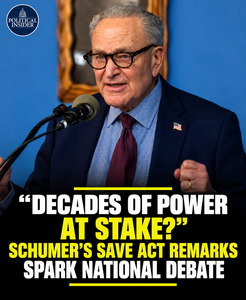
The dramatic wording in the uploaded image suggests that Schumer's remarks have suddenly triggered a new nationwide debate.
The underlying story is more complicated.
Schumer has been opposing the legislation for months, and the Senate's debate over the measure began in March. His position is not a new announcement, but part of a continuing confrontation over federal election rules.
The bill itself has also repeatedly failed to secure the votes needed to advance.
What Happens Next?
The SAVE America Act remains part of the larger national argument over voter identification, citizenship verification and federal involvement in election administration.
For Republicans, the legislation represents an effort to establish uniform federal requirements for federal elections.
For Democrats, including Schumer, it represents a potential expansion of federal election restrictions that could affect eligible voters.
With Congress now away from Washington for the pre-midterm campaign period, the next major chapter is likely to unfold through campaigning, litigation and renewed congressional negotiations rather than another immediate Senate debate.
The fight over the SAVE Act may have left the Senate floor for now — but with the midterms approaching, the argument over who sets the rules for voting is far from over.
Comments (0)
Loading comments...
May You Like


Shocking news from Ohio: an unexpected development ahead of Trump's rally