Federal Judge Signals Trouble for Part of TikTok’s $400 Million Children’s Privacy Settlement
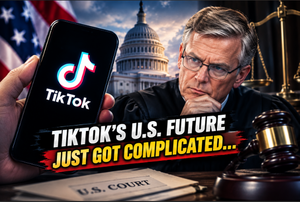
September 19, 2026 — A federal judge has questioned whether TikTok should be released early from a years-old privacy order, potentially complicating its newly announced $400 million settlement with the U.S. government.
TikTok and its Chinese parent ByteDance face a new obstacle to their $400 million privacy settlement after a federal judge signaled he may refuse to terminate an older court order.
U.S. District Judge George H. Wu in Los Angeles said he was inclined to reject the companies’ request to end a 2019 consent decree imposed on TikTok’s predecessor, Musical.ly.
The tentative decision matters because the settlement requires TikTok to pay $300 million immediately, while another $100 million would become due only if the earlier consent decree is formally vacated.
Wu said the record before the court did not yet show that ending the decree would provide a durable remedy or appropriately reflect the changes cited by the parties.
The judge scheduled a hearing for Monday, September 21, giving TikTok and the government another opportunity to explain why federal oversight created under the 2019 agreement should be lifted.
The disputed decree traces back to a Federal Trade Commission case alleging Musical.ly knowingly allowed children under 13 to use its service while collecting personal information without verified parental consent.
In 2019, Musical.ly agreed to pay $5.7 million to resolve those allegations, then the largest civil penalty obtained by the FTC in a children’s online privacy case.
That earlier order required the company to comply with the Children’s Online Privacy Protection Act and maintain specific reporting and record-keeping obligations that remain scheduled to continue through 2029.
The current $400 million settlement was announced by the Justice Department in August and is intended to resolve a separate lawsuit filed against TikTok and ByteDance in 2024.
That lawsuit alleged the companies knowingly permitted children younger than 13 to create accounts, collected personal information from them, and sometimes failed to honor parental deletion requests.
COPPA generally requires online services covered by the law to notify parents and obtain verifiable parental consent before collecting, using or disclosing personal information from children under 13.
The Justice Department said the settlement reflected substantial changes at TikTok since litigation began, including adjustments to ownership, management, compliance functions, privacy practices and protections for younger users.
Government officials described the proposed resolution as one of the largest recoveries ever obtained in a COPPA case, emphasizing both the financial penalty and the company’s stated compliance improvements.
TikTok’s U.S. joint venture has told the court that users must enter their birth dates and that the platform employs age-moderation systems designed to detect underage users misrepresenting their age.
Those safeguards are central to TikTok’s argument that its current operations differ significantly from the circumstances behind the 2019 decree, which was created before the platform reached its present scale.
However, Wu’s tentative position suggests the court wants more detail before concluding that newer policies and corporate changes justify removing a legally binding privacy order years ahead of schedule.
The issue does not necessarily invalidate the broader settlement. Instead, it creates uncertainty around the additional $100 million payment and whether TikTok will remain subject to the older compliance obligations.
The case also highlights the continuing regulatory focus on children’s privacy as social-media platforms rely on age gates, automated detection tools and parental controls to separate younger users from adult services.
Neither TikTok nor the Justice Department immediately commented on the judge’s tentative position when Reuters sought responses, leaving the parties’ fuller arguments for the scheduled court hearing.
Until the court rules, the settlement remains under judicial review, with the key question being whether TikTok’s claimed reforms are sufficient to justify ending oversight established after the earlier Musical.ly case.
Related Images

Comments (0)
Loading comments...
May You Like

Russian Drone Strikes Kyiv Bridge as German Chancellor Arrives in Ukraine
South Korea–Ukraine Rift Deepens Over North Korean POW Transfer as PURL Draws New Scrutiny