The Inflation–Power Grid Fight: What the New Numbers Actually Show About Trump, Electricity Rates and AI Data Centers
A new wave of public concern over inflation is colliding with a separate but increasingly important fight over America's electricity grid.
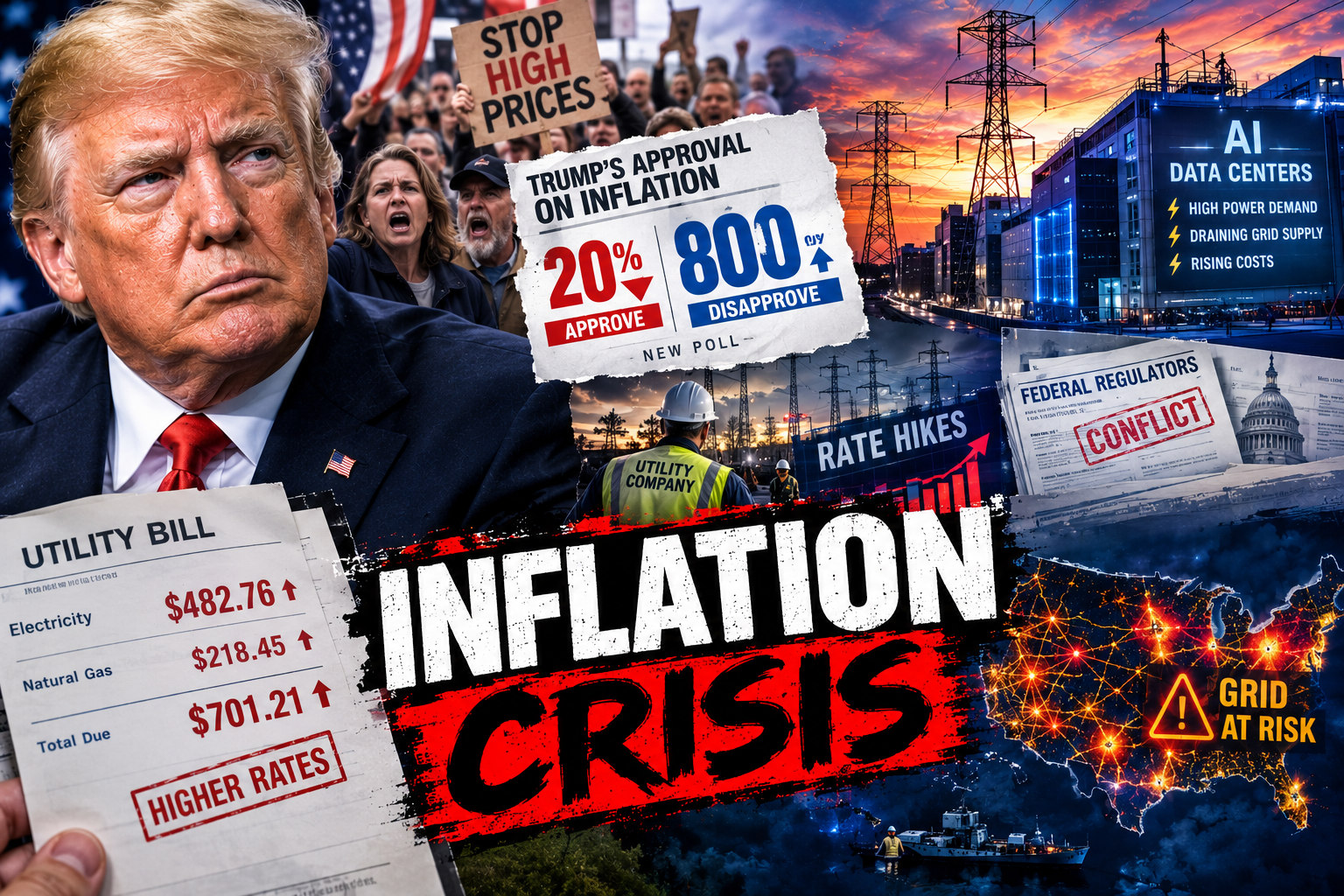
A viral graphic claims that 80% of Americans disapprove of President Donald Trump's handling of inflation, while portraying artificial-intelligence data centers as a major force behind rising utility bills and a looming grid crisis.
The underlying story is real, but the graphic mixes several different developments — and its “20% approve / 80% disapprove” figure does not match the latest national polling.
A new AP-NORC poll released Oct. 1 found that just 17% of U.S. adults approve of Trump's handling of the cost of living, while 26% approve of his handling of the economy overall. Meanwhile, 65% say Trump's policies are responsible for persistently high prices.
At the same time, federal regulators and lawmakers really are confronting a rapidly growing electricity demand problem associated in part with AI data centers.


The 80% Figure Does Not Match the Latest Poll
The image prominently displays:
20% APPROVE
80% DISAPPROVE
as a purported new poll measuring Trump's approval on inflation.
The latest AP-NORC survey paints a somewhat different picture.
Among 2,140 U.S. adults surveyed Sept. 24–28, only 17% approved of Trump's handling of the cost of living, while roughly seven in 10 said his handling of the issue had been worse than expected. About six in 10 Republicans also disapproved of his handling of the cost of living.
So the broad direction of the graphic — very low public approval of Trump's handling of living costs — is supported by current polling.
But 80% disapproval is not the figure reported by AP-NORC.
The distinction matters because the 17% approval figure would imply roughly 83% disapproval if everyone else were categorized as disapproving, but poll questions can include respondents who neither approve nor disapprove or who decline to answer. The exact 20/80 presentation therefore should not be treated as an official AP-NORC result.
Public Anxiety Over Prices Is Growing
The latest polling nevertheless shows substantial economic frustration.
AP-NORC found that 65% of Americans say Trump's policies are responsible for higher-than-usual prices, compared with 67% of Republicans who say factors outside Trump's control are more responsible.
Concern extends beyond political identification.
About half of Americans surveyed said they were extremely or very concerned about being able to afford gasoline, up from 39% in July. A similar share expressed serious concern about affording food.
The Conference Board separately reported that its consumer-confidence index fell to 81.9 in September, the lowest reading since April 2014. The organization cited continuing concerns over inflation, wages and the economic effects of the Iran war.
That provides important context for why electricity prices have become such a politically sensitive issue.
AI Data Centers Are Creating a Genuine Grid Debate
The second half of the graphic focuses on AI data centers.
Here, there is a substantial underlying story.
AI companies are building enormous data centers that require large amounts of electricity. Their expansion is occurring while parts of the U.S. grid already face capacity constraints.
The issue is particularly visible in PJM Interconnection, the largest U.S. regional transmission organization, serving roughly 67 million people.
Recent reporting shows that rapidly growing electricity demand from data centers is contributing to tighter power supplies and higher capacity costs in the PJM region.
FERC Commissioner Mark See said Sept. 29 that soaring electricity demand from data centers, artificial intelligence, domestic manufacturing and other strategic industries was challenging the region's supply. He also said customers driving new costs should bear appropriate responsibility rather than leaving existing customers to pay them.
That is very close to the central issue depicted in the graphic.
The Federal Government Is Already Trying to Address It
This is not simply a dispute between utilities and Washington.
The Trump administration has already attempted to address the issue through its Ratepayer Protection Pledge.
In March, the White House said major technology companies including Amazon, Google, Meta, Microsoft, OpenAI, Oracle and xAI had agreed to build, bring or purchase new generation resources and cover infrastructure upgrades associated with their data centers.
The administration's stated objective was to prevent households from bearing the infrastructure costs associated with AI expansion.
But the pledge is voluntary, and questions remain about how rapidly new electricity generation and transmission infrastructure can actually be built.
Congress Just Fought Over Who Should Pay
The dispute escalated dramatically in Congress in September.
The House passed the Ratepayer Protection Act by an overwhelming 417–3 vote. The measure was intended to address concerns that ordinary electricity customers could end up paying for infrastructure needed to serve large data centers.
But on Sept. 30, the Senate blocked the legislation.
Reuters reported that the Senate vote was 57–43, short of the 60 votes required to advance it.
The disagreement was not simply about whether consumers should be protected.
The competing proposals differ over how that protection should work.
Supporters of the House bill argued that data centers should bear costs associated with the additional electricity infrastructure they require.
Democratic senators argued that the legislation did not go far enough and backed an alternative approach requiring data centers to fully fund necessary grid upgrades.
That leaves the issue unresolved.
FERC Is Also Pressuring the Grid Operator
Federal regulators have taken action independently of Congress.
In June, the Federal Energy Regulatory Commission ordered all six regional grid operators under its jurisdiction to justify or reform their tariffs for large electricity users, including data centers. The stated goal was to accelerate connections while protecting existing ratepayers.
Then on Sept. 29, FERC partly rejected elements of PJM's proposed reliability backstop procurement program.
The dispute centered partly on how the costs of obtaining additional electricity capacity should be allocated.
FERC's position was that new customers creating new costs should bear an appropriate share of those costs, rather than automatically shifting them to existing households and businesses.
Reuters reported that PJM faces a potential 6,800-megawatt shortfall, with rapidly expanding data-center demand among the factors driving the problem.
Are Data Centers Actually Raising Everyone's Electricity Bill?
This is where the viral framing becomes more complicated.
There is evidence that AI-driven electricity demand is contributing to pressure on regional power markets.
Axios reported that AI-related demand was helping push electricity costs higher in PJM, with capacity prices rising sharply as data-center demand expanded.
But it would be inaccurate to say that every increase in an American household's electricity bill is caused by AI data centers.
Electricity prices are affected by multiple factors, including:
- fuel costs;
- generation capacity;
- transmission investment;
- weather;
- regional demand;
- regulatory decisions;
- utility infrastructure;
- power-market rules; and
- new large industrial loads such as data centers.
The data-center boom is therefore one component of a broader electricity-supply and infrastructure problem, rather than a single explanation for national inflation.
The Administration's Position Is More Complicated Than the Graphic Suggests
The graphic portrays the Trump administration as promising lower bills while data centers simultaneously drive prices upward.
The actual policy record is more nuanced.
The White House has explicitly promoted the idea that technology companies should pay for new power generation and infrastructure associated with their data centers.
At the same time, the administration has strongly supported rapid expansion of domestic AI infrastructure.
That creates a policy challenge: How quickly can the United States add enough electricity and transmission capacity to accommodate AI growth without shifting the cost onto existing customers?
Federal regulators are now actively wrestling with precisely that question.
Why the Issue Is Becoming Political
The timing is particularly significant.
The November 2026 midterm elections are approaching, and economic concerns remain prominent among voters.
Reuters reported Oct. 1 that Republicans are increasingly confronting voter dissatisfaction over living costs, while energy prices have become an important campaign issue.
At the same time, AI data centers are becoming a politically visible target because communities can see large industrial facilities being proposed while utility regulators debate who should finance the infrastructure needed to serve them.
The conflict therefore connects three separate issues:
Inflation → electricity prices → AI infrastructure.
But they should not be treated as one single cause-and-effect chain.
What the Viral Graphic Gets Right — and What It Leaves Out
Supported by current evidence
- Public approval of Trump's handling of the cost of living is extremely low in the latest AP-NORC survey.
- Only 17% approved of his handling of the cost of living.
- 65% said Trump's policies were responsible for higher-than-usual prices.
- Consumer confidence has fallen to its lowest level since 2014.
- AI data centers are increasing electricity demand.
- PJM faces significant capacity challenges.
- FERC is examining how large-load customers should pay for new infrastructure.
- Congress has been debating legislation intended to prevent households from subsidizing data-center electricity costs.
- The House passed the Ratepayer Protection Act, while the Senate blocked it.
Not established by the evidence
- That exactly 80% of Americans disapprove of Trump's inflation handling.
- That AI data centers alone are responsible for America's rising utility bills.
- That the U.S. power grid is facing an imminent nationwide “meltdown.”
- That federal regulators are engaged in a single coordinated “backroom war” with utility companies.
- That Trump's energy policies have already caused the rate increases depicted on the fictional utility bill in the image.
The real story is significant without those claims: Americans are increasingly concerned about the cost of living, while the rapid expansion of AI is forcing regulators, utilities, technology companies and Congress to confront a difficult question about electricity costs.
The Question Now Is Who Pays for the AI Boom
The central policy dispute is becoming clearer.
The United States wants to expand AI infrastructure rapidly, but that expansion requires enormous amounts of electricity and new infrastructure.
Federal officials, utilities and lawmakers are now debating whether data centers, utilities, existing ratepayers or some combination of them should bear the cost.
FERC's recent actions show that the issue has moved beyond political rhetoric and into actual electricity-market regulation.
And with consumer confidence falling and cost-of-living concerns remaining high, the debate over who pays for America's AI-powered electricity demand is likely to remain politically important through the November elections.
Comments (0)
Loading comments...
May You Like

Russian Drone Strikes Kyiv Bridge as German Chancellor Arrives in Ukraine

Russian Drone Strikes Kyiv Bridge as German Chancellor Arrives in Ukraine
OBAMA STUNS ON INSTAGRAM: MESSAGE MARKING 34-YEAR MILESTONE SPARKS A BUZZ