The Mike Johnson disaster and the "Mini-Madani" faction — We must fight to
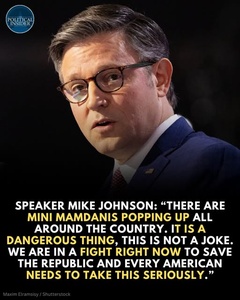
WASHINGTON — A phrase coined by House Speaker Mike Johnson has become part of the Republican Party’s broader effort to portray progressive Democratic candidates as evidence of a deeper ideological shift ahead of November’s congressional elections.
The Quote Behind the Debate
Johnson used the phrase “mini Mamdanis” in June after several progressive candidates associated with New York City Mayor Zohran Mamdani won Democratic congressional primaries in New York.
In a June 24 social-media post, Johnson warned that “mini Mamdanis” were appearing around the country, calling the development dangerous and urging Americans to take the political battle seriously.
The graphic circulating online therefore uses a genuine Johnson statement, but it presents an older remark rather than a newly issued warning from September.


Why Mamdani Matters
Mamdani, a Democratic socialist, emerged as an influential figure among the Democratic Party’s progressive wing after several candidates aligned with his politics won important New York congressional primaries.
On June 23, three candidates backed by Mamdani won Democratic House nominations, including Brad Lander, Claire Valdez and Darializa Avila Chevalier.
Reuters reported that the victories strengthened the influence of the Democratic Socialists of America and gave Republicans additional ammunition to portray Democrats as moving toward the left.
Republicans have subsequently used Mamdani as a political reference point, although Democratic candidates described as progressive do not necessarily share his entire platform or policy positions.
Michigan Expands the Fight
The argument gained another prominent example in Michigan, where Abdul El-Sayed won the Democratic Senate nomination in August after narrowly defeating former Representative Haley Stevens.
El-Sayed campaigned on Medicare for All, economic issues, reducing the influence of money in politics and ending unconditional U.S. military aid to Israel.
After the Michigan result, Johnson again invoked “Mini Mamdanis,” while Mamdani rejected the comparison and congratulated El-Sayed for focusing on healthcare and the cost of living.
El-Sayed is now facing Republican Mike Rogers in Michigan, one of several closely watched Senate contests that could influence control of Congress after November’s elections.
Republicans Debate the Strategy
Republican candidates have not uniformly embraced Johnson’s approach. Reuters found in August that campaigns were divided over whether socialism should become a central theme of their midterm messaging.
Five Republican campaigns interviewed by Reuters said they were leaning into the socialism argument, while six viewed it as secondary or questioned whether it would resonate with swing voters.
Some Republican strategists have argued that voters are more concerned about gasoline prices, groceries and living costs than broad ideological labels such as socialism or communism.
That tension has produced different campaign strategies, with some Republicans emphasizing Democratic candidates’ progressive affiliations while others concentrate on economic conditions and individual candidates’ records.
Democrats Face Internal Tensions
The Democratic Party is simultaneously dealing with disagreements between progressive candidates and more centrist party figures as nominees prepare for competitive November contests.
Reuters reported in September that some prominent Democrats had withheld endorsements or avoided campaigning alongside progressive nominees, including El-Sayed in Michigan.
The disagreements reflect broader arguments within the party over economic policy, foreign affairs, socialism and how aggressively Democrats should embrace progressive candidates who defeated establishment-backed rivals.
Eight moderate House Democrats also joined Republicans earlier this month in approving a resolution condemning socialism, drawing criticism from democratic socialist lawmakers.
The Broader Midterm Environment
The political environment has also been shaped by economic pressures and dissatisfaction with President Donald Trump, potentially complicating Republican efforts to make ideology the dominant campaign issue.
A Reuters/Ipsos poll conducted in September found Trump’s approval rating at 32%, while only 17% of respondents approved of his handling of the cost of living.
Among registered voters surveyed, Democrats led Republicans 43% to 35% when respondents were asked which party they preferred to control Congress, an eight-point difference.
Reuters cautioned that national congressional preference polls provide a broad picture but cannot capture the state-by-state and district-by-district dynamics that ultimately determine control of Congress.
What “Mini Mamdanis” Really Means
Johnson’s phrase is political rhetoric rather than an official classification of Democratic candidates, and candidates described that way can have substantially different positions on taxation, healthcare, immigration and foreign policy.
Mamdani himself has rejected the idea that every progressive candidate should be considered his political equivalent, including after El-Sayed’s Michigan primary victory.
For Republicans, however, the phrase provides a simple way to connect multiple progressive candidates to a nationally recognizable political figure and make ideological differences central to the campaign.
For Democrats, the challenge is to decide whether to emphasize progressive economic proposals, distance individual candidates from national ideological battles, or focus primarily on issues such as affordability and healthcare.
With the November 3 midterms approaching, the “mini Mamdanis” debate is likely to remain part of the campaign conversation, but its political significance will depend on how voters respond to competing arguments.
Ultimately, the 2026 elections will be decided across individual House districts and Senate states, where local candidates, economic conditions, national politics and voter turnout will intersect rather than through one national slogan alone.
Comments (0)
Loading comments...
May You Like

South Korea–Ukraine Rift Deepens Over North Korean POW Transfer as PURL Draws New Scrutiny
TRUMP HIT WITH 26 ARTICLES OF IMPEACHMENT

Barack Obama Draws Attention With New Literary Podcast