The Numbers Behind Trump’s 39% Approval — and the Economic Pressure Building Toward November
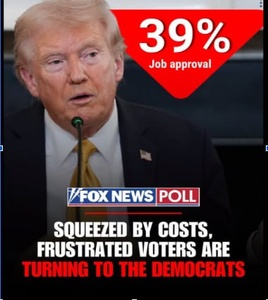
WASHINGTON — A new poll puts President Donald Trump’s job approval at 39%, while voters increasingly identify the cost of living as their most important concern ahead of the November midterm elections.
The 39% Figure
The survey, conducted September 11–14 among 1,211 registered voters, found 39% approving of Trump’s job performance and 61% disapproving. The poll carries a ±3 percentage-point margin of sampling error.
Trump’s approval in the survey has remained below 40% since April. His rating was 42% in April before falling back to 39% in the latest measurement.
The poll also found Trump’s strongest issue rating was immigration, at 43%, while 24% approved of his handling of inflation, matching a previous low in the survey.
Those numbers come as voters report continued pressure from everyday expenses, particularly gasoline, groceries, healthcare and housing.
The Cost-of-Living Problem
The Fox survey found 34% of voters independently named the cost of living as the country's most important issue, followed by 14% citing the economy or jobs.
Gasoline prices were considered a major problem by 61% of respondents, while 62% said grocery prices were a major problem. Housing costs concerned 54%, and healthcare costs 52%.
Economic pessimism extends beyond individual prices. Nearly three-quarters of voters have rated economic conditions negatively during the past year, according to the survey.
Meanwhile, 63% said the Trump administration had made the economy worse, including approximately one-quarter of Republican respondents, according to the same poll.
Democrats Gain Ground on Inflation
The poll found voters giving Democrats a 15-point advantage when asked which party would better handle inflation, reversing a Republican advantage that existed several years earlier.
Democratic ratings on inflation improved by five points since July, although the survey indicates that this shift does not necessarily represent confidence in Democratic economic policies.
Among voters who preferred Democrats on inflation, 51% attributed that preference to perceived Republican failures, while 47% cited confidence that Democratic policies could reduce prices.
The distinction is important: the poll measures which party voters trust more on an issue, rather than demonstrating that voters universally support one party's proposed policies.
Broader Economic Anxiety
The Fox findings arrive alongside other measures showing substantial economic uncertainty among American households.
The Conference Board reported that consumer confidence fell sharply in September to 81.9, its lowest level since April 2014, amid concerns about prices, employment and future economic conditions.
Reuters reported that gasoline prices, higher mortgage rates and continuing concerns about employment have contributed to the deterioration in consumer sentiment heading into the midterm elections.
Trump himself acknowledged the political difficulty surrounding the economy on September 30, saying he had done a “very bad job” explaining what he considers his administration's economic achievements.
The president also said he planned an extensive campaign schedule for Republican candidates, arguing that his administration's economic record had not been communicated effectively enough to voters.
The Midterm Connection
The Fox survey also measured preferences for congressional candidates. Among all registered voters, 51% said they would support the Democratic candidate in their House district, compared with 44% for the Republican candidate.
Among voters who said they were certain to vote, the Democratic candidate led 54% to 43% in the survey. These figures describe the poll's snapshot, not an election outcome prediction.
Political attitudes remain sharply divided, however. The same survey found both major parties receiving negative overall favorability ratings, with neither enjoying broadly positive public sentiment.
Trump's own approval also remains significantly stronger among Republicans than among the electorate as a whole, illustrating how national averages can conceal substantial differences between partisan groups.
One Poll Does Not Tell the Whole Story
Other recent surveys have produced different measurements of Trump's overall approval, underscoring why individual polls should not be treated as definitive assessments of public opinion.
For example, a September Marquette Law School national survey measured Trump's approval at 37% among adults, while 63% disapproved of his job performance.
A separate Marist survey of registered voters reported 39% approval and 59% disapproval, producing a similar overall picture but with different methodology and field dates.
The latest AP-NORC survey also found particularly weak public ratings for Trump's handling of the cost of living and economy, although its overall approval measurement was lower than the figure.
What the Numbers Reveal
Across these surveys, the precise approval percentage varies, but economic concerns repeatedly appear as an important part of Americans' assessments of the administration.
For Trump and Republican candidates, the political significance of those economic perceptions will become clearer as campaigns focus increasingly on household finances, gasoline prices, inflation and employment.
For Democrats, the Fox poll shows greater trust on inflation and several other issues, but it also records unfavorable views of the Democratic Party itself.
That creates a complicated political environment in which dissatisfaction with the current administration does not automatically translate into enthusiasm for its opponents.
With the November 3 midterms approaching, the central question is increasingly how voters will connect their everyday economic experiences with their judgments about the parties competing for Congress.
Comments (0)
Loading comments...
May You Like

Russian Drone Strikes Kyiv Bridge as German Chancellor Arrives in Ukraine
OBAMA STUNS ON INSTAGRAM: MESSAGE MARKING 34-YEAR MILESTONE SPARKS A BUZZ

South Korea–Ukraine Rift Deepens Over North Korean POW Transfer as PURL Draws New Scrutiny