
The Pentagon’s AI Advantage Is Reshaping Modern Warfare
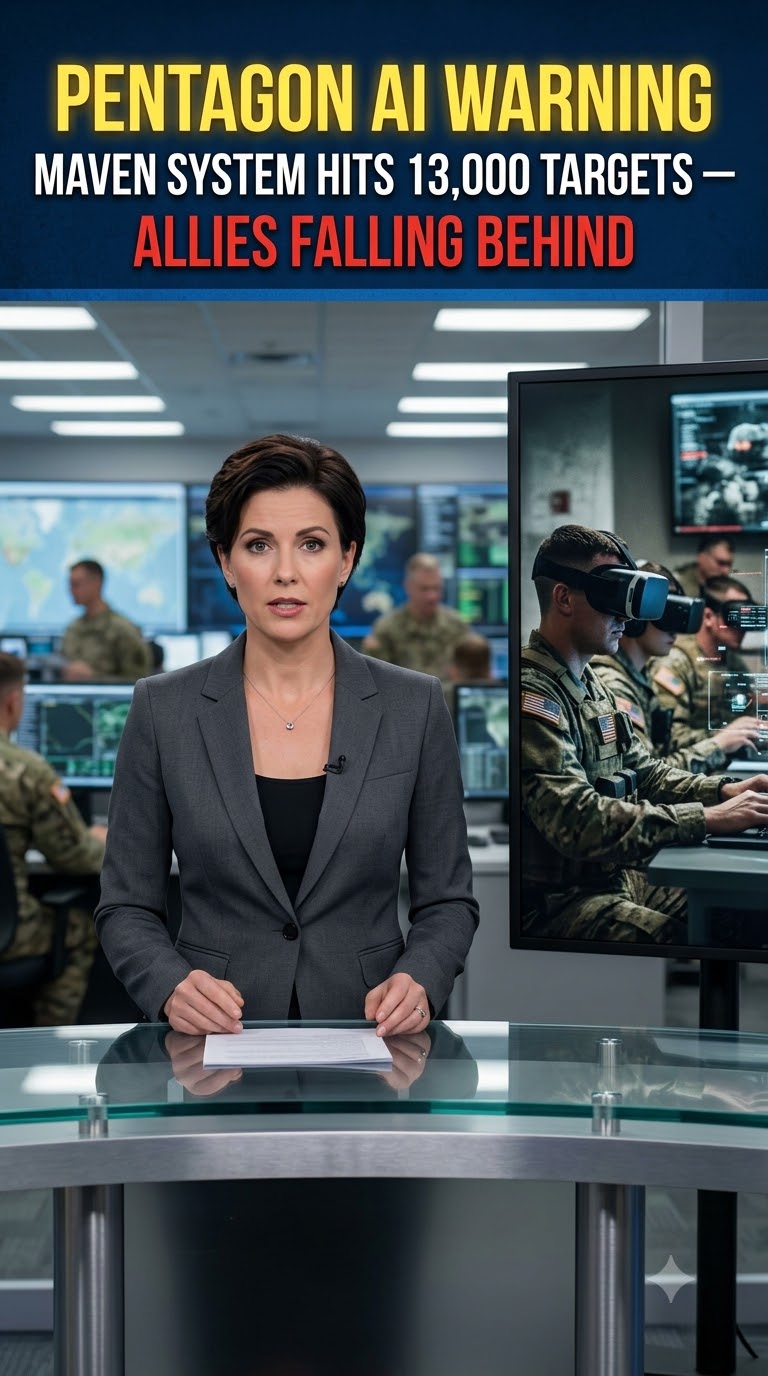
WASHINGTON — The Pentagon is warning that one of America’s biggest military advantages in the emerging artificial intelligence race may be difficult for even its closest allies to match.
Cameron Stanley, the Defense Department’s chief digital and artificial intelligence officer, said this week that U.S. allies simply do not have the same resources, experience or scale available to the American military when it comes to deploying AI.
“They don't have the resources that we do, they don't have the experience that we do, they don't have the scale that we do,” Stanley said at the Billington Cybersecurity Summit.
The comments offer a revealing look at how quickly artificial intelligence has moved from an experimental technology inside the Pentagon to a tool being integrated into real military operations.
And nowhere has that transformation been more visible than in the U.S. campaign against Iran.
AI Moves From the Lab to the Battlefield
One of the systems at the center of that transformation is the Maven Smart System, an AI-enabled military platform developed by Palantir.
Originally launched as Project Maven in 2017, the program was designed to help the military process enormous amounts of intelligence data, including imagery and other battlefield information, and identify objects or potential targets much faster than human analysts could do alone.
Over time, Maven evolved into a broader battlefield information and command platform.
During the 2026 war with Iran, the system became a major part of the U.S. military's operational architecture.
Stanley said Maven helped support the targeting process for more than 13,000 targets during the first 38 days of the campaign. The broader figure of more than 13,000 Iranian targets has also been reported by the Associated Press based on statements from senior U.S. military officials.
The significance is not simply the number of targets.
It is the speed at which information can move from detection to decision.
Military analysts traditionally have to gather information from multiple sensors and databases, evaluate it, identify potential targets, determine what weapons might be appropriate and coordinate with commanders.
AI systems can compress much of that process by bringing large quantities of information into a common operational picture.
That is what makes Maven potentially transformative.
The “Kill Chain” Is Getting Faster
Modern military operations depend heavily on what defense officials call the kill chain — the sequence that moves from finding a potential target to deciding what action should be taken.
Maven is designed to shorten that chain.
Earlier versions of the system focused heavily on computer vision and intelligence analysis. The platform has since expanded into a much broader system capable of combining battlefield information and helping commanders understand what is happening across multiple domains.
A 2026 investigation by WIRED described how Maven had become deeply embedded across U.S. military operations, with tens of thousands of American personnel using the system. The reporting also found that AI-assisted targeting had dramatically increased the number of targets military teams could process.
That speed matters in a modern conflict where drones, missiles, satellites and electronic sensors can generate more information than human teams can reasonably process.
But it also creates a difficult question:
How fast should a military allow AI to influence decisions that can ultimately result in lethal force?
Humans Still Make the Final Decision
The Pentagon maintains that AI does not independently decide which targets should be destroyed.
Human operators remain responsible for reviewing and approving lethal actions.
That distinction is important.
Maven can help identify objects, organize intelligence, prioritize information and connect commanders with available weapons and units. But the system is not supposed to replace human responsibility for the decision to strike.
Still, the increasing speed of the technology is changing the nature of that human role.
When AI can present thousands of potential targets in a fraction of the time required by traditional methods, commanders are no longer simply reviewing a handful of recommendations.
They may be supervising an entire machine-assisted targeting ecosystem.
That creates new risks involving errors, misleading data, cyberattacks and the possibility that an AI system could misidentify an object or produce an incorrect recommendation.
Those concerns became especially intense after a U.S. strike in Minab, Iran, that Iranian officials said killed at least 168 people, including many children. More than 120 members of Congress subsequently demanded answers from the Pentagon about civilian casualties and the use of AI in military operations.
America’s Allies Face a Different Problem
Stanley’s warning was not simply about technology.
It was also about resources.
The United States has enormous advantages in computing infrastructure, defense spending, satellite networks, intelligence collection and access to private-sector AI companies.
Many U.S. allies do not have the same scale.
Stanley said the Pentagon is working with NATO and Five Eyes partners — including Britain, Canada, Australia and New Zealand — to help them develop AI capabilities without repeating mistakes Washington made during its own rapid expansion into military AI.
That creates a potentially significant gap inside America's alliance network.
If the United States develops battlefield AI significantly faster than its partners, military interoperability could become more complicated rather than easier.
The Pentagon therefore faces a balancing act: maintain America's technological lead while ensuring allies can operate alongside U.S. forces.
AI Is Becoming a Military Infrastructure
The Pentagon's AI ambitions extend far beyond targeting.
Stanley said the Defense Department has also rolled out GenAI.mil, an internal generative-AI platform that he says has reached approximately 1.7 million users.
Another system, known as Agent Network, is designed to shorten the time between gathering intelligence and making command decisions.
The broader goal is to make AI part of everyday military operations rather than treating it as a specialized experiment.
That could eventually mean AI assisting with logistics, intelligence analysis, battlefield communications, planning, surveillance and decision-making across virtually every major military command.
For the Pentagon, the objective is increasingly clear: move faster than potential adversaries.
The New Military AI Race
The United States is not the only country pursuing military AI.
China, Russia and other major powers are investing heavily in autonomous systems, drones, battlefield analytics and AI-enabled command networks.
That means Washington increasingly sees military AI as part of the broader competition for technological and strategic superiority.
But the Pentagon's experience in Iran may prove to be an important turning point.
The conflict demonstrated that AI is no longer something military planners can discuss only in laboratories or future-war scenarios.
It is already being integrated into an active war.
The central question now is whether the United States can maintain its technological advantage while developing the safeguards, training and human oversight necessary to prevent speed from becoming a liability.
America may currently have the largest military AI ecosystem in the world.
But as the Pentagon itself acknowledges, the next stage of the AI arms race will not simply be about who has the most advanced technology.
It will be about who can deploy it fastest — and who can control it most effectively when the stakes are life and death.
Comments (0)
Loading comments...
May You Like

Jack Smith Defends His Integrity as Trump Investigations Face Renewed Political Firestorm

Obama Steps Back Into the Political Spotlight as Democrats Target Trump’s Senate Majority

FIGHT OVER OBAMA’S IRAN POLICY













