
“THE PHILIPPINES WILL BE THE ONLY AMERICAN COLONY IN ASIA,” TRUMP SAYS AFTER FLAGS BURN IN MANILA!
“THE PHILIPPINES WILL BE THE ONLY AMERICAN COLONY IN ASIA,” TRUMP SAYS AFTER FLAGS BURN IN MANILA!
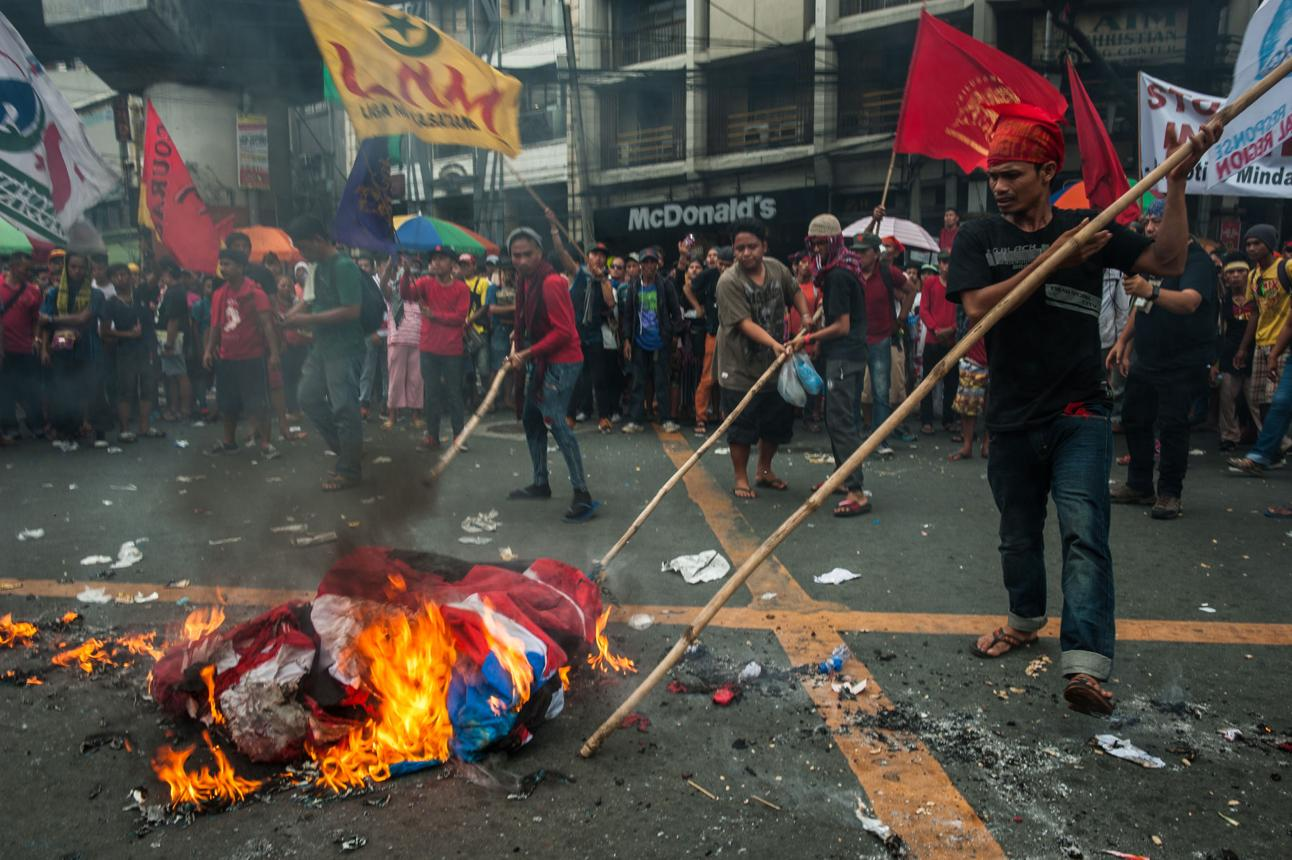
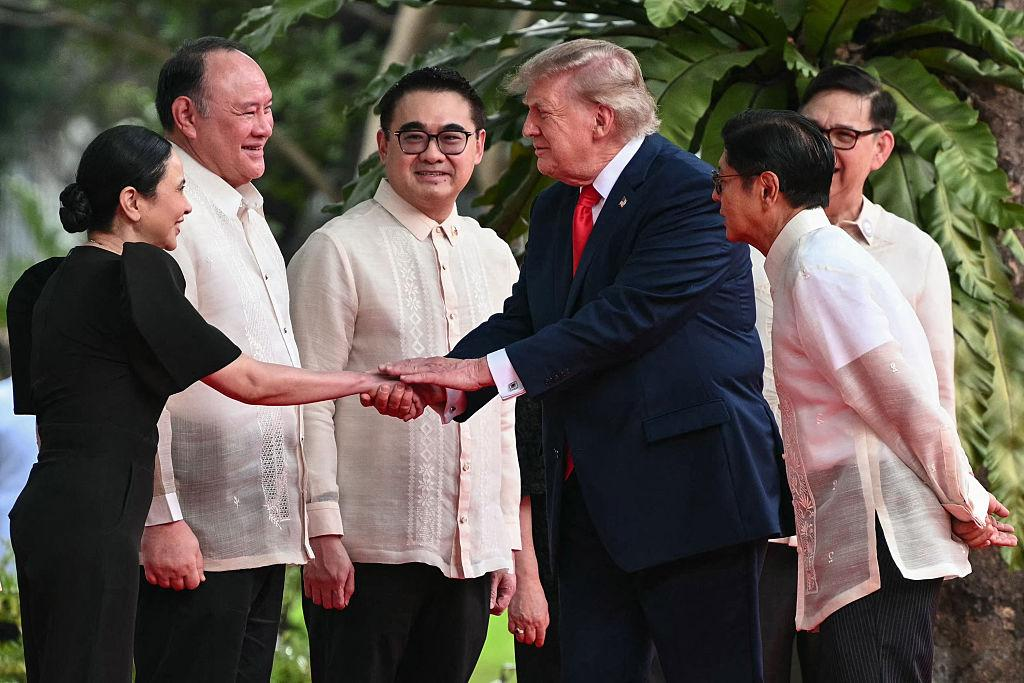
MANILA, Philippines — November 19, 2026 — American flags burned on the streets of Manila as protesters challenged President Donald Trump's visit to the Philippines, bringing longstanding disputes over national sovereignty, military cooperation and economic development into the spotlight. The demonstrations coincided with Trump's meeting with President Ferdinand Marcos Jr. during a major Southeast Asian diplomatic summit.
The November 18 protest unfolded near Malacañang Palace, where Philippine authorities had established a security perimeter around the visiting American president.
Organizers estimated that more than 2,000 people joined the demonstration, although that figure was not independently verified.
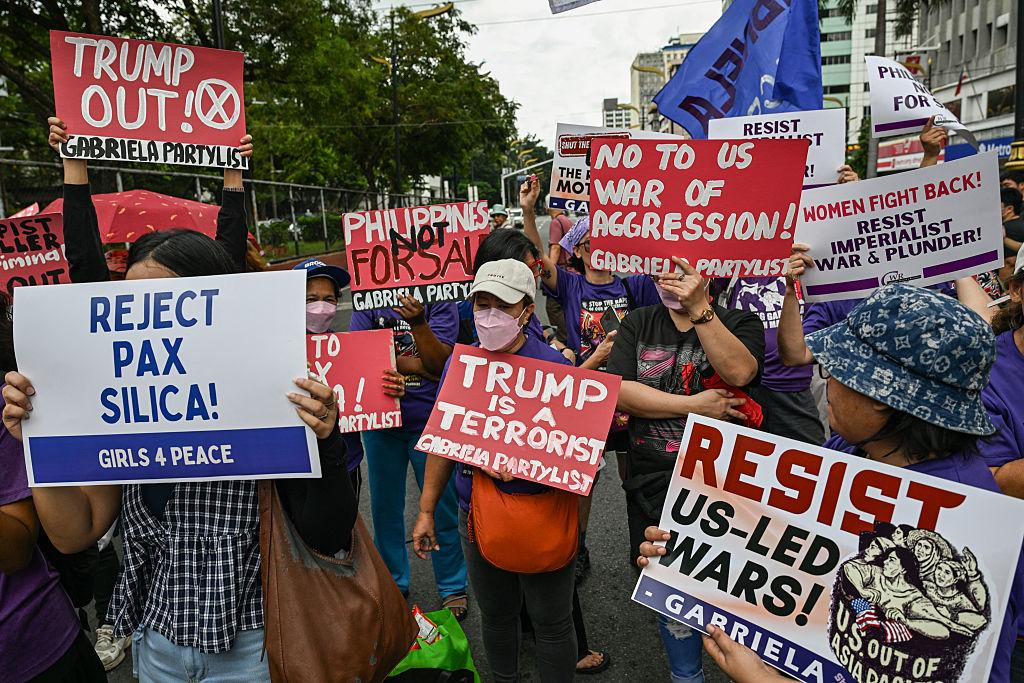
Protesters opposed Trump's visit, the U.S.-led Pax Silica technology initiative and what they described as excessive American influence over Philippine affairs.
The burning of American flags was documented by local news organizations and international photographers.
The confrontation also revived a historical question: how much influence should Washington exercise over a country it once governed as a colonial power?
Trump's documented remarks during the visit emphasized cooperation with the Philippines, including defense and energy. The available public record does not establish that he announced a plan to turn the country into an American colony.
The march began as Trump participated in meetings connected to the 49th Association of Southeast Asian Nations summit.
Demonstrators gathered in central Manila and attempted to move toward Mendiola, a traditional protest area near the presidential palace.
Police stopped the march along Recto Avenue at San Sebastian Street.
The crowd continued its demonstration behind the barricades.
According to GMA News, BAYAN Secretary-General Raymond Palatino said more than 2,000 people participated in the rally.
He criticized the police restrictions and described the protest as successful despite being prevented from reaching its intended destination.
The march reflected organized opposition to the American president's policies and the Philippine government's relationship with Washington.
It did not represent an official change in the Philippines' foreign policy.
Inside Malacañang, Marcos continued the diplomatic program with Trump.
Outside, protesters expressed a sharply different view of the relationship.
The flag burning was a deliberate political gesture.
Palatino told GMA News that demonstrators burned an American flag when Trump arrived at the palace.
Photographs distributed through Reuters Connect showed a burning U.S. flag on Recto Avenue.
The images captured one of the most recognizable moments of the demonstration.
For participating activists, the flag symbolized opposition to American military influence and economic policies.
The act also drew on a longer tradition of anti-colonial political expression in the Philippines.
However, the meaning of a protest symbol should not be confused with a formal government decision.
Burning a flag did not end the U.S.-Philippine alliance or change the country's constitutional status.
It was an expression of political opposition by demonstrators, not a declaration issued by the Philippine state.
Philippine police established substantial barriers around roads leading toward Malacañang.
GMA News reported that officers positioned container vans and barbed wire along Recto Avenue near San Sebastian Street.
Other roads were closed, forcing motorists and commuters to use alternative routes.
The security arrangements formed part of a larger operation to protect the ASEAN summit and visiting leaders.
Associated Press reported that nearly 23,000 security personnel had been deployed during the summit period.
Authorities faced the responsibility of securing diplomatic venues while managing demonstrations.
Protest organizers argued that the restrictions interfered with their ability to express political opposition.
The disagreement centered on the balance between public safety and freedom of assembly.
It also became part of the broader criticism directed at the Philippine government during Trump's visit.
The demonstrators did not reach the presidential palace.
Instead, they held a program along Recto Avenue after encountering the police barricades.
Participants displayed banners and chanted slogans against Trump's visit.
Their messages focused on foreign military influence, the Pax Silica initiative and the rights of communities potentially affected by industrial development.
The physical separation between the protest and the presidential meeting produced two contrasting scenes.
One showed diplomatic engagement between the leaders of two treaty allies.
The other showed Filipino activists challenging the political and economic consequences of that relationship.
Both scenes occurred during the same visit.
The demonstrations were therefore not evidence that the Philippine government had rejected Washington.
They demonstrated that the relationship remains contested within Philippine society.
The Philippines has a direct historical connection to American colonial rule.
After the Spanish-American War, Spain ceded the Philippines to the United States under the 1898 Treaty of Paris.
Filipino resistance to American control led to the Philippine-American War, beginning in 1899.
The conflict caused substantial loss of life and became a defining episode in the country's struggle for independence.
The Philippines later developed institutions of self-government while remaining under American sovereignty.
In 1935, the Commonwealth of the Philippines was established as part of a transition toward independence.
The country became fully independent on July 4, 1946.
That history gives the word colony a particular political significance.
It is not simply a description of foreign influence.
It refers to a system in which one state exercises sovereignty over another territory.
Independence did not end the relationship between Manila and Washington.
The two countries signed a Mutual Defense Treaty in 1951.
The treaty established a framework for cooperation in responding to armed attacks in the Pacific region.
Subsequent agreements supported military training, exercises and other defense arrangements.
The relationship has experienced periods of tension and renegotiation.
Philippine leaders have differed over the appropriate extent of American military involvement.
Nevertheless, the two countries continue to cooperate on security and economic issues.
That modern relationship is fundamentally different from colonial administration.
The Philippines has its own constitution, elected government, diplomatic service and authority over its foreign policy.
Disagreements about American influence are politically significant, but they do not make the Philippines a U.S. colony.
The American president's public remarks emphasized the strength of the alliance.
Reuters reported that Trump announced expanded defense cooperation with the Philippines and cited more than $5 billion in approved arms sales.
He also discussed possible cooperation on civilian nuclear energy and a proposed natural gas export project in Alaska.
Trump described the bilateral relationship as stronger than ever.
His statements presented the Philippines as a treaty ally and potential economic partner.
They did not announce a change in Philippine sovereignty.
The distinction is central to the controversy.
A commitment to expand military cooperation can be debated on its merits, but it is not equivalent to a declaration that another country will become a colony.
The documented remarks concern defense, energy and trade rather than territorial control.
One of the largest figures mentioned during the visit involved military equipment.
Trump said the United States had approved more than $5 billion in arms sales to the Philippines.
Approved sales are not necessarily the same as completed deliveries.
Military purchases may involve contracts, financing arrangements, production schedules and subsequent transfers.
The figure nevertheless illustrates the scale of defense cooperation discussed by the two governments.
For supporters of the alliance, access to American military equipment can strengthen the Philippines' ability to defend its territory and maritime interests.
For critics, reliance on foreign defense systems can create long-term financial and strategic dependencies.
Those are competing assessments of the same policy relationship.
Neither interpretation changes the legal fact that the Philippines remains an independent state.
The Philippines and China have longstanding disputes over maritime claims in the South China Sea.
Philippine vessels have faced confrontations with Chinese ships in waters claimed by Manila.
The United States has repeatedly reaffirmed its treaty commitments to the Philippines.
These developments make military cooperation an important part of bilateral discussions.
During the November 18 meeting, Trump said he was not concerned about the situation in the disputed waters and expressed confidence in the alliance.
His remarks did not resolve the underlying maritime disputes.
Nor did they announce a new territorial arrangement.
The question for Philippine policymakers remains how to protect national interests while managing relations with the United States, China and neighboring countries.
That issue has direct implications for defense spending, diplomacy and regional stability.
Trump also raised the possibility of American participation in a Philippine civilian nuclear power project.
The proposal was presented as a potential way to strengthen economic and technological cooperation.
The Philippines has faced energy-security challenges, including exposure to international fuel prices.
Nuclear power could provide an additional source of electricity if a project were developed and operated successfully.
However, a statement of interest is not the same as a completed agreement.
A nuclear energy project would require substantial planning, financing, regulation and safety arrangements.
Other countries have also expressed interest in cooperation with Manila on nuclear technology.
The discussions therefore represent a possible area of future collaboration, not evidence of exclusive American control over the Philippine energy sector.
Another subject discussed by Trump was a planned natural gas export project in Alaska.
The president described the Philippines as a potential partner.
The proposal reflects the country's interest in securing energy supplies and Washington's interest in expanding American energy exports.
Liquefied natural gas can be transported internationally by specialized ships.
Importing countries may use it for electricity generation and industrial activity.
However, any future arrangement would depend on commercial negotiations, infrastructure and market conditions.
The existence of discussions does not establish that a supply contract has been signed.
It also does not transfer control over Philippine energy policy to Washington.
The project illustrates how the two countries are considering closer economic cooperation while remaining separate sovereign governments.
Pax Silica is a U.S.-led initiative focused on advanced technology supply chains.
Its areas of interest include semiconductors, artificial intelligence infrastructure and critical minerals.
The initiative aims to strengthen cooperation among participating countries and reduce vulnerabilities in strategically important industries.
For the Philippine government, such cooperation could create opportunities for investment, manufacturing and employment.
For opponents, the proposed arrangements raise questions about who controls resources and who benefits from development.
The controversy became especially intense around plans for a technology manufacturing hub in Capas, Tarlac province.
Protesters connected that proposal to concerns about land rights, environmental effects and the influence of foreign governments over domestic development decisions.
Human Rights Watch reported that protests began on November 15 in opposition to the planned technology hub.
The organization said the project could displace Indigenous people and small farmers from their homes and farmland.
Those concerns helped bring rural communities and advocacy groups into the wider demonstrations.
Large industrial developments require land, infrastructure and access to resources.
They can create employment opportunities but may also generate disputes over existing land use.
The central questions include whether affected residents have been adequately consulted and how their rights will be protected.
The answers depend on project plans, land records and the legal processes governing development.
For protesters, the issue was not simply whether the United States and the Philippines should cooperate economically.
It was whether the cooperation would protect communities directly affected by the proposed project.
Advanced technology supply chains have become increasingly important to international economic policy.
Semiconductors are used in electronics, vehicles, communications equipment and industrial systems.
Critical minerals are essential for numerous manufacturing and energy technologies.
Countries seeking greater supply-chain resilience may support investment in processing, manufacturing and related infrastructure.
The Philippines could potentially benefit from participation in these industries.
However, the economic results would depend on whether investment materializes and whether the projects are commercially viable.
Projected jobs should not be confused with employment already created.
Similarly, a government-backed development plan does not automatically resolve disputes over land or environmental protection.
Those uncertainties explain why the Pax Silica initiative attracted both government support and organized opposition.
The November 18 flag burning followed several days of demonstrations during the ASEAN summit.
Human Rights Watch reported that approximately 6,000 people participated across the broader protest period.
That estimate covered multiple events rather than only the march near the presidential palace.
Demonstrators included activists concerned about land rights, military cooperation and civil liberties.
Some protests involved efforts to march toward summit venues.
Others used speeches, banners and symbolic displays.
The movement brought together several political concerns under opposition to Trump's visit.
The different groups did not necessarily share identical priorities.
However, they converged on the view that the Philippine government should reconsider aspects of its relationship with Washington.
Human Rights Watch reported that Philippine police arrested or detained at least 245 people during the demonstrations.
The organization said 236 people were detained while traveling from the Southern Tagalog region toward the main protest site.
Among those detained were farmers, journalists, environmental defenders and human rights workers, according to its account.
The organization also reported that children were among those held.
It questioned the legality of the mass arrests and urged authorities to release people detained solely for peaceful assembly.
The reported detentions became an additional focus of the protests.
Activists demanded that police respect civil liberties and allow demonstrations to proceed.
These concerns were separate from the original disagreements over U.S. policy, but they became part of the same political confrontation.
The Philippine Commission on Human Rights raised concerns about reports of minors being arrested and demonstrators suffering injuries.
It also examined complaints concerning detention conditions.
Local reporting said commission representatives initially faced difficulties accessing a police detention facility.
The commission emphasized the need for police to observe legal safeguards and exercise restraint.
Its concerns did not establish that every arrest was unlawful.
Instead, they identified matters requiring investigation.
Police retain authority to respond to specific unlawful conduct during demonstrations.
But peaceful assembly is also protected by human rights principles and domestic legal standards.
The distinction matters because the behavior of one participant cannot automatically justify treating an entire protest as criminal.
The handling of detainees became one of the most immediate legal questions arising from the summit demonstrations.
The ASEAN summit brought numerous foreign leaders and delegations to Manila.
Protecting visiting officials required a large security operation.
Authorities established restricted areas and controlled access to important routes.
Those measures affected demonstrators as well as commuters and motorists.
GMA News reported road closures near Mendiola and other locations associated with the summit.
Some passengers had to walk after vehicles were diverted.
The restrictions demonstrated how international diplomatic events can affect everyday activity in a host city.
Police had a responsibility to protect the summit.
Protesters argued that the security measures went beyond what was necessary.
Assessing that disagreement requires examining the actual threats, restrictions and actions of those involved.
The public record does not support treating every security measure as either automatically justified or automatically unlawful.
Burning a flag can attract international attention because of its symbolic meaning.
The U.S.-Philippine Mutual Defense Treaty remains a formal agreement between the two governments.
Changing or terminating such arrangements involves legal and diplomatic processes.
The November 18 demonstration did not constitute such a process.
Nor did the act of burning American flags establish that the Philippine government had withdrawn its support for the alliance.
Trump and Marcos continued their official discussions during the visit.
Reuters reported that the American president emphasized stronger defense cooperation rather than a reduction in ties.
A declaration that the Philippines would become an American colony would represent an extraordinary claim about sovereignty.
It would be fundamentally different from announcing defense cooperation or investment.
The Philippines is a sovereign republic with its own government and constitution.
A change in that status could not be established merely through an informal remark or a social media post.
Such a claim would require clear evidence of an official policy announcement and an explanation of the legal basis being asserted.
The public statements instead describe a continuing alliance between two independent countries.
This distinction is particularly important because the Philippines' history of American colonial rule gives the allegation substantial emotional and political weight.
The documented agenda provides a clearer explanation for the tensions than the suggestion of a hidden colonial plan.
Washington and Manila were discussing defense cooperation, arms sales, energy and technology.
Protesters were concerned about the consequences of those arrangements.
The Pax Silica initiative generated objections related to land rights and industrial development.
Military cooperation raised questions about national sovereignty and regional security.
Those issues were openly discussed by officials, journalists and protest organizers.
They do not establish a secret agreement to change Philippine sovereignty.
Nor do they show that Trump threatened colonial rule in response to the flag burning.
The verified evidence points to a dispute over policy and influence rather than a documented territorial demand.
The allegation draws attention because it connects a contemporary diplomatic dispute with a painful historical experience.
American colonial rule remains part of Philippine national history.
Questions about foreign influence have therefore carried political significance for generations.
A claim that the country could become a colony again would naturally raise concerns about independence and self-government.
But the historical significance of the allegation makes accurate evidence especially important.
A political relationship can involve unequal resources, competing interests and disputes over influence without becoming colonial administration.
Those concerns can be examined through actual agreements, funding arrangements and policy decisions.
They do not require an unsupported claim that one government has announced sovereignty over another.
The immediate aftermath involves several continuing issues.
Philippine authorities face scrutiny over the arrests and treatment of protesters during the summit.
The proposed Pax Silica development remains subject to questions about its impact on communities in Tarlac.
The governments of the United States and the Philippines must determine how to advance any proposed defense and energy cooperation.
Those decisions will involve negotiations, legal requirements and domestic political debate.
The flag burning did not settle any of these questions.
It brought them into international view.
The longer-term significance of the demonstrations will depend on whether the concerns raised by protesters influence future decisions.
The bilateral alliance remains in place, and the Philippine government continues to exercise its own sovereign authority.
The central facts are clear.
Protesters burned American flags near the Philippine presidential palace during Trump's visit.
Police prevented marchers from reaching Mendiola.
Activists opposed the Pax Silica initiative, U.S. military influence and other policies associated with the visit.
Human rights organizations reported hundreds of detentions during the wider summit protests.
Trump publicly discussed expanded defense cooperation and potential energy projects with Marcos.
The evidence does not establish that he declared the Philippines a future American colony.
It also does not establish that the flag burning triggered a secret American plan to take control of the country.
The documented dispute concerns the extent and consequences of U.S. influence over an independent treaty ally.
That is a substantial political issue without the need to attribute an unsupported territorial threat to the American president.
The Manila demonstrations exposed a continuing disagreement over how the Philippines should manage its relationship with the United States.
For protesters, the issues include national sovereignty, land rights, economic independence and the presence of American military influence. For the Philippine government, cooperation with Washington remains an important part of its defense and economic agenda.
Trump's public remarks on November 18 focused on expanding that cooperation.
The burning flags became a symbol of opposition, but the historical and political dispute extends well beyond the streets surrounding Malacañang.
Comments (0)
Loading comments...
May You Like

IOWA ENVIRONMENTAL DISASTER: 5-TON WASTE BLAST DISPLACES 3,000 FAMILIES!


PACIFICA PIER IN CALIFORNIA COLLAPSE REVEALS MASSIVE CRACK BENEATH THE OCEANs!









Popular Posts





