The Real Story Behind the Trump-Taliban 'Photo of His Home' Threat — Separating Fact From Viral Fiction
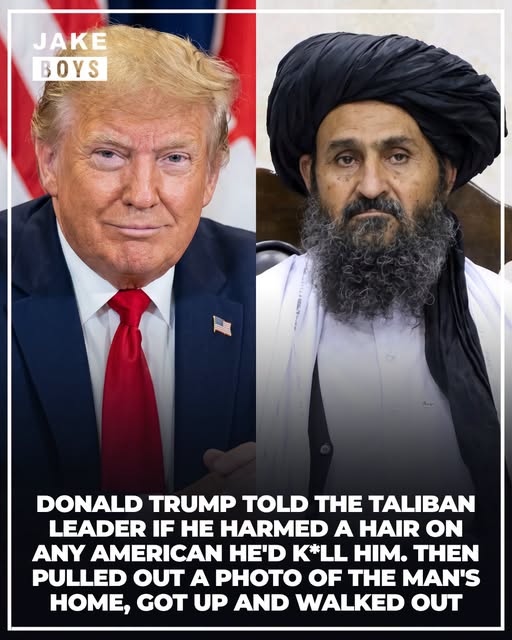
A viral graphic claims President Donald Trump once told a Taliban leader that if he harmed a single American, he would kill him — then pulled out a photo of the man's home, got up, and walked out. The dramatic story has been shared widely, but the official record tells a different, more complicated story.
WASHINGTON – A striking image circulating on social media features President Donald Trump alongside Mullah Abdul Ghani Baradar, the co-founder of the Taliban, with text claiming Trump delivered a chilling face-to-face threat during negotiations. The post has amassed thousands of shares, with many commenters praising Trump's hardline approach.
But what actually happened during those negotiations? The answer lies somewhere between viral legend and diplomatic reality.
The Viral Claim: A Hollywood-Style Showdown
The graphic reads: "DONALD TRUMP TOLD THE TALIBAN LEADER IF HE HARMED A HAIR ON ANY AMERICAN HE'D K*LL HIM. THEN PULLED OUT A PHOTO OF THE MAN'S HOME, GOT UP AND WALKED OUT."
The story is vivid, cinematic, and emotionally satisfying — a scene of American strength and intimidation. According to viral accounts, the specific face-to-face version of the tale was popularized by Rep. Wesley Hunt, who recounted the dramatic showdown to highlight Trump's intense negotiation tactics .
But the official record tells a different story.
What Actually Happened: The March 2020 Phone Call
On March 3, 2020, President Donald Trump held a 35-minute telephone conversation with Mullah Abdul Ghani Baradar — the first known conversation between a sitting U.S. president and a Taliban leader .
The call came just days after the U.S. and the Taliban signed a historic agreement in Doha, Qatar, aimed at ending America's longest war. Under the deal, the U.S. committed to a phased withdrawal of troops, contingent on Taliban counterterrorism commitments .
According to a Taliban spokesman's readout of the call, Baradar told Trump: "It is the inherent right of the Afghans that all the points of this agreement are implemented as soon as possible so that peace may come to Afghanistan." He also urged Trump to "not allow anyone to take actions that violate the terms of the agreement thus embroiling you even further in this prolonged war" .
Trump, speaking to reporters afterward, described the conversation warmly: "We had a very good conversation with the leader of the Taliban today. They're looking to get this ended, and we're looking to get it ended... the relationship is very good that I have with the Mullah. We had a good, long conversation today" .
No Photo, No Walkout
There is no evidence in the official record — from the Taliban readout, the U.S. government, or credible news reports — that Trump pulled out a photograph of Baradar's home, threatened to kill him, or abruptly walked out of a meeting .
The call was conducted remotely, with Baradar based in Doha, Qatar . There was no face-to-face meeting, no dramatic gesture, and no dramatic exit.
The viral story appears to be an embellishment — a legend that has grown around an already unconventional diplomatic moment.
What Was Real: A 'Very Good Relationship'
What was real was the unprecedented nature of the call itself. James Dobbins, a former U.S. special representative for Afghanistan and Pakistan, said he was confident no prior U.S. president had ever spoken directly with a Taliban leader. He attributed the call to Trump's "showmanship" .
"Talking to the president is... a major deliverable," Dobbins said. "Prior administrations would consider this selling one's self cheaply, or selling a considerable asset at considerably below value" .
The call was part of Trump's broader push to end the war in Afghanistan, which he had made a priority. The Doha agreement called for a phased U.S. withdrawal if the Taliban kept its commitments, with intra-Afghan talks scheduled to begin on March 10, 2020 .
The Bottom Line
| What the Viral Story Claims | What the Official Record Shows |
|---|---|
| Trump threatened to kill the Taliban leader | No evidence of any death threat |
| Trump pulled out a photo of Baradar's home | No record of any such gesture |
| Trump "got up and walked out" | The call was by phone, not in person |
| The story is being presented as factual | It appears to be a viral embellishment popularized by Rep. Wesley Hunt |
The Trump-Baradar phone call was genuinely historic — the first direct conversation between a U.S. president and a Taliban leader. But the viral version, with its threats and dramatic gestures, is not supported by the facts.
In the world of viral political content, dramatic stories often outpace the truth. This one is no exception.
Comments (0)
Loading comments...
May You Like
OBAMA STEPS BACK INTO THE POLITICAL SPOTLIGHT
Jack Smith Defends His Integrity as Trump Investigations Face Renewed Political Firestorm
TRUMP HIT WITH 26 ARTICLES OF IMPEACHMENT