The Republican Party will lose: warning signs ahead of the election
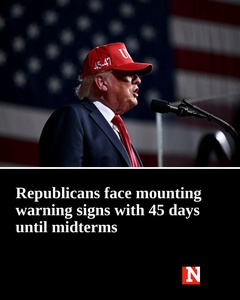
With Midterms Closing In, What Warning Signs Are Republicans Facing?
WASHINGTON — With the November 3 midterm elections approaching, Republicans are confronting several political and economic pressures that could influence contests for control of Congress.
A Narrow Congressional Majority
Republicans currently control the White House and both chambers of Congress, but their congressional majorities remain relatively narrow, leaving competitive House and Senate races especially important this fall.
National polling has recently shown Democrats holding an advantage on congressional preferences, although such surveys measure nationwide sentiment rather than determining individual House or Senate outcomes.
A Marquette Law School poll conducted in September found 54% of likely voters choosing Democratic congressional candidates, compared with 41% choosing Republican candidates on the generic ballot.
That represented a wider Democratic advantage than the same survey recorded in July, when Democrats led Republicans 51% to 45% among likely voters nationwide.


What the Polling Shows
A separate September survey from the Cook Political Report found Democrats ahead 49% to 47% among likely voters across 37 competitive House districts included in its battleground study.
Those figures provide snapshots of voter preferences rather than predictions, because turnout, individual candidates, local issues and late campaign developments can substantially alter individual congressional contests.
President Donald Trump remains central to the Republican campaign, repeatedly encouraging his supporters to view the midterms as an opportunity to reinforce his administration's agenda.
At the Republican midterm convention in Dallas, Trump told supporters to “pretend” he was on the ballot, underscoring his continuing role in the party's campaign strategy.
Yet some Republican candidates in competitive races have publicly differed with Trump on tariffs, military action against Iran, agricultural policies and other issues affecting their states.
Economic Pressure
Affordability has become another important campaign issue, with Republicans facing criticism over gasoline prices, food costs and broader household expenses during the closing weeks before voting.
A September Reuters/Ipsos poll found Trump's approval rating at 35%, while 44% of respondents preferred Democratic candidates on the generic congressional ballot, compared with 37% for Republicans.
The same survey found 63% of Americans, including 40% of Republicans, opposed Trump's proposal for a $5,000 dividend if Republicans retain control of Congress.
The administration's handling of the conflict with Iran has also become politically significant as disruptions to energy supplies have contributed to higher gasoline prices and broader economic concerns.


Republicans Face Different Challenges Across Races
Republicans are defending congressional seats in states and districts where Trump performed strongly in 2024, but individual candidates face different political environments because congressional races are decided separately.
The Wall Street Journal reported that several Republicans in competitive races have attempted to distance themselves from specific Trump policies, rather than breaking completely with the president.
Democrats are seeking to capitalize on dissatisfaction with the governing party while simultaneously navigating internal disagreements over ideology, candidate selection and campaign messaging.
The House battlefield is particularly fragmented, with dozens of competitive districts potentially determining which party controls committees, investigations and the chamber's legislative agenda.
What Control of Congress Could Mean
If Democrats take control of the House, they would gain greater authority over committees and congressional investigations, potentially increasing oversight of the Trump administration.
The Senate presents a different electoral map, with Republicans defending numerous seats but Democrats needing victories across several competitive statewide contests to change the chamber's balance.
With Election Day now approaching, the available polling shows meaningful differences between national voter preferences and individual battleground races, making broad conclusions about the final congressional balance premature.
The image's “45 days” reference also depends on when it was published: September 19 was 45 days before November 3, while September 21 leaves 43 days until Election Day.
For Republicans, the remaining campaign period will center on turnout, economic concerns, Trump's political role and competitive congressional races, while Democrats will seek to translate national polling advantages into individual victories.
Comments (0)
Loading comments...
May You Like

Shocking news from Ohio: an unexpected development ahead of Trump's rally

Jack Smith Defends His Integrity as Trump Investigations Face Renewed Political Firestorm

gfnhgmnghnmfgnbvvvvvvvvv