
The Trump Era Is Losing Ground Abroad—but Is It Really Dying?
The Trump Era Is Losing Ground Abroad—but Is It Really Dying?
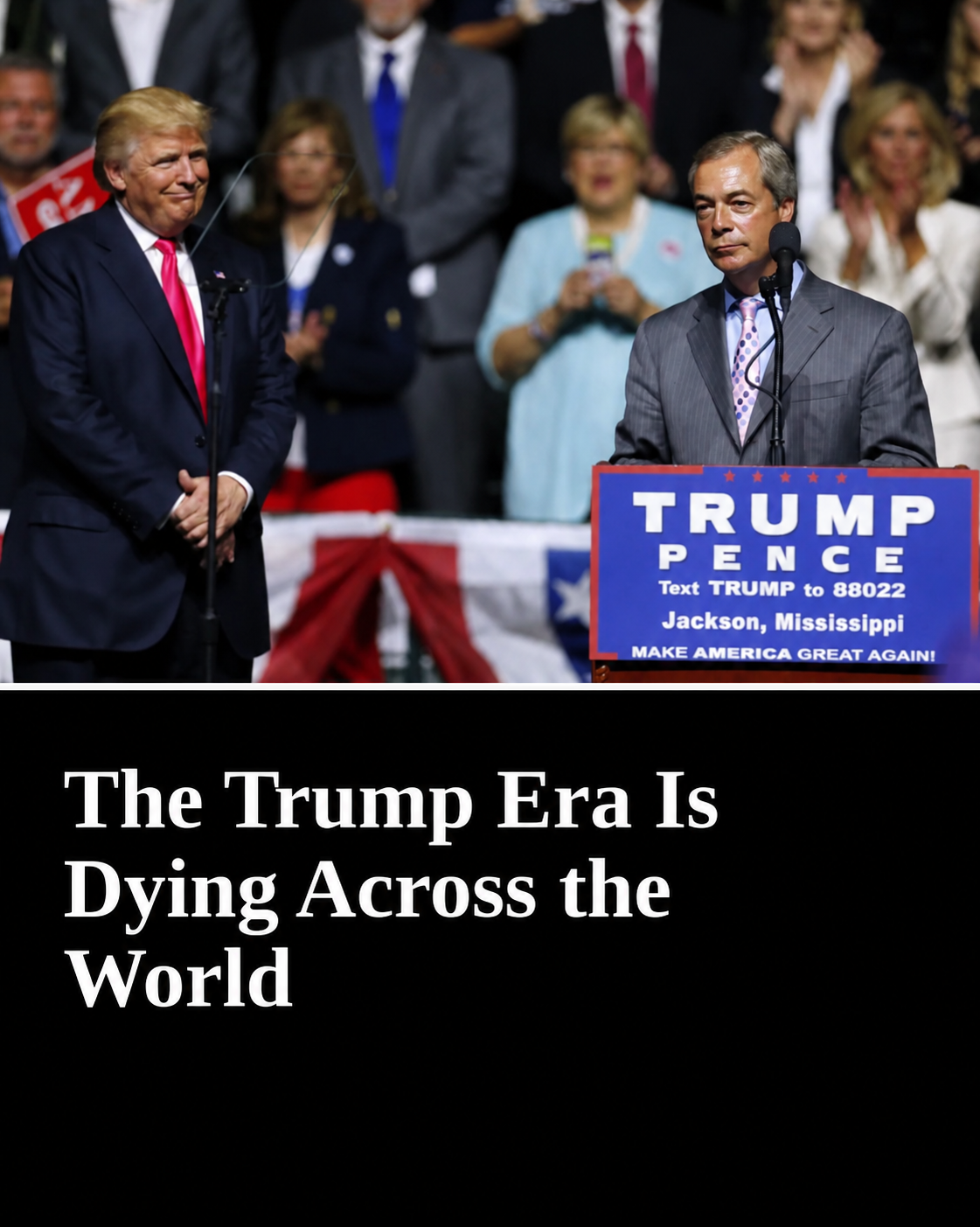


The phrase “The Trump Era Is Dying Across the World” captures a powerful political mood: the idea that Donald Trump’s nationalist brand, once celebrated by some movements overseas, is now encountering growing resistance. But a slogan is not a measurement. To understand whether Trump’s international influence is fading, it is necessary to separate public opinion, electoral politics, diplomacy, and the enduring appeal of the movements that have aligned themselves with him.
The graphic accompanying this article shows Trump beside British politician Nigel Farage at a campaign rally in Jackson, Mississippi, in August 2016. Contemporary reports identify the event as a Trump rally where Farage, a leading figure in the Brexit campaign, appeared as a guest. The image is a snapshot of an earlier moment when Trump’s political project and Brexit-era populism were presented as part of a wider international revolt against established institutions.
That moment mattered because Trump’s 2016 victory was never only an American story. His campaign became a reference point for politicians and activists who opposed immigration, criticized international institutions, promoted national sovereignty, or argued that mainstream parties had ignored ordinary voters. Farage and other right-wing populists saw common themes in the two movements, even though the United States and Britain faced different political circumstances.
A decade later, the international picture is more complicated. Pew Research Center’s 2026 survey of 42,151 adults across 36 countries found that a median of 23% had confidence in Trump to do the right thing regarding world affairs. That is a weak showing for a U.S. president seeking to shape international events, although it does not mean that every respondent opposes him or that every country has turned against his agenda.
The same Pew study found that confidence in Trump was lower than confidence in several other world leaders included in the survey. Views varied considerably by country: Trump remained relatively popular in some places, while respondents in many European countries and elsewhere expressed much less confidence. A global median can reveal a broad pattern, but it can also conceal meaningful regional and ideological differences.
Public attitudes toward Trump and attitudes toward the United States are related, but they are not identical. Pew’s 2026 research found a median of 37% with a favorable view of the United States across the 36 countries surveyed, compared with 57% who viewed the country unfavorably. Those results suggest that the problem extends beyond personal opinions of one president, touching questions about American reliability, power, and the consequences of U.S. policy.
The distinction matters for allies. When people in allied countries doubt the American president, governments may face pressure to diversify trade, strengthen regional partnerships, or reduce reliance on Washington. Such changes rarely happen overnight, and they may be driven by security calculations as much as public sentiment. Still, declining trust can make cooperation more politically difficult and can weaken the persuasive power that traditionally accompanied U.S. leadership.
The economic relationship is another source of tension. Tariffs and threats of trade restrictions can be presented by Trump supporters as bargaining tools intended to win concessions. Abroad, however, the same measures can be interpreted as evidence that access to the American market is less predictable. Businesses and governments may respond by seeking alternative suppliers, customers, and agreements, even when the United States remains an essential economic partner.
Security policy can also affect perceptions. Allies assess not only a president’s words but whether they can rely on U.S. commitments during a crisis. Disputes over defense spending, military assistance, and the terms of alliances can energize domestic arguments about strategic autonomy. Yet countries do not necessarily abandon longstanding partnerships because of one administration; geography, military capacity, and shared interests continue to shape decisions.
The 2016 image of Trump listening to Farage is revealing in this context. Brexit and Trumpism shared an anti-establishment style and a focus on national sovereignty, but their political outcomes were not interchangeable. Britain’s departure from the European Union involved years of negotiation and continuing debate, while Trump’s influence depends on U.S. elections, institutions, courts, Congress, and the decisions of future administrations.
Nor should international criticism be confused with the disappearance of populist politics. Parties that emphasize immigration control, cultural identity, distrust of elites, and national preference can remain influential even when voters disagree with Trump personally. Some supporters may admire his willingness to challenge conventions while rejecting specific tariffs or foreign-policy decisions. Others may support similar domestic policies for reasons rooted in their own national histories.
The Pew findings also point to ideological divides. In many countries, people on the political right are more likely than those on the left to express confidence in Trump. Supporters of right-wing populist parties often view him more positively than those who oppose such parties. This means that the international response is not a simple contest between the world and Trump; it is also a struggle within countries over identity, economics, democracy, and the proper role of government.
That divide complicates predictions about whether the “Trump era” is ending. Political eras are not defined only by approval ratings. They also leave behind policy changes, personnel networks, court decisions, new party coalitions, and shifts in what political candidates believe they can say. Even a president whose popularity falls may continue to shape debate long after leaving office.
At the same time, weak confidence abroad can impose real limits. Leaders who lack trust may find it harder to persuade partners to accept difficult compromises or to join initiatives they describe as serving a shared interest. Diplomacy depends on credibility as well as leverage. A government can still exert enormous economic and military power while finding that other countries are less willing to follow its lead voluntarily.
There are reasons to avoid treating polls as forecasts. Surveys capture opinion at a particular moment, and views can change after elections, economic shifts, wars, negotiations, or unexpected events. Results also depend on which countries were included, how questions were worded, and when interviews took place. The 2026 Pew findings are substantial evidence of current international skepticism, not proof that attitudes will remain fixed.
The domestic political picture in the United States also matters to the international story. Foreign leaders and voters watch American elections, court rulings, legislative debates, and changes in policy because these institutions determine how durable presidential decisions may be. A controversial announcement can have an immediate impact, but partners may wait to see whether it survives legal review, congressional resistance, or a change in administration.
For Trump’s overseas admirers, the central question may be whether his movement offers a transferable political model or depends on his unique persona and America’s unusual global position. Some ideas associated with Trump—skepticism toward multilateral institutions, restrictive immigration policy, and confrontational rhetoric—have international counterparts. But leaders who imitate his style must still answer to their own electorates, economies, constitutions, and political traditions.
For critics, the strongest evidence of a fading Trump-era consensus is not a viral graphic or a single diplomatic dispute. It is the accumulation of measurable signals: low confidence ratings in many countries, unfavorable views of the United States in much of the surveyed world, and practical efforts by partners to hedge against uncertainty. Those indicators deserve attention, while still being interpreted alongside the countries and constituencies where Trump retains support.
The most defensible conclusion is therefore narrower than the graphic’s sweeping headline. International confidence in Trump is low in many places, and the image of America as a dependable partner has faced serious challenges. But neither global opinion nor political influence has vanished uniformly. Trumpism may be losing some of its international appeal while continuing to shape debates, parties, and policies across borders.
The era’s ultimate legacy will depend on what happens after the headlines fade: whether allies rebuild trust, whether trade and security relationships adapt, whether populist parties retain their voters, and whether U.S. institutions sustain or reverse current policies. For now, the evidence supports a story of growing skepticism and contested influence—not a definitive worldwide ending.
Comments (0)
Loading comments...
May You Like

DAVENPORT AIRBNB HORROR — “SHOTS AT THE DOOR” GAME, 1 DEAD, 6 INJURED!

FLORIDA AIRBNB NIGHTMARE — 50 TEENS, 7 SHOOTING VICTIMS LINKED TO “SHOTS AT THE DOOR”!

WWE BRONSON REED DEAD AT 38, STIMULANTS DETECTED, $10M INSURANCE PAYOUT FROZEN!









Popular Posts



