“They Sure Don’t Make Republicans Like Him Anymore”: The Viral Tribute to John McCain’s Grace That Still Haunts American Politics
“They Sure Don’t Make Republicans Like Him Anymore”: The Viral Tribute to John McCain’s Grace That Still Haunts American Politics
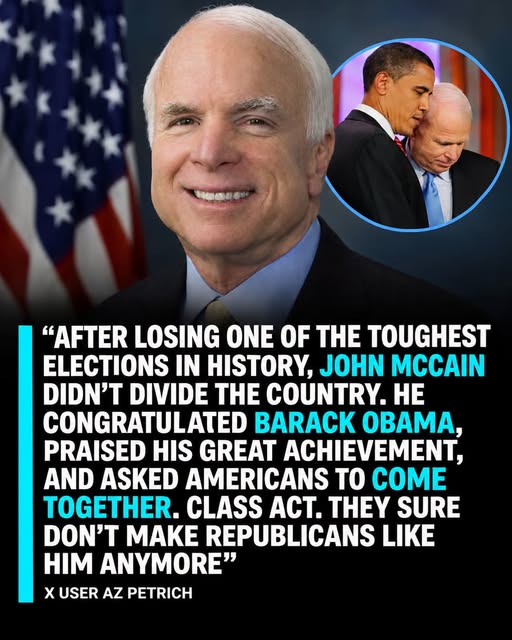
The image is designed to evoke a profound sense of loss—not just for a man, but for a vanished political era. At its center is a portrait of the late Senator John McCain, smiling with the easy confidence of a veteran statesman. In a smaller inset, a photograph captures a moment of extraordinary civility: Barack Obama, leaning in with a respectful expression, standing beside McCain at a memorial service. Below them, a quote attributed to an X user named “az petrich” delivers a verdict that has resonated deeply with millions:
“AFTER LOSING ONE OF THE TOUGHEST ELECTIONS IN HISTORY, JOHN MCCAIN DIDN’T DIVIDE THE COUNTRY. HE CONGRATULATED BARACK OBAMA, PRAISED HIS GREAT ACHIEVEMENT, AND ASKED AMERICANS TO COME TOGETHER. CLASS ACT. THEY SURE DON’T MAKE REPUBLICANS LIKE HIM ANYMORE.”
The post, which has circulated widely across social media, is not merely a nostalgic tribute. It is a sharp, implicit indictment of the current political moment—a reminder of a time when a defeated candidate could put country above party, and when grace was not seen as weakness.
The Verdict: A True Story of Grace Under Fire
Unlike many viral political quotes, this one is grounded in a documented, historically significant event. On November 4, 2008, John McCain did, in fact, deliver a concession speech that has since been widely praised as a model of political dignity. He did, in fact, congratulate Barack Obama—not just for winning, but for inspiring millions of Americans who had once believed they had little influence. And he did, in fact, urge his supporters to offer Obama their “good will and earnest effort to find ways to come together”.
What makes the story extraordinary is the context. McCain was not conceding a minor contest. He had just lost one of the most consequential and bitterly fought presidential elections in modern American history. His running mate, Sarah Palin, was a polarizing figure. His crowds had, at times, turned ugly, with supporters shouting “terrorist” and “kill him” about Obama. And yet, when the moment came to speak, McCain chose not to stoke that anger. He chose to extinguish it.
The Speech That Defined a Career
The speech, delivered on a warm Arizona evening at the Biltmore Hotel in Phoenix, began with a simple, generous act. “A little while ago, I had the honor of calling Senator Barack Obama to congratulate him on being elected the next president of the country that we both love” , McCain said. The crowd booed. McCain did not flinch. “Please,” he said, quieting them. He then continued, acknowledging the historic nature of Obama’s victory.
“This is an historic election, and I recognize the special significance it has for African-Americans and for the special pride that must be theirs tonight” , he said. “Senator Obama has achieved a great thing for himself and for his country. I applaud him for it” .
But the most powerful moment came when McCain spoke directly to his own supporters—the people who had fought for him, donated to him, and believed in him. He did not tell them to fight on. He did not tell them the election was stolen. He told them to do something far harder.
“I urge all Americans who supported me to join me in not just congratulating him, but offering our next president our good will and earnest effort to find ways to come together, to find the necessary compromises, to bridge our differences, and help restore our prosperity, defend our security in a dangerous world, and leave our children and grandchildren a stronger, better country than we inherited” , he said.
And then, in a line that has echoed through the years, he added: “Whatever our differences, we are fellow Americans. And please believe me when I say no association has ever meant more to me than that” .
The Context: A Campaign That Could Have Gone Dark
To truly appreciate McCain’s grace, one must remember the campaign that preceded it. The 2008 race was not a genteel affair. McCain’s rallies were often marked by hostility toward Obama. At a town hall in Minnesota, a woman told McCain she couldn’t trust Obama because he was “an Arab.” McCain took the microphone from her and said, “No, ma’am. He’s a decent family man, a citizen that I just happen to have disagreements with on fundamental issues” .
It was a moment that defined McCain’s character—a willingness to defend his opponent’s humanity even when it cost him political points. As Slate noted at the time, McCain’s concession speech was a “class act,” a “respectful” address in which he “said all the things he didn’t have to”. The Chicago Tribune later called it the “gold standard” for presidential concession speeches.
The Contrast: A Vanished Political Norm
The viral quote’s final line— “They sure don’t make Republicans like him anymore” —is where the nostalgia gives way to a sharper, more painful critique. It is a statement that resonates because it is, in the eyes of many, demonstrably true.
In the years since McCain’s death in 2018, the Republican Party has undergone a profound transformation. The politics of grace, of institutional respect, of putting country above party—the very qualities McCain embodied—have been increasingly marginalized. The 2020 election saw a sitting president refuse to concede, inciting a violent attack on the Capitol. The 2024 election was marked by relentless attacks on the integrity of the electoral system. The 2026 midterms have been defined by bitter partisan warfare, with accusations of betrayal and disloyalty flying across the aisle.
Against this backdrop, McCain’s speech reads like a relic from another world. It is not just a tribute to a man; it is a lament for a political culture that seems to have vanished.
The Bottom Line
The viral graphic is right about one thing: John McCain was a class act. But the story is bigger than a single speech. It is a reminder that the strength of a democracy is measured not only by how it treats its winners, but by how its losers behave. McCain understood that. He understood that the peaceful transfer of power is not a concession to the other side—it is a cornerstone of the Republic itself.
Whether that understanding can be recovered remains one of the defining questions of our time. But for now, the words of a defeated senator from Arizona, delivered on a warm November night nearly two decades ago, continue to echo—a testament to what politics can be, and a warning of what it becomes when grace is abandoned.
📸 Suggested Images
-
The Concession Speech: A photo of John McCain at the Biltmore Hotel in Phoenix on November 4, 2008, with a quote overlay of “Whatever our differences, we are fellow Americans.”
The Moment of Respect: A photo of McCain taking the microphone from the woman who called Obama “an Arab,” with the caption: “No, ma’am. He’s a decent family man.”
The Inset Photo: The image of Obama and McCain at the memorial service, illustrating the bipartisan respect that transcended their political rivalry.
The Contrast: A split image of McCain’s 2008 concession speech alongside a modern political rally, highlighting the shift in political norms.
Comments (0)
Loading comments...
May You Like