Thomas Massie Lost His Primary After Clashing With Trump — Now He’s Naming Alleged Epstein Co-Conspirators on the House Floor
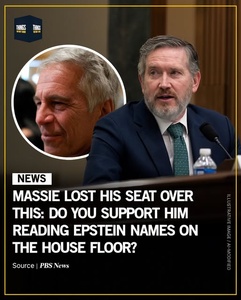
The Kentucky Republican is using his final months in Congress to intensify his campaign for Epstein-file disclosure after losing a Trump-targeted primary earlier this year.
WASHINGTON — Rep. Thomas Massie is using his remaining months in Congress to escalate his long-running campaign for disclosure of Jeffrey Epstein records after losing his Republican primary earlier this year.
Massie, a Kentucky Republican known for frequently challenging his own party, lost the May primary to former Navy SEAL Ed Gallrein, who entered the contest with President Donald Trump’s endorsement.
PBS reported that Gallrein defeated Massie by nearly ten percentage points, ending the congressman’s bid for another term representing Kentucky’s heavily Republican 4th Congressional District.
Trump had aggressively opposed Massie, whose disputes with the president included his criticism of the Iran war and his prominent campaign to force greater disclosure of government records concerning Epstein.
Those issues make the viral claim that Massie simply “lost his seat over this” too definitive. His Epstein activism was significant, but voters were deciding among candidates based on multiple issues.
Massie’s Epstein campaign actually achieved a major congressional victory before his primary defeat. In November 2025, the House overwhelmingly approved legislation forcing disclosure of additional Epstein-related government records.
The House passed that legislation 427–1 after Massie and Democratic Rep. Ro Khanna successfully used a discharge petition to force the measure onto the floor despite resistance from congressional leadership.
Trump had initially opposed the effort and characterized continued attention surrounding Epstein as politically motivated, but changed course before the vote and urged House Republicans to support releasing the records.
Massie nevertheless argued in February that the Justice Department had not fully complied with the resulting disclosure law, claiming millions of documents remained unreleased or excessively redacted.
Massie and Khanna were subsequently permitted to examine unredacted material. PBS reported in February that they identified six men whose names had been redacted from publicly released versions of certain documents.
The lawmakers did not publicly identify those six men at that time. Khanna said their objective was accountability rather than political retaliation against people merely appearing somewhere within the enormous collection of documents.
Massie later said he found documents in which names of people described in FBI materials as Epstein co-conspirators had been concealed from public versions, intensifying his criticism of Justice Department redactions.
After losing his primary, Massie continued pressing the issue rather than abandoning it. He introduced what he described as an Epstein Files Transparency Act 2.0 during his remaining congressional term.
The proposal would give Epstein survivors, members of Congress and state attorneys general additional legal mechanisms to seek records when they believe the Justice Department has failed to comply with disclosure requirements.
Massie said state attorneys general particularly need access because some may possess authority to investigate potential violations of state law even when federal prosecutors have declined to bring charges.
Then came the development highlighted by the viral graphic. On August 31, Massie took to the House floor and publicly named 14 people he characterized as Epstein co-conspirators requiring investigation and possible prosecution.
That action followed an idea Massie had discussed considerably earlier: using constitutional protections for congressional speech to publicly disclose names that Epstein survivors might otherwise fear identifying themselves.
In September 2025, Massie explained that lawmakers enjoy protections under the Constitution’s Speech or Debate Clause for statements made during legislative proceedings, providing unusual protection for remarks delivered on the House floor.
He said survivors could face lawsuits, threats or financial consequences if they publicly released names themselves, while lawmakers could potentially use their congressional protections to bring information into public view.
That does not, however, mean everyone named by Massie has been established as an Epstein co-conspirator in court. Congressional allegations and references in investigative files are not equivalent to criminal convictions.
The same caution applies broadly to Epstein records. A person can appear in correspondence, address books, flight records, photographs or investigative documents for numerous reasons unrelated to participation in Epstein’s crimes.
Massie has argued that law enforcement should determine which people require prosecution, while also criticizing what he sees as excessive secrecy protecting wealthy or politically connected individuals associated with the investigation.
His confrontation with Republican leadership has continued beyond Epstein. This week, Massie criticized Speaker Mike Johnson after the House recessed early while several pieces of legislation Massie wanted considered remained unfinished.
Massie is also pursuing an effort to impeach Defense Secretary Pete Hegseth over the Iran war, another issue that contributed to his political break with Trump before the Kentucky primary.
That broader record is why describing Massie’s defeat solely as punishment for “reading Epstein names” oversimplifies the timeline: he lost the primary months before his August 31 floor speech.
What can be established is that Massie’s Epstein activism was among the issues behind his conflict with Trump, and Trump backed the challenger who ultimately defeated him in Kentucky.
Massie’s defeat has not ended that activism. With his House term continuing until January, he has instead used his remaining time to demand additional documents and publicly challenge Justice Department redactions.
His political future is less clear. After losing the primary, Massie filed paperwork allowing him to seek federal office again in 2028 while declining to specify which office he might eventually pursue.
For now, the unusual situation remains: a defeated Republican congressman is spending his final months in office intensifying investigations that helped put him at odds with the president and Republican leadership.
Comments (0)
Loading comments...
May You Like

FIGHT OVER OBAMA’S IRAN POLICY

Russian Drone Strikes Kyiv Bridge as German Chancellor Arrives in Ukraine