
Thomas Massie Names 14 Alleged Epstein Co-Conspirators on House Floor — But the Trump Imprisonment Claim Goes Beyond the Evidence
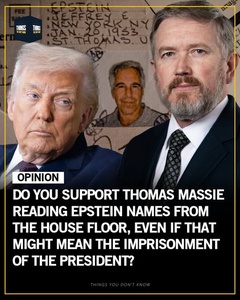
The Kentucky Republican is demanding investigations and additional disclosures from the Epstein files, while the public record does not establish that his House-floor disclosures could send President Donald Trump to prison.
WASHINGTON — Rep. Thomas Massie has escalated his long-running campaign for transparency surrounding Jeffrey Epstein by publicly naming 14 people on the House floor whom he said deserved investigation and possible prosecution.
Massie made the disclosures August 31, during his final months in Congress, after repeatedly accusing the Justice Department of withholding or excessively redacting important material from the Epstein files.
PBS reported that Massie called the 14 individuals Epstein “co-conspirators” and said they should be investigated and prosecuted, making his allegations unusually explicit for remarks delivered inside Congress.
That description, however, represents Massie’s characterization. Being named by a member of Congress does not establish that an individual committed a crime or participated in Epstein’s sex-trafficking operation.
The distinction is especially important because Epstein-related government records contain thousands of references to people appearing for different reasons, including correspondence, social contacts, witness statements, investigative leads and financial relationships.
Massie’s strategy of reading names publicly was not spontaneous. As early as September 2025, he discussed using the House floor to help Epstein survivors disclose information without personally facing potentially ruinous lawsuits.
Massie pointed to the Constitution’s Speech or Debate protections, explaining that lawmakers receive broad protection for legislative speech that ordinary citizens making allegations publicly would not necessarily enjoy.
He said survivors had considered compiling their own list but feared lawsuits, threats and financial consequences if they personally released allegations involving wealthy or politically powerful individuals.
Massie also cautioned that the public would ultimately need to distinguish between people with innocent associations with Epstein and individuals allegedly involved in abuse or other criminal conduct.
The transparency campaign eventually produced a remarkable congressional result. In November 2025, the House voted 427–1 for legislation requiring release of Epstein-related government records after a successful discharge petition forced action.
Trump initially resisted the continuing political focus on Epstein but ultimately called on Republicans to support releasing the files, and he said he would sign the legislation if Congress sent it to him.
The subsequent document releases did not end the controversy. Massie argues that the Justice Department continues withholding records and applying redactions beyond what the transparency legislation permits.
In February, Massie and Democratic Rep. Ro Khanna were permitted to examine some unredacted DOJ records and compared them with versions of documents that had been released publicly.
They said they found six men whose identities were concealed in public versions and whose appearance in the unredacted material potentially warranted additional scrutiny. They initially declined to identify those six.
Massie separately said he examined approximately 40 unredacted documents and discovered three instances in which names of people identified within FBI material as Epstein co-conspirators had been concealed.
One person Massie repeatedly highlighted was former retail executive Les Wexner, whose name appeared in an FBI document Massie described during his confrontation with Attorney General Pam Bondi.
Again, appearing in such investigative material does not itself establish criminal liability. Wexner has not been convicted of an Epstein-related crime, and investigative labels are not equivalent to judicial findings.
Massie’s broader complaint concerns not only names but prosecutorial decisions. He wants DOJ to disclose internal material explaining why particular people were investigated, not investigated, prosecuted or ultimately left uncharged.
That issue forms a central component of Massie’s proposed Epstein Files Transparency Act 2.0, which he began promoting after arguing that the first transparency law had not produced sufficient disclosure.
The proposed legislation would give Epstein victims additional legal standing to obtain their own records and provide Congress with mechanisms intended to enforce compliance with disclosure requirements.
It would also expand opportunities for state attorneys general to pursue Epstein-related crimes when evidence potentially supports prosecution under state law, according to Massie’s explanation of the measure.
That brings the issue much closer to what Massie says he wants: investigators evaluating evidence rather than simply publishing lists of famous people associated in different ways with Epstein.
The viral graphic, however, adds another proposition by suggesting Massie’s disclosures could potentially lead to President Trump’s imprisonment.
Nothing about reading names on the House floor can itself imprison a president. Congress can investigate, subpoena witnesses, publish information and potentially refer evidence to prosecutors, but criminal punishment requires a separate judicial process.
Trump’s name has appeared in the broader public discussion surrounding Epstein because the two men were socially acquainted decades ago, something documented through photographs, video and other publicly available material.
But social association, photographs, correspondence or appearance somewhere in investigative records cannot by themselves demonstrate participation in Epstein’s crimes.
The Epstein releases have also contained allegations involving Trump that require careful qualification. PBS reported this year on an allegation collected by the FBI concerning Trump and a minor.
The reporting emphasized substantial evidentiary limitations: many claims collected by investigators were categorized as unverifiable, not credible or impossible to track down, while important information surrounding the particular allegation remained missing.
An FBI record showing that investigators received or examined an allegation is therefore not equivalent to proof that the alleged conduct occurred, much less a criminal conviction.
The same standard must apply regardless of the political identity of the person named. Epstein records can provide investigative leads, but guilt requires evidence tied to a specific criminal offense.
Massie himself has framed his campaign as an effort to determine why potentially culpable people were never charged, rather than treating every person mentioned in the files as automatically guilty.
Khanna has similarly described the transparency effort as an attempt to expose wrongdoing among powerful figures in technology, finance, real estate and international institutions rather than simply score partisan political points.
The political conflict surrounding Massie has nevertheless become intense. Trump opposed Massie’s reelection and endorsed his Republican primary challenger after disputes involving Epstein transparency, foreign policy and federal spending.
Massie lost that May primary and will leave the House in January, but he has continued pursuing Epstein disclosure legislation during the remaining months of his congressional term.
That timeline makes his August 31 naming exercise particularly significant: Massie is using the legislative protections and platform available to him before his congressional service ends.
Whether any of his allegations eventually produce criminal cases will depend on prosecutors examining underlying evidence and determining whether particular offenses can be proved under applicable federal or state law.
Even then, criminal charges would remain allegations. Imprisonment could occur only following the legal processes required for conviction or a guilty plea and sentencing.
For Trump specifically, the public record currently does not establish that Massie’s 14-name House-floor disclosure creates a factual or legal basis for saying the president faces imprisonment.
The verified story is substantial without that speculation: a Republican congressman publicly identified 14 people he says deserve investigation in connection with Epstein and is demanding further disclosure from Trump’s Justice Department.
Comments (0)
Loading comments...
May You Like

Russian Drone Strikes Kyiv Bridge as German Chancellor Arrives in Ukraine

gfnhgmnghnmfgnbvvvvvvvvv

Shocking news from Ohio: an unexpected development ahead of Trump's rally












