Thomas Massie Reads Epstein-Linked Names on House Floor as Pressure Mounts Over Unreleased Files
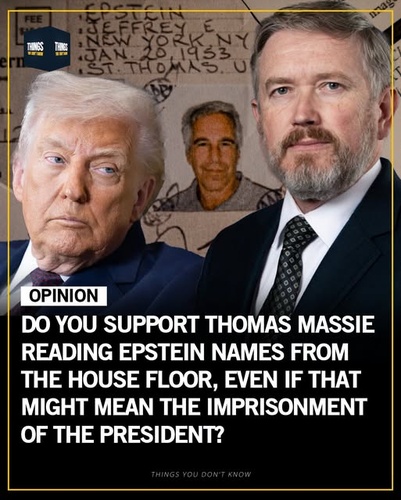
Rep. Thomas Massie has escalated his campaign for greater transparency in the Jeffrey Epstein investigation, reading the names of 14 people on the House floor whom he said should be investigated and prosecuted.
The development has fueled renewed online speculation about whether the Epstein files could eventually implicate President Donald Trump. But the viral graphic circulating online goes beyond what Massie actually said: Massie did not announce that Trump should be imprisoned, nor does being mentioned in Epstein-related records establish criminal wrongdoing.
Massie names 14 people on the House floor
On Aug. 31, Massie, a Kentucky Republican and one of Congress' leading advocates for releasing the Epstein records, said he had read the names of several alleged Epstein “co-conspirators” into the congressional record.
The names included Jes Staley, Leon Black, Les Wexner, David Copperfield, Lapo Elkann, Tom Pritzker, Glenn Dubin, Frédéric Fekkai, Edoardo Teodorani, Jean-Luc Brunel, Daniel Siad, Ramsey Elkholy, Prince Andrew and Lesley Groff. Massie said those individuals should be investigated and prosecuted.
Massie's move was part of a broader effort to force the Justice Department to release additional Epstein-related records.
He also began collecting signatures for a discharge petition designed to force consideration of the Epstein Files Transparency Act II.
What is the Epstein Files Transparency Act II?
Massie and Democratic Rep. Ro Khanna introduced H.R. 9694, the Epstein Files Transparency Act II, on July 15, 2026.
According to the official House bill record, the measure would amend the existing Epstein Files Transparency Act and provide additional avenues for enforcement. It would allow state attorneys general, victims and members of Congress to challenge the Justice Department over alleged failures to comply with the disclosure requirements. The bill was referred to the House Judiciary Committee and has not become law.
The issue has become increasingly contentious because lawmakers continue to argue that significant Epstein-related material remains withheld or heavily redacted.
The Justice Department says it has already released millions of pages. In January, DOJ announced the publication of more than 3 million additional pages, bringing its total production to nearly 3.5 million pages, along with thousands of videos and hundreds of thousands of images.
Does Massie's action mean Trump could be imprisoned?
No — not simply because his name appears in Epstein-related material.
This distinction is crucial.
The Epstein files contain references to numerous prominent people who knew Epstein, communicated with him, appeared in contact books, traveled in overlapping social circles or were mentioned in documents. Being named in a file is not itself evidence that a person committed a crime.
That principle applies to Trump as well as to anyone else.
The Justice Department itself has warned that the released material includes documents, images and allegations submitted to the FBI that may be false or unreliable. In January, DOJ specifically said some sensational claims involving Trump contained in the files were unfounded.
Separately, the Associated Press reported that the department later released previously withheld FBI interview summaries containing uncorroborated allegations involving Trump. Trump has denied wrongdoing.
Therefore, a reference to Trump in Epstein records — even a more serious allegation — would not automatically establish guilt or justify imprisonment.
A criminal prosecution would require evidence supporting specific criminal charges, followed by the normal constitutional and judicial process.
Massie's list did not include Trump
Another important point is that Trump was not among the 14 names Massie read on Aug. 31, according to reporting on the speech and the list of names publicly documented from it.
Massie's focus was on people he characterized as Epstein co-conspirators who should be investigated. His speech was part of his continuing criticism of the Justice Department's handling of the Epstein records.
That does not mean Trump has no connection to the broader Epstein controversy. Trump and Epstein were socially acquainted decades ago, and Trump's name has appeared in Epstein-related records. Reuters has reported that the released files raised additional questions about Trump's past statements concerning what he knew about Epstein's crimes.
But social association, a name appearing in documents and criminal liability are three different things.
Why the House floor matters
Massie's decision to read the names publicly is significant because congressional speech receives strong constitutional protection under the Speech or Debate Clause.
That protection is one reason lawmakers have considered the House floor an avenue for publicly discussing names contained in sensitive investigative material. Earlier this year, Massie and Khanna also considered using the House floor to identify individuals whose names remained redacted in Epstein documents.
Massie is now trying to turn the publicity surrounding the names into legislative pressure.
The bigger battle is over whether Congress can force the Justice Department to provide additional unredacted records and whether state authorities and Epstein survivors should have stronger legal tools to challenge withholding of those records.
The Epstein controversy is becoming bipartisan
The latest push is notable because Massie's effort has attracted support from Democrats as well as Republicans.
The House version of the Epstein Files Transparency Act II was introduced jointly with Khanna and Teresa Leger Fernández, while additional lawmakers from both parties have subsequently backed the measure.
The unusual alliance reflects how the Epstein issue has moved beyond a conventional partisan dispute.
Survivors and lawmakers from both parties have demanded greater transparency, while the Justice Department has defended its release process and cited privacy protections for victims and other legal restrictions. The House Oversight Committee is also continuing its investigation into Epstein's network and associates.
What the viral graphic gets right — and what it leaves out
The graphic accurately reflects a real congressional development: Thomas Massie did read Epstein-related names on the House floor and is pushing for further disclosure of government records.
But its suggestion that this could mean the imprisonment of the president is hypothetical, not a reported consequence of Massie's action.
What is established:
- Massie read 14 names into the congressional record.
- He said those people should be investigated and prosecuted.
- He launched a renewed effort to force consideration of the Epstein Files Transparency Act II.
- The bill seeks stronger mechanisms to compel DOJ compliance with Epstein-record disclosure requirements.
- Trump was not one of the 14 people Massie named.
What is not established:
- Massie did not announce that Trump should be imprisoned.
- Being named in Epstein documents does not establish that someone committed a crime.
- The Epstein Files Transparency Act II is not yet law.
- There is no current criminal judgment against Trump arising from the Epstein files.
Bottom line
Thomas Massie's latest House-floor speech has intensified the political fight over Jeffrey Epstein's network and the government's remaining records. It could lead to further investigations if additional evidence emerges.
But the leap from “a president's name appears in Epstein records” to “the president should be imprisoned” is a legal conclusion that cannot be made without evidence of a specific crime, a valid prosecution and due process.
The more immediate question is whether Massie and his bipartisan allies can obtain enough congressional support to force the Justice Department to disclose more of the Epstein records — and whether those records contain evidence that warrants new criminal investigations.
Comments (0)
Loading comments...
May You Like

Shocking news from Ohio: an unexpected development ahead of Trump's rally

OBAMA STEPS BACK INTO THE POLITICAL SPOTLIGHT