Thomas Massie Reads Epstein-Related Names on House Floor — But Does That Mean the President Could Be Imprisoned?
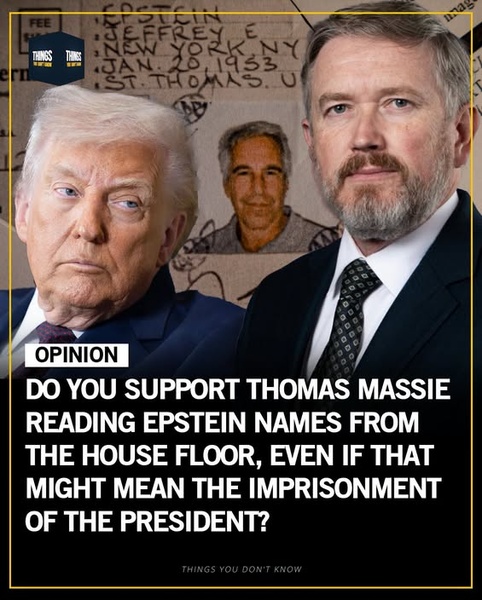
Verdict: The underlying event is real, but the graphic's wording is speculative.
The image asks whether people support Rep. Thomas Massie reading Epstein-related names into the congressional record “even if that might mean the imprisonment of the president.” That framing goes beyond what Massie actually did.
What Massie actually did
On August 31, 2026, Rep. Thomas Massie took to the House floor and publicly named 14 people whom he described as Epstein “co-conspirators” who should be investigated and prosecuted. The names included Jes Staley, Leon Black, Les Wexner, David Copperfield, Lapo Elkann, Tom Pritzker, Glenn Dubin, Frédéric Fekkai, Edoardo Teodorani, Jean-Luc Brunel, Daniel Siad, Ramsey Elkholy, Andrew Mountbatten-Windsor (formerly Prince Andrew), and Lesley Groff.
Massie simultaneously began a discharge petition seeking 218 House signatures to force consideration of his Epstein Files Transparency Act II. The bill seeks additional mechanisms for victims, state officials and members of Congress to challenge the Justice Department's withholding or redaction of Epstein-related records.
As of the latest reporting I found, the petition had 106 signatures, well short of the 218 required to force a House vote.
Being named is not the same as being guilty
This is the most important qualification.
Massie's statements were allegations and calls for investigation, not criminal convictions. Being mentioned in Epstein records, having a relationship with Epstein, or even being accused by a member of Congress does not by itself establish that someone committed a crime. Several people Massie named have never been charged with Epstein-related crimes.
That distinction matters particularly because earlier releases of Epstein-related material have demonstrated that a person's name appearing in a document does not necessarily mean that person participated in Epstein's crimes. In February, for example, reporting found that several men whose names appeared in an FBI photo lineup had no apparent connection to Epstein.
So a responsible news report should use terms such as “named,” “accused,” “alleged” or “identified by Massie” rather than presenting every person on the list as a proven criminal.
What about the president?
This is where the graphic moves from fact into speculation.
The image does not establish that Donald Trump is one of the people Massie named on August 31. Trump is not among the 14 names Massie read during that speech.
The graphic appears to be asking a hypothetical question: What if further Epstein evidence ultimately implicated the president? Would you still support Massie's effort?
That's a legitimate political question, but it shouldn't be presented as though Massie's speech itself established that the president is facing imprisonment.
There is also an important legal distinction between investigation, prosecution and imprisonment. Even if evidence eventually implicated a sitting president in criminal conduct, that would not mean a member of Congress reading names automatically sends the president to prison. There would have to be a lawful investigative and judicial process.
Why could Massie read the names on the House floor?
There is a significant constitutional reason.
Article I, Section 6 protects members of Congress for legislative speech and debate. The congressional Constitution Annotated explains that the Speech or Debate Clause provides broad protection for legitimate legislative acts and can provide immunity from civil or criminal liability arising from those acts.
That protection is designed to preserve Congress's independence—not to give members a general license to commit crimes or make any statement anywhere without consequences.
In Massie's case, speaking on the House floor is precisely the kind of legislative activity the constitutional protection is designed to cover.
Massie's larger objective is transparency
The more consequential part of the episode may actually be Massie's continuing effort to obtain additional Epstein records.
Massie and Democratic Rep. Ro Khanna previously worked together on legislation requiring the government to release Epstein-related material. In July 2026, they introduced H.R. 9694, the Epstein Files Transparency Act II, and Massie filed a discharge petition on August 31 to try to bypass committee and force a floor vote.
That makes the episode bigger than simply Massie reading names. He's attempting to use congressional procedure to force additional disclosure and scrutiny of the government's handling of the Epstein files.
Bottom line
The graphic is based on a real event, but its final premise is hypothetical.
- True: Massie read 14 Epstein-related names on the House floor.
- True: He said those people should be investigated and prosecuted.
- True: He is pushing another bill to obtain greater access to Epstein records.
- Important context: Being named or appearing in Epstein records does not automatically establish criminal wrongdoing.
- Not established by this event: That Massie's speech implicates Trump in a crime or means the president could be imprisoned.
- Fair political question: Whether the public should support transparency and investigation even if an investigation ultimately reaches politically powerful people—including a president.
The strongest headline would therefore focus on Massie's demand for investigation and transparency, rather than implying that Trump's imprisonment is an established consequence.
Comments (0)
Loading comments...
May You Like

Shocking news from Ohio: an unexpected development ahead of Trump's rally

South Korea–Ukraine Rift Deepens Over North Korean POW Transfer as PURL Draws New Scrutiny
OBAMA STUNS ON INSTAGRAM: MESSAGE MARKING 34-YEAR MILESTONE SPARKS A BUZZ