
Three Warships Have Left San Diego — and the Next Destination Is Drawing Attention
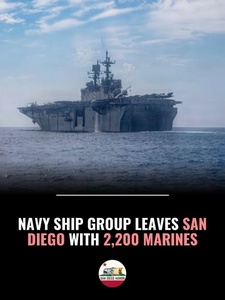
WASHINGTON — Three U.S. Navy amphibious ships quietly departed San Diego this week carrying the 13th Marine Expeditionary Unit, adding another major American force to a rapidly changing military picture.
A Quiet Departure From San Diego
The group is led by the USS Makin Island, a Wasp-class amphibious assault ship, accompanied by the amphibious transport docks USS Anchorage and USS John P. Murtha.
The three vessels form the Makin Island Amphibious Ready Group, which departed San Diego on Sept. 28 for a scheduled deployment, according to U.S. Naval Institute reporting.
Embarked aboard the ships is the 13th Marine Expeditionary Unit, a Marine Air-Ground Task Force designed to operate from the sea and respond rapidly to contingencies.
A typical ARG/MEU combination includes about 2,200 Marines and sailors in the expeditionary unit, in addition to roughly 2,000 sailors assigned across the three amphibious ships.
The 13th MEU includes infantry, logistics and aviation elements, giving the formation the ability to conduct a range of operations without relying entirely on forces already positioned ashore.
Built for More Than One Mission
The Makin Island is essentially a mobile sea-based aviation and assault platform, capable of operating helicopters, tiltrotor aircraft and F-35B fighter jets.
The accompanying ships provide additional space for Marines, vehicles, equipment and landing craft, allowing the formation to move personnel and military equipment from sea toward potential operating areas.
The Marine Corps has described the current deployment as part of routine operations and readiness activities, while the Navy has not publicly announced a specific combat mission for the group.
That distinction matters because amphibious ready groups routinely deploy to different regions and can perform exercises, evacuations, humanitarian missions or combat operations depending on subsequent orders.
Why the Destination Matters
The timing of the departure, however, has attracted attention because the United States is simultaneously increasing its military presence around the Middle East.
USNI News reported that the Makin Island group was initially identified as departing for a scheduled deployment, while later reporting indicated that the force could be moving toward the U.S. Central Command area.
Al-Monitor reported that the Makin Island and the 13th MEU were being sent toward the Middle East, alongside the deployment of another aircraft carrier, the USS Theodore Roosevelt.
The move would place another amphibious force into a region where U.S. naval assets are already operating amid continuing tensions involving Iran and maritime security.
The Financial Times likewise reported that the United States is deploying additional troops and warships to the Middle East, including the Makin Island Amphibious Ready Group.
A Larger Naval Buildup
The Makin Island group would not be entering an empty theater. Other U.S. naval forces are already operating in the region, including carrier and amphibious formations.
The USS Boxer Amphibious Ready Group, carrying the 11th Marine Expeditionary Unit, deployed from San Diego earlier this year and later reached the Middle East.
That earlier deployment involved roughly 2,200 Marines and demonstrated how quickly an amphibious force based on the U.S. West Coast can eventually become part of operations thousands of miles away.
The arrival of another Marine expeditionary unit would give U.S. commanders another sea-based force capable of moving personnel, aircraft and equipment without requiring an immediate permanent base ashore.
What the Marines Bring
The 13th MEU's aviation component includes F-35B Lightning II aircraft as well as MV-22B Ospreys and other rotary-wing aircraft, according to USNI News.
That combination gives the formation several different capabilities, ranging from long-range troop transport and reconnaissance to air support and amphibious operations.
The unit can also operate independently for extended periods, making an ARG/MEU particularly useful when commanders need forces that can remain offshore while retaining multiple options.
But the deployment itself does not establish that the Marines are being sent into combat. Their precise operational orders and destination can change after departure.
What Happens Next?
For now, the clearest confirmed fact is that the Makin Island Amphibious Ready Group has left San Diego with the 13th MEU aboard.
The Navy has described the deployment in terms of scheduled operations, while multiple recent reports connect the movement with the broader U.S. military buildup toward the Middle East.
The key question will be where the three ships ultimately operate and what orders they receive once they reach their assigned theater.
Their departure adds another mobile Marine force to an already substantial American naval presence — but the movement alone does not indicate what specific mission the Pentagon may eventually assign them.
Comments (0)
Loading comments...
May You Like

South Korea–Ukraine Rift Deepens Over North Korean POW Transfer as PURL Draws New Scrutiny

South Korea–Ukraine Rift Deepens Over North Korean POW Transfer as PURL Draws New Scrutiny

OBAMA STUNS ON INSTAGRAM: MESSAGE MARKING 34-YEAR MILESTONE SPARKS A BUZZ












