
Thune’s SAVE Act Standoff Backfires as Trump Shows Up at Capitol and Presses Senate Republicans
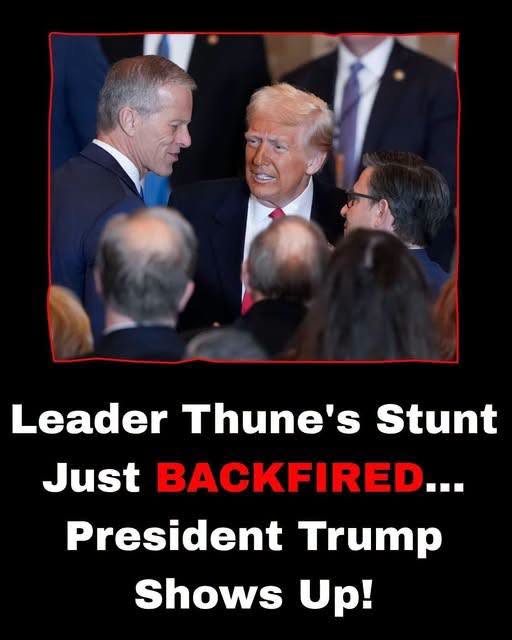
A viral political graphic claims Senate Majority Leader John Thune’s maneuver against President Donald Trump “just backfired” after Trump unexpectedly appeared at the Capitol. The claim refers to a very real clash inside the Republican Party over Trump’s demand that Congress pass the SAVE America Act, but the “backfired” language is political commentary rather than an established fact.
The underlying episode took place on June 24, 2026, when Trump went to the Capitol for a closed-door lunch with Senate Republicans amid growing tensions with Thune over the voting bill and the Senate filibuster.
Trump Walked Into a Senate Republican Meeting Thune Was Already Struggling to Control
Trump’s appearance came at an awkward moment for Thune.
The president had spent months demanding passage of the SAVE America Act, which would require documentary proof of citizenship to register to vote in federal elections and photo identification at the polls.
Thune repeatedly warned Trump that Republicans did not have the votes to overcome the Senate's 60-vote threshold. Trump, meanwhile, increasingly urged Republicans to change the filibuster rules so the legislation could pass with a simple majority.
The June 24 lunch therefore represented more than a routine meeting between a president and his party's senators. It became a test of whether Trump could pressure Republican senators into changing course.
The “Stunt” Was Actually the Housing Bill Fight
The immediate trigger was not simply the Senate lunch.
Hours before Trump arrived at the Capitol, he abruptly canceled a planned signing ceremony for the 21st Century ROAD to Housing Act, a bipartisan housing package that had passed the House 358-32 and the Senate 85-5.
Trump said he would not sign the legislation until Congress passed the SAVE America Act, which he described as a national emergency.
The move caught Republican lawmakers off guard.
Thune had publicly praised the housing legislation and said he hoped Trump would eventually sign it. He emphasized that the bill addressed housing supply and affordability.
“I think it’s a big win,” Thune said, adding that he hoped Trump would find a way to sign it.
That is the background behind the graphic's claim that Thune was making a move that ultimately “backfired.”
But calling it Thune's stunt is misleading. The documented last-minute maneuver was Trump's cancellation of the signing ceremony, not an action by Thune to prevent Trump from appearing at the Capitol.
Trump Showed Up Anyway
Despite the canceled housing ceremony, Trump still went to Capitol Hill for the Republican Senate lunch.
That gave him a direct opportunity to confront senators over the issues frustrating him — particularly the SAVE Act and the Senate's filibuster rules.
Trump reportedly pressed Republicans to find a way to move the voting legislation forward.
But the meeting did not produce the breakthrough Trump wanted.
Sen. Kevin Cramer, R-N.D., summarized the result by saying senators walked out with essentially the same views they had before the meeting, although they had heard the president out.
That is a crucial detail missing from the viral graphic.
Trump showed up — but his appearance did not suddenly produce enough votes to pass the SAVE Act.
The Meeting Became a Test of Republican Unity
The lunch also exposed a deeper disagreement between Trump and some Senate Republicans.
Four Republican senators had recently voted with Democrats on a war-powers resolution concerning Trump's military campaign against Iran. Trump was angry about that vote and confronted some of the senators.
The most dramatic exchange involved Sen. Bill Cassidy of Louisiana, who challenged Trump over the Iran war and questioned whether the administration had achieved its stated objectives.
The conversation reportedly became heated, with Trump telling Cassidy to sit down. Cassidy later said he stood by his challenge.
Trump subsequently told reporters that the meeting had been “great” and described the Republican Party as largely unified, while acknowledging that there were senators he did not like. The official presidential record confirms those remarks.
Thune Was Under Pressure From Both Sides
Thune was caught between Trump's demands and the arithmetic of the Senate.
Republicans controlled 53 Senate seats, meaning they could not simply pass legislation over a unified Democratic filibuster.
Trump wanted Republicans to eliminate or circumvent the filibuster.
Thune resisted that approach, repeatedly arguing that Republicans did not have enough votes to change the rules and that destroying the filibuster could ultimately hurt Republicans when Democrats regain control of the Senate.
That disagreement would continue for months.
By late July, Trump was publicly demanding that Thune keep the Senate in Washington through its August recess until the SAVE Act passed. Thune responded that simply keeping senators in Washington would not solve the underlying vote problem.
The SAVE Act Still Had Not Passed by the August Recess
This is where the “backfired” narrative becomes particularly interesting.
Trump's June pressure campaign did not result in passage of the legislation.
By Aug. 6, Thune said the Senate had already held five votes involving the SAVE Act or portions of it and that he intended to find another opportunity to put the issue before senators. But he also acknowledged the fundamental political problem: Democrats had consistently opposed the measures.
The Senate ultimately left Washington for its August recess without passing the SAVE America Act.
Sen. Jim Banks' office reported that the Senate adjourned until Sept. 14 without passing the SAVE Act, despite Trump's repeated demands that Thune cancel the recess.
So, if the graphic means that Trump's appearance failed to produce the legislative victory being demanded, that part is supported by what happened afterward.
And Trump's Housing Tactic Had an Unexpected Result
There was another significant development that the graphic does not mention.
Trump's decision to withhold his signature from the housing legislation did not kill the bill.
Under the Constitution, a bill can become law without the president's signature if the required period expires while Congress remains in session.
That is exactly what happened.
On July 11, 2026, the 21st Century ROAD to Housing Act became law without Trump's signature. The federal government lists it as Public Law 119-101, approved July 11.
In other words, Trump's attempt to use the signing ceremony as leverage over the SAVE Act ultimately did not prevent the bipartisan housing legislation from becoming law.
That is arguably the strongest factual basis for describing the episode as a political backfire — although whether it was a “backfire” depends on one's political judgment.
The Standoff Continued Into August
The disagreement did not disappear after the June confrontation.
Trump continued pressing Thune to act on the SAVE Act, while Thune maintained that Republicans lacked the votes for the necessary procedural changes.
By early August, Axios reported that the Senate's final-week agenda before recess did not include the SAVE Act, highlighting the continuing divergence between Trump's priorities and Thune's legislative strategy.
Thune later said Republicans would seek another vote, portraying the issue as a campaign weapon against Democrats ahead of the midterms.
The result was a remarkable political situation: Trump had the presidency, Republicans controlled both chambers of Congress, and yet one of his highest-priority legislative proposals remained stalled because Republican senators themselves could not agree on how to get it through the Senate.
What the Viral Graphic Gets Right — and What It Leaves Out
What it gets right:
- Trump did appear at the Capitol for a Senate Republican lunch on June 24.
- The meeting took place amid a major Trump-Thune dispute over the SAVE America Act.
- Trump directly pressured Republican senators over the voting bill and the filibuster.
- The SAVE Act did not pass as a result of the meeting.
- The bipartisan housing bill Trump had refused to sign eventually became law without his signature.
What it leaves out:
- The documented last-minute “stunt” was Trump canceling his own housing-bill signing ceremony, not Thune preventing Trump from coming to the Capitol.
- Trump had already been scheduled to meet Senate Republicans; his Capitol appearance was not an entirely spontaneous arrival.
- The lunch did not deliver the SAVE Act victory Trump wanted.
- “Backfired” is an interpretation, not an objective description established by the government or congressional record.
- Thune's resistance was largely based on his claim that Republicans lacked the votes to overcome the filibuster.
Bottom Line
MOSTLY TRUE — BUT FRAMED AS POLITICAL COMMENTARY.
The image correctly captures a real and consequential confrontation between Donald Trump and Senate Majority Leader John Thune.
Trump went to the Capitol on June 24, 2026, met with Senate Republicans and pushed them to advance the SAVE America Act. But the meeting did not produce the breakthrough Trump sought, and the bill remained stalled.
The more consequential twist came afterward: Trump had canceled the planned signing of a major bipartisan housing bill to pressure Congress on the SAVE Act, yet the housing bill became law anyway on July 11 without his signature.
So the headline “Leader Thune's stunt just BACKFIRED” should not be presented as an established fact. A more accurate description is that the Trump-Thune confrontation failed to break the SAVE Act deadlock, while Trump's attempt to use the housing signing as leverage ultimately did not stop the housing legislation from becoming law.
Comments (0)
Loading comments...
May You Like

Jack Smith Defends His Integrity as Trump Investigations Face Renewed Political Firestorm

gfnhgmnghnmfgnbvvvvvvvvv

Shocking news from Ohio: an unexpected development ahead of Trump's rally













