Treasury Flags $8 Billion
Treasury Flags $8 Billion in Suspicious Foreign-Directed Payments — What the Warning Could Mean for U.S. Financial Security
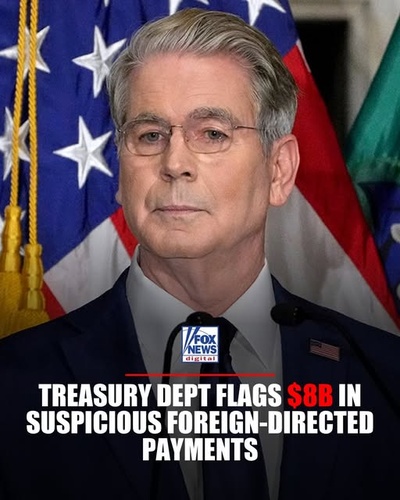
A striking headline featuring U.S. Treasury Secretary Scott Bessent has raised questions about financial security, international money transfers and the federal government's efforts to detect potentially suspicious activity. The Fox News Digital graphic states that the Treasury Department has flagged $8 billion in suspicious foreign-directed payments, a figure large enough to attract attention from policymakers, financial institutions and the public.
The reported amount immediately raises an important question: what does it mean when federal authorities identify billions of dollars in suspicious transactions? Although the headline suggests a significant financial development, it does not identify the period covered, the countries involved, the types of payments examined or whether investigators have established that any particular transaction was illegal.
That distinction is essential. Financial transactions can be classified as suspicious for numerous reasons, including unusual transfer patterns, inconsistencies in customer information, unexplained changes in account activity or potential connections to high-risk jurisdictions. A suspicious transaction is not necessarily a criminal transaction, and a reported total does not automatically represent money stolen, laundered or transferred unlawfully.
The Treasury Department plays a central role in protecting the integrity of the American financial system. Through its regulatory and enforcement responsibilities, the department works with banks, financial services companies and other government agencies to identify potential money laundering, sanctions violations, fraud and financing connected to criminal organizations.

One of the department's most important financial intelligence agencies is the Financial Crimes Enforcement Network, commonly known as FinCEN. The agency collects and analyzes financial information to help identify possible illicit activity and support investigations by authorized authorities. Its work is closely connected to the Bank Secrecy Act, which establishes reporting and recordkeeping obligations for certain financial institutions.
Banks and other covered businesses are required to maintain systems designed to identify unusual activity and, under applicable circumstances, submit Suspicious Activity Reports. These reports can alert authorities to transactions that warrant additional examination, but they are not equivalent to criminal charges or findings of wrongdoing.
A large dollar figure associated with suspicious activity can reflect the combined value of many transactions rather than a single transfer or coordinated operation. Some reports may involve activity that ultimately proves lawful, while others may lead investigators toward evidence of fraud, money laundering or sanctions evasion. The reporting process is intended to help authorities distinguish between those possibilities.
International payments are especially important because money can move through multiple financial institutions and jurisdictions before reaching its final destination. Cross-border transfers support legitimate commerce, investment, family remittances and humanitarian assistance. At the same time, complex international payment networks can sometimes be exploited by individuals seeking to conceal the origin, destination or purpose of funds.
The United States maintains extensive financial relationships with businesses, governments and individuals around the world. American banks process international transactions involving imports, exports, investment, travel and other economic activities. Protecting those transactions against abuse is an important part of maintaining confidence in the financial system.
However, aggressive financial monitoring must also account for the fact that legitimate international activity can appear unusual. A business expanding into a new market, a family transferring funds overseas or a company making a large one-time payment may trigger additional review without having violated any law.

The challenge for regulators is therefore to identify meaningful warning signs without treating every unfamiliar transaction as evidence of misconduct. Effective monitoring requires financial institutions to examine transaction patterns, customer profiles, business purposes and available supporting documentation.
The reported $8 billion figure also raises questions about how the amount was calculated. Financial intelligence reporting can involve overlapping records, multiple institutions and transactions that are related to one another. Without an explanation of the methodology, readers cannot determine whether the total represents unique payments, the cumulative value of reported activity or another measurement.
Treasury officials may use suspicious transaction information to identify emerging financial risks, but the department's role extends beyond monitoring bank accounts. It also administers economic sanctions through the Office of Foreign Assets Control, which implements restrictions involving designated individuals, organizations and jurisdictions.
Sanctions enforcement has become an important element of American foreign policy. Restrictions can target entities associated with terrorism, illicit weapons programs, corruption, cybercrime or other activities identified under applicable legal authorities. Financial institutions must screen transactions against relevant sanctions requirements and investigate potential matches.
A transaction involving a foreign destination does not automatically violate sanctions. The legal status of a payment depends on factors including the identities of the parties, the nature of the transaction, applicable restrictions and whether any licenses or exemptions are available.
The Treasury Department also works with domestic and international partners to address money laundering. Criminal networks may attempt to disguise proceeds from fraud, drug trafficking, corruption or other offenses by moving funds through accounts, businesses and jurisdictions that make the original source difficult to trace.
Financial investigators often look for patterns rather than relying on one isolated transfer. Repeated payments between apparently unrelated parties, unexplained movement through intermediary accounts and transactions inconsistent with a customer's stated business activities can all justify closer examination.

The growing sophistication of digital financial services has added new challenges to this work. Electronic payment platforms, online banking and other technologies allow funds to move rapidly across borders. These systems provide substantial benefits to consumers and businesses, but they also require effective safeguards against fraud and illicit activity.
Financial institutions increasingly rely on automated monitoring systems to identify unusual behavior. Such systems can process large volumes of transactions and highlight patterns that would be difficult for individual analysts to detect manually. However, automated alerts still require careful interpretation because unusual activity does not necessarily indicate criminal intent.
The accuracy of financial intelligence depends partly on the quality of information available to investigators. Incomplete customer records, complicated ownership structures and transactions involving several jurisdictions can make it difficult to determine who ultimately controls funds or why a payment was made.
Beneficial ownership transparency has consequently become an important topic in financial regulation. Authorities may need to understand which individuals ultimately own or control a company, particularly when complex corporate structures make financial relationships difficult to follow. Rules in this area remain subject to legal, administrative and policy developments.
For ordinary Americans, the discussion may seem distant from everyday financial concerns. Yet illicit finance can have consequences for consumers, businesses and public institutions. Fraud schemes can cause direct financial losses, while money laundering can help criminal organizations retain resources and expand their activities.
The federal government also has an interest in protecting the reputation and reliability of American financial markets. Banks and international businesses depend on confidence that transactions can be processed lawfully and that serious misconduct will be investigated through established procedures.
At the same time, financial enforcement must respect legal protections and avoid unnecessary disruption to legitimate economic activity. Overly broad restrictions or poorly designed compliance requirements can create costs for businesses and individuals who have no connection to unlawful conduct.

The reported figure could become politically significant if officials connect it to a particular federal program, government payment system or international network. But the headline alone does not establish such a connection. It would be inappropriate to infer that the $8 billion came from taxpayer-funded benefits, foreign aid, private bank transfers or any other specific source without additional documentation.
Similarly, the term “foreign-directed” requires clarification. It might refer to payments sent abroad, payments influenced by foreign entities or another classification used in the underlying report. Those meanings are not interchangeable, and each would carry different implications for financial oversight.
A complete assessment would require the Treasury Department's original findings, the relevant reporting period, the criteria used to flag transactions and an explanation of whether any enforcement actions followed. Those details would allow the public to understand the scale and significance of the activity more accurately.
If investigators identify evidence of criminal conduct, appropriate authorities may pursue further action under applicable laws. Such proceedings can involve subpoenas, asset tracing, civil enforcement or criminal charges, depending on the circumstances and the agencies responsible.
But a financial intelligence alert is not a verdict. Individuals and organizations named in investigations retain applicable legal rights, and allegations must be evaluated through evidence rather than assumptions.
The headline's most significant implication is therefore the need for transparency about how suspicious financial activity is detected, categorized and investigated. A large number can signal a substantial monitoring effort, but it cannot explain the nature of the underlying transactions on its own.
Additional reporting published on October 30 clarifies the central finding. FinCEN said the more than $8 billion involved potentially suspicious payments identified from 2021 through 2025, made through U.S.-based money services businesses at the direction of foreign agents. The figure was not presented as a confirmed total of criminal proceeds.
Bessent announced the finding during a broader fraud-enforcement initiative in Minnesota. He said the Treasury Department had stopped nearly $190 million associated with overseas fraud and returned more than $100 million to American victims. Officials also described expanded investigative activity and new guidance to help financial institutions recognize potentially suspicious transactions.
The administration additionally announced guidance concerning charities and nonprofit organizations. Authorities warned that certain organizational structures and funding arrangements can obscure the ultimate destination of money, potentially creating opportunities for fraud or illicit financing. These concerns do not establish that nonprofit organizations generally are engaged in misconduct.
FinCEN's alert also provides an important qualification: suspicious-activity reporting is investigative information, not proof that a crime occurred. The reported amount may include attempted transactions, overlapping activity and payments that ultimately prove legitimate.
The development is significant because it highlights the government's effort to strengthen oversight of international financial transfers. Its ultimate impact will depend on whether investigators can identify specific violations, recover funds and demonstrate that additional safeguards reduce financial crime without unnecessarily interfering with lawful payments.
The $8 billion finding is a substantial financial warning, but the amount of money actually connected to proven criminal activity remains a separate question.
Comments (0)
Loading comments...
May You Like

Trump Says Iran War Will “Get Wrapped Up Soon”

Danica Patrick Accuses Democrats