
Bolsonaro Family Faces Mounting Legal Pressure in Brazil — But Claims of a Sudden Surrender and Trump Abandonment Need Scrutiny
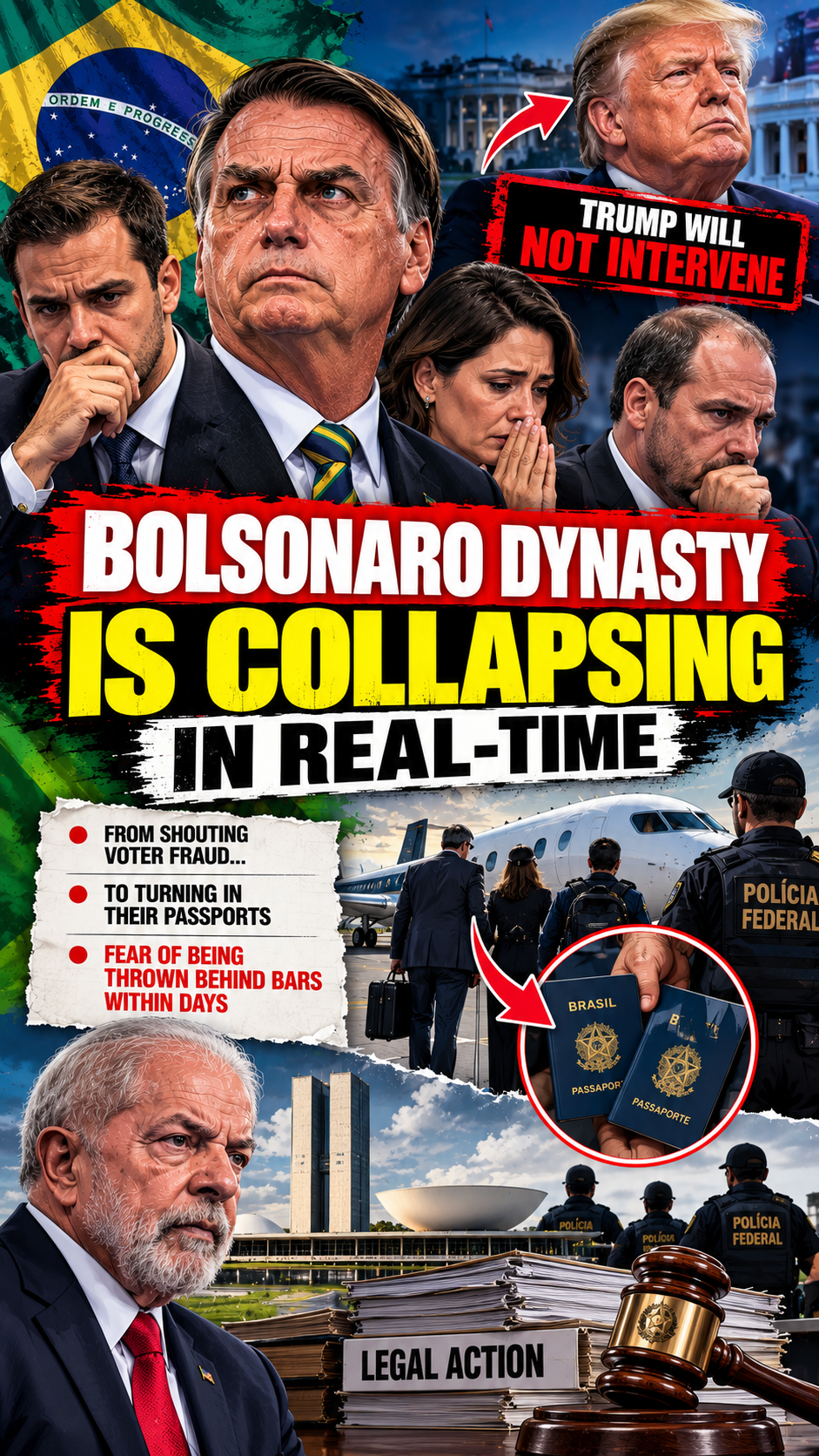
Brazil's former president Jair Bolsonaro and members of his political family remain at the center of a prolonged struggle involving criminal investigations, electoral legitimacy and the country's democratic institutions. Their legal difficulties have also become an issue in relations between Brazil and the United States, particularly because of President Donald Trump's public support for Bolsonaro.
But a dramatic account circulating online—that the entire Bolsonaro family abruptly surrendered its passports, abandoned a planned challenge to an election and began preparing for imprisonment after Trump refused to intervene—combines several distinct claims that require independent verification.
The family's legal exposure is real. Brazilian authorities have pursued investigations involving alleged efforts to overturn the 2022 presidential election, and Bolsonaro's supporters have repeatedly challenged the legitimacy of legal proceedings against him.
What has not been established by the material accompanying the viral claim is that every prominent member of the family surrendered a passport overnight, that a single American statement triggered such an action, or that the Brazilian government coordinated an immediate arrest operation against the entire family.
Those distinctions matter because the underlying controversy involves some of the most consequential legal proceedings in Brazil's recent political history.
The dispute began after Bolsonaro lost the October 2022 presidential runoff to Luiz Inácio Lula da Silva, who returned to office on January 1, 2023.
Bolsonaro and his allies had spent months questioning Brazil's electronic voting system. The country's electoral authorities rejected unsupported allegations that the system had been manipulated to change the result.
On January 8, 2023, supporters of the former president stormed the presidential palace, Congress and the Supreme Federal Court in Brasília, causing extensive damage and prompting a major criminal investigation.
Brazilian authorities subsequently examined whether political and military figures had participated in a broader attempt to prevent the peaceful transfer of power.
Bolsonaro has denied wrongdoing and has portrayed the proceedings against him as politically motivated.
The central legal question has not been whether a political party may criticize an election result. It has been whether particular individuals participated in criminal conduct intended to undermine the constitutional order.
The latest reporting adds a crucial development: the immediate controversy concerns Jair Bolsonaro's son Flávio Bolsonaro, who lost Brazil's October 25, 2026, presidential runoff to Lula and was ordered to surrender his passports the following day.
Flávio's defeat and the subsequent court order have placed the Bolsonaro family's political and legal difficulties in sharper focus. However, the passport order relates to a separate criminal investigation, and the available evidence does not establish that it was part of a coordinated effort by Lula to punish his election opponent.

The election result was decisive. Lula won approximately 51.8% of the runoff vote, defeating Flávio by more than four million votes and securing another presidential term.
Flávio initially disputed the result, alleging that the decision to extend voting hours in some locations had compromised the election.
Brazilian authorities said the extension was necessary because weather and transportation problems had interfered with voting.
An analysis of electoral records cited by Reuters found that fewer than 35,000 ballots were cast during the additional two hours—far below the margin separating the candidates.
That finding significantly weakens the argument that the extension alone could have changed the outcome. It does not, by itself, resolve every allegation about election administration, but it provides a concrete measure against which the claim can be assessed.
Flávio subsequently retreated from his initial demand to annul the election.
Rather than continuing to seek wholesale cancellation of the result, he said he would pursue a legal challenge alleging that Lula had improperly used government resources and welfare announcements to influence voters.
Those allegations have not been established as facts.
Flávio also said he would organize opposition lawmakers in Congress, indicating that his political response would continue through legislative and legal channels.
His Liberal Party acknowledged Lula's victory, even as Flávio continued criticizing the electoral process.

The passport order introduced a separate and more immediate legal problem for Flávio.
On October 26, Supreme Court Justice Alexandre de Moraes prohibited the senator from leaving Brazil and ordered him to surrender his ordinary and diplomatic passports to the Federal Police.
Flávio disclosed the order publicly after visiting his father in Brasília. He said police had served him with the restriction as he left the residence and that he intended to comply.
He denied having any intention of fleeing Brazil.
The order was issued in connection with an investigation involving Flávio and lawyer Willer Tomaz, who are suspected of involvement in financial wrongdoing, including possible money laundering.
According to Agência Brasil, the investigation concerns financial relationships involving the two men. Tomaz has also faced scrutiny over suspected transactions linked to betting businesses.
Both have denied wrongdoing. The allegations remain subject to legal proceedings and should not be presented as criminal convictions.
Flávio offered a different explanation for the travel restriction.
He suggested that the measure had been prompted by comments from his brother Eduardo Bolsonaro, who had advised him during a podcast appearance to leave Brazil if he lost the presidential election.
But the reported judicial proceedings concern an existing financial investigation, and Flávio's explanation does not establish the legal basis of the order.
The timing has nevertheless intensified political scrutiny of the judiciary.
Brazilian newspaper Folha de S.Paulo reported that some Supreme Court justices were concerned the decision could aggravate tensions and create the appearance of retaliation against a defeated presidential candidate.
That concern is distinct from a finding that the order was unlawful or politically directed.

The legal difficulties extend to other members of the family, but they are not identical.
Jair Bolsonaro was convicted over his role in the attempt to overturn his 2022 election defeat and received a 27-year prison sentence. Recent reporting describes him as being under house arrest in Brasília.
His son Eduardo Bolsonaro, a former federal lawmaker living in the United States, has faced a separate criminal case involving attempts to pressure Brazilian judicial authorities through American sanctions and trade measures.
On October 8, Justice Moraes ordered enforcement of Eduardo's four-year-and-two-month sentence, issued an arrest warrant and canceled his Brazilian passports.
Eduardo has rejected the proceedings as politically motivated. He remains in the United States, and reporting indicates that his extradition is uncertain.
The family's legal situation therefore involves different individuals, different proceedings and different legal consequences.
Flávio is subject to a travel restriction in an ongoing investigation. Eduardo faces an arrest warrant following a conviction. Jair is serving a sentence arising from the attempted overthrow of the constitutional order after the 2022 election.
These circumstances help explain why the family's political future has become so closely intertwined with judicial proceedings.
They do not support the blanket claim that all family members suddenly surrendered their passports together.

Trump's response to the Brazilian election added another layer of uncertainty.
Speaking to reporters on October 26, the American president questioned the credibility of the election and suggested it appeared suspicious.
However, he offered no evidence that the result had been manipulated.
He also said he had not taken sides in the election and did not announce measures intended to reverse Lula's victory.
The distinction is significant. Trump's comments questioned the process, but they did not constitute an official American rejection of the result or a commitment to intervene on Flávio's behalf.
The absence of an announced intervention contrasts with reporting about the administration's earlier involvement in Brazilian politics.
In an October 24 investigation, Reuters reported that two State Department officials had worked to help restore the Bolsonaro family's political influence, according to ten current and former American officials familiar with the effort.
The report described diplomatic and sanctions-related measures that sources said were intended to strengthen the Bolsonaro family's position.
Those allegations concern earlier U.S. policy decisions and should not be conflated with proof that Trump had agreed to overturn the October 25 election result.

A report by The Washington Post on October 26 offered a more personal explanation for Flávio's decision to abandon the annulment demand.
Citing a family adviser who spoke anonymously, the newspaper reported that Flávio was deeply concerned about the possibility of imprisonment and the legal consequences facing him and his father.
The adviser said the senator feared being detained within days and believed his political and legal position had become increasingly precarious.
That is an attributed account from an unnamed person close to the family—not an independently verified description of Flávio's private thoughts.
It also does not establish that an arrest was scheduled or imminent.
The same reporting connected his retreat from the annulment demand to the lack of a clear signal that Trump would intervene, along with the size of Lula's electoral victory and the recognition of the result by Brazilian institutions.
Flávio's public position has been more defiant.
Although he abandoned the immediate effort to annul the entire election, he continued to question the process and announced plans to organize opposition lawmakers.
He also said he would pursue allegations of abuse of political and economic power against Lula's campaign.
Such a legal challenge is different from a successful reversal of the election result. It would require judicial consideration of evidence and the applicable electoral laws.
No ruling establishing that Lula's victory was fraudulent has been identified in the current reporting.

Lula's victory creates a new political landscape in Brazil.
The president secured another term after overcoming a first-round deficit, while Flávio demonstrated substantial electoral support despite losing the runoff.
According to reported official figures, Lula received approximately 64.3 million votes, compared with 59.8 million for Flávio.
That result gives Lula a renewed presidential mandate but does not eliminate political opposition.
Flávio and his allies have indicated that they intend to continue organizing within Congress, where conservative and center-right parties retain significant influence.
Brazil's government must also navigate fiscal pressures, public security concerns, economic growth, social spending and diplomatic relations with Washington.
The legal disputes involving the Bolsonaro family will unfold alongside those policy challenges.
The independence of Brazil's judiciary, the rights of defendants and the legitimacy of the electoral process are all central to how those disputes are assessed.
For supporters of the investigations, the proceedings represent accountability for alleged wrongdoing and attempts to undermine democratic institutions.
For Bolsonaro allies, they raise concerns about judicial power, due process and political discrimination.
Those arguments should be evaluated against court decisions, documented evidence and the applicable law rather than assumptions about the motives of every participant.

The events of October 25 and 26 illustrate why several separate developments should not be compressed into one dramatic claim.
Brazil held a presidential runoff and Lula won by more than four million votes. Flávio initially called for the result to be annulled but subsequently shifted toward a narrower legal challenge. The Supreme Court restricted his ability to leave the country in connection with a financial investigation. Trump questioned the election but did not announce an intervention to overturn it.
Those are documented developments.
What remains less certain is how much Trump's position influenced Flávio's decisions, whether the reported fears of imprisonment accurately reflect his private concerns and how the ongoing financial investigation will proceed.
The anonymous adviser's account offers one possible explanation, but it cannot substitute for verified legal documents or Flávio's own statements.
Similarly, a court-ordered travel restriction does not prove that a person intends to flee or that a criminal conviction is inevitable.
The available evidence supports describing the Bolsonaro family as facing substantial political and legal pressure after a consequential election defeat.
It does not establish that the entire family has surrendered, that Lula personally orchestrated the passport restrictions or that Trump made a secret agreement to abandon them.
The immediate story is a defeated presidential candidate, a documented passport order, a retreat from an election-annulment demand and an American president who questioned the result without announcing intervention.
Those facts are significant on their own—and they will continue to shape Brazil's political debate as Lula prepares for another term.
Comments (0)
Loading comments...
May You Like

WWE BRONSON REED—STAR COLLAPSES AT COMPANY EVENT, FATAL DRUG REACTION SUSPECTED!

EAST COAST MEGASTORM—2 MILLION HOUSES DAMAGED, 5 MILLION AT RISK OF BLACKOUTS, WATER FAILURES!

EAST COAST DISASTER—179 THOUSANDS OF HOMES AT RISK, CAUSING $50 BILLION IN DAMAGE!










Popular Posts



