
Trump Admin Touts 96% Drop in Immigration From Muslim-Majority Countries Since 2024 — What the Data Actually Shows
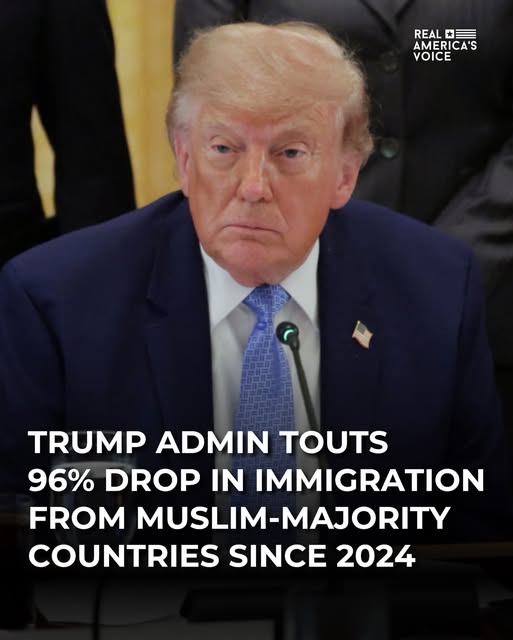
The Trump administration is celebrating a dramatic 96% reduction in legal immigration from Muslim-majority nations since 2024, sharing data from the Cato Institute on social media. The White House's Rapid Response 47 account posted a chart showing immigrant visa issuances and refugee admissions from 45 majority-Muslim countries fell from 21,096 in December 2024 to just 808 in February 2026. While the numbers are accurate, the data also reveals a complex reality: the cuts have blocked thousands of family members of U.S. citizens, reduced employment-based immigration, and affected immigrants of all faiths — including Christians.
WASHINGTON – The Trump administration touted a striking statistic this week: legal immigration from Muslim-majority countries has plummeted by 96% since President Donald Trump returned to office.
The administration's Rapid Response 47 account on X shared a chart from the Cato Institute, a libertarian-leaning think tank, showing that monthly immigrant visa issuances and permanent lawful refugee admissions from 45 majority-Muslim countries fell from 21,096 in December 2024 to 808 in February 2026.
"This is what securing our borders looks like," the post declared, signaling the administration's satisfaction with the outcome.
The Data Behind the Decline
According to the Cato Institute's analysis of State Department data, the decline is both historic and comprehensive.
Key findings:
-
Refugee admissions from majority-Muslim countries dropped to zero, falling from 5,157 in December 2024 to 0 in February 2026
Immigrant visas — primarily for family members of U.S. citizens — fell by 95%
Afghans accounted for 27% of the total drop, going from 5,563 legal immigrants and refugees in December 2024 to just 9 in February 2026 — a 99.8% decline
Pakistanis followed with a 97.9% drop, falling by 2,963
Employment-based immigrant visas were reduced by 41%
Only three countries — Qatar, Indonesia, and the United Arab Emirates — saw increases during this period. Turkey had the smallest decline at just 8%.
The Human Impact: Families, Christians, and U.S. Citizens
While the administration frames the data as a national security victory, the Cato Institute's analysis highlights the collateral consequences.
About half of the legal immigrants blocked are close family members of U.S. citizens and legal permanent residents. Approximately 3,500 spouses and minor children of U.S. citizens are being blocked each month by the policies.
Notably, many of the affected immigrants are not Muslim. Among refugees from these 45 countries between 2002 and 2024, 28% were not Muslim — including Christians, Jews, and other religious groups. Christians alone accounted for 21% of those refugees. In 2025, the State Department ceased reporting on the religious makeup of refugees.
The Cato analysis notes that if the 2024 level of immigration had continued, another 180,000 immigrants and refugees could have come legally in 2025 and 2026.
The Legal Architecture Behind the Cuts
The restrictions stem from a series of executive actions rather than a single piece of legislation:
-
A presidential proclamation suspended refugee admissions for 120 days starting January 2025
A presidential determination allocated FY2026 refugee admissions almost exclusively to South Africans
A proclamation barring entry from 40 countries — 10 of which are majority-Muslim — took effect in December 2025
A USCIS memorandum applied the 40-country ban to U.S. citizen petitioners inside the United States
A State Department "immigrant visa pause" affecting 75 countries, 28 of them majority-Muslim
The administration has argued that these measures are necessary to prevent threats from entering the country. The Office of the Inspector General has reported that vetting failed to flag threats from 40% of Afghan asylum seekers admitted in 2021 following the collapse of the pro-U.S. government in Afghanistan.
Legal Challenges Continue
The policies have not gone unchallenged in court.
In June 2026, U.S. District Judge John McConnell in Rhode Island blocked the administration from freezing work permits, green cards, citizenship applications, and other immigration benefits for noncitizens from 39 countries affected by the travel bans. The judge wrote that these immigrants "had been following the rules, yet were targeted because of where they came from".
"If people wish to immigrate to the United States, they ought to follow the law and do things the right way," McConnell wrote. "This case serves as a perfect example of immigrants doing just that".
The judge described the administration's national security justifications as "pretextual concerns" that masked anti-immigrant sentiments. The government has appealed, and the case remains ongoing.
The Bottom Line
| What the Administration Says | What the Data Shows |
|---|---|
| 96% drop in immigration from Muslim-majority countries | Accurate — from 21,096 in Dec 2024 to 808 in Feb 2026 |
| A national security achievement | Also blocked 3,500 spouses/children of U.S. citizens per month |
| Targeted at Muslim countries | 28% of affected refugees from these countries were non-Muslim |
| Legal immigration reduced | Employment-based visas down 41%; refugee admissions from these countries at zero |
The 96% figure is real. What it represents depends on where you stand: for the Trump administration, it is proof of a promise kept. For critics, it is a policy that has separated families, ended refugee resettlement for some of the world's most vulnerable people, and raised serious questions about religious discrimination.
The numbers tell a dramatic story. The context tells a more complicated one.
Comments (0)
Loading comments...
May You Like


South Korea–Ukraine Rift Deepens Over North Korean POW Transfer as PURL Draws New Scrutiny













