
Trump Administration Cut U.S.-Backed Nepal Disaster Monitoring Program — Then a Catastrophic Himalayan Flood Struck
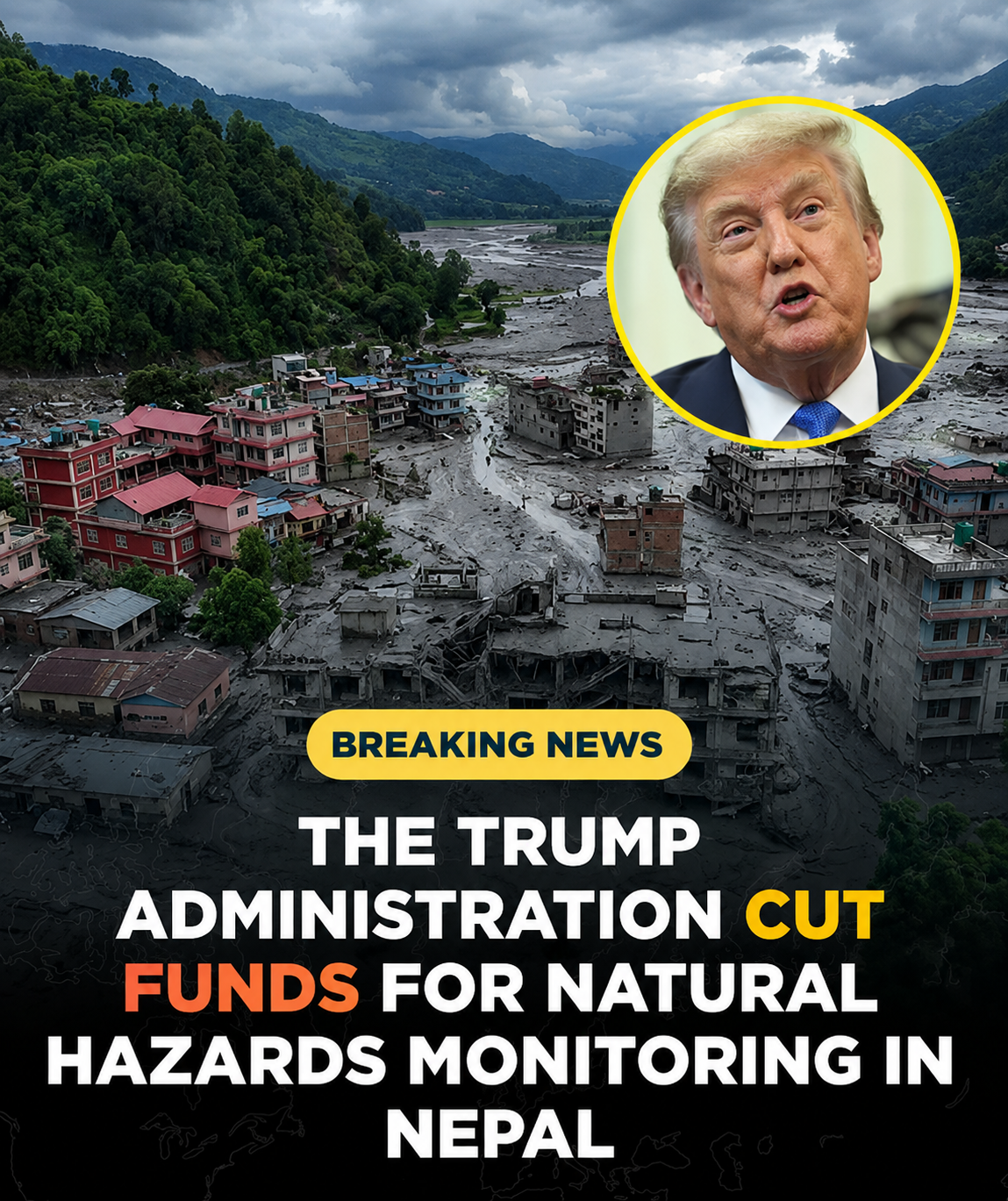
KATHMANDU/WASHINGTON — A devastating disaster in Nepal has thrust a controversial question back into the international spotlight: what happens when governments scale back the systems designed to monitor natural hazards in some of the world's most dangerous terrain?
A U.S.-backed environmental monitoring initiative serving Nepal and other countries across the Hindu Kush Himalaya formally ended in January 2025, after major changes to U.S. foreign-aid policy under President Donald Trump. The program, known as SERVIR-Hindu Kush Himalaya (SERVIR-HKH), had used satellite imagery, geospatial technology and scientific data to help monitor floods, landslides, glaciers and other environmental hazards.
Now, roughly a year and a half later, Nepal is confronting one of the worst disasters in its recent history.
A catastrophic flood triggered by a glacier-related collapse on Aug. 26 tore through the Trishuli River valley, destroying villages, roads, bridges and hydropower infrastructure. By Sept. 4, Nepalese authorities reported at least 1,287 deaths and more than 5,000 people missing, while rescue teams were still searching for survivors in devastated areas.
The timing has prompted fierce criticism of the Trump administration's foreign-aid cuts.
But there is an important distinction between the end of the program and claims that the funding cut caused the deaths. Experts and U.S. officials say it would be impossible to establish that the former SERVIR program could have predicted or prevented this particular catastrophe.
A Disaster-Monitoring Program Ends
SERVIR-HKH was part of a broader partnership involving the U.S. Agency for International Development, NASA and the International Centre for Integrated Mountain Development, or ICIMOD.
For years, the initiative worked across the Hindu Kush Himalaya region, including Nepal, Bangladesh, Bhutan, Pakistan and other countries. Its purpose was not simply to collect climate data. It developed practical tools using satellite observations and geospatial analysis to help governments understand environmental threats and make better decisions.
The program worked on issues ranging from flood forecasting and glacier inventories to mapping potentially dangerous glacial lakes and identifying areas vulnerable to landslides.
ICIMOD says the SERVIR-HKH initiative formally concluded in January 2025 following disruptions to U.S. funding.
However, an important nuance has emerged: the program's end did not mean every tool disappeared overnight. ICIMOD says that many services, tools and resources developed through the initiative remain active, while some regional activities continue through the broader SERVIR network.
That distinction matters because social-media posts and political commentary have increasingly presented the story as a straightforward chain:
Trump cuts funding → Nepal loses warning system → deadly flood happens.
The actual evidence is considerably more complicated.
The Trump Administration's Foreign-Aid Overhaul
The program's termination came amid a sweeping restructuring of U.S. foreign assistance after Trump returned to the White House in January 2025.
His administration froze much of U.S. foreign aid and moved to dismantle or restructure USAID. Programs associated with climate, development and disaster-risk reduction were among those affected.
Former officials and people involved with SERVIR have said the sudden loss of funding disrupted work that had been expected to continue into 2026.
Birendra Bajracharya, a former director of SERVIR-HKH, told CNN that the project received a stop-work notice near the end of January 2025. Some work could not be completed, including efforts involving landslide monitoring.
The broader political argument is therefore straightforward: critics say the United States abandoned a relatively inexpensive scientific infrastructure project in one of the world's most disaster-prone regions just as climate and geological risks were intensifying.
But that does not establish that the project would have prevented the August 2026 disaster.
Could SERVIR Have Prevented the Catastrophe?
This is where the story becomes much more complicated.
SERVIR-HKH was never a complete, nationwide emergency-warning network capable of predicting every Himalayan disaster in real time.
Its work included satellite-based mapping, environmental monitoring, flood-related analysis and tools that could help authorities understand hazards. It also supported flood forecasting and mapping activities in Nepal.
But the U.S. State Department has pushed back against claims that the program could have forecast the exact event that devastated Nepal.
A State Department spokesperson said SERVIR-HKH was not designed as an end-to-end real-time flood-warning system and argued that the specific glacier-related catastrophe was not forecastable with the technology available at the time. The department also said some SERVIR tools and services remain available through ICIMOD and that the United States continues to support flood-mitigation efforts in Nepal through other initiatives.
That means the strongest version of the viral claim — that cutting SERVIR directly caused the deaths — goes beyond the available evidence.
The more defensible conclusion is different:
The funding cuts removed or disrupted some scientific and disaster-risk work at a time when Nepal desperately needed greater monitoring capacity. Whether that changed the outcome of this particular disaster cannot currently be proven.
Then the Himalayas Were Hit by a Catastrophic Flood
On Aug. 26, a massive cascade of ice, rock and water struck the Himalayan border region.
The disaster devastated Nepal's Rasuwa district and the Trishuli River corridor, while also affecting Tibet on the Chinese side of the border.
Entire settlements were transformed into fields of mud and debris. Roads and bridges disappeared. Hydropower facilities were buried. The Gyirong border crossing, an important trade route between China and Nepal, was severely damaged.
The humanitarian consequences rapidly escalated.
Thousands of people were reported missing, while rescue teams faced extraordinary obstacles created by unstable slopes, destroyed roads and blocked tunnels.
At one hydropower facility, rescuers eventually found workers who had survived for days underground. Reuters reported that two men were rescued after being trapped for nine days, while authorities believed hundreds of other workers could still be trapped at several hydropower sites.
Nepal's Warning Systems Were Already Under Pressure
The tragedy has also exposed a much broader problem that cannot be reduced to American foreign aid.
Nepal sits in one of the world's most geologically and climatically dangerous regions.
Its mountains contain glaciers, unstable slopes and potentially dangerous glacial lakes. Heavy monsoon rainfall can combine with melting ice, landslides and rapidly changing river conditions to create cascading disasters.
And climate change is making the situation increasingly difficult.
A senior United Nations official warned this week that the Himalayas face escalating risks from glacial floods as warming temperatures destabilize glaciers and increase pressure on natural barriers. Scientists have identified dozens of potentially dangerous glacial lakes across Nepal, China and India, while the number of vulnerable sites is believed to have increased.
The problem is therefore bigger than one cancelled American program.
Nepal needs continuous satellite observation, ground sensors, hydrological measurements, seismic monitoring, reliable communications and rapid-warning systems capable of reaching communities in remote valleys.
Nepal Is Now Trying to Rebuild
Ironically, the disaster has forced authorities to accelerate precisely the kind of monitoring infrastructure that experts have been warning about for years.
Nepal is planning to rebuild and strengthen an early-warning system along its border with China.
The proposed system is expected to combine seismic sensors, cameras and satellite communications, allowing authorities to monitor unstable areas and transmit warnings even when conventional communications networks fail.
Officials acknowledge that such technology may provide only minutes of warning in some circumstances.
But in a mountain disaster, minutes can mean the difference between life and death.
A warning that reaches a village five minutes earlier can give residents time to move uphill, evacuate a dangerous building or escape a river channel.
The United States Is Still Providing Some Support
Another detail frequently lost in online versions of the story is that the United States has not completely abandoned disaster-related assistance to Nepal.
When the August disaster struck, Washington initially announced $500,000 in emergency assistance, later increasing the U.S. contribution to about $3.6 million, according to reporting by The Guardian. The initial amount was sharply criticized by aid experts who argued that it was inadequate compared with America's historical role in international disaster response.
The State Department, meanwhile, says the United States continues to support flood-warning and disaster-mitigation capacity through other international programs.
That makes the political argument even more complicated.
The question is no longer simply whether Washington is helping Nepal.
It is what kind of help Washington is willing to provide — emergency relief after disaster, or long-term investment intended to reduce the scale of disasters before they happen.
A Warning About What Happens Next
The Nepal catastrophe has become a powerful case study in the consequences of underinvestment in disaster preparedness.
Critics of Trump's foreign-aid cuts argue that prevention is usually cheaper than emergency response. A satellite-monitoring project, they say, may look insignificant on a federal budget spreadsheet — until a disaster destroys communities and governments have to spend millions or billions responding to it.
Supporters of the administration's restructuring counter that the United States cannot indefinitely fund every overseas development and climate initiative, particularly when Washington can pursue more targeted programs through other agencies and international organizations.
Both arguments contain an element of reality.
What remains unresolved is whether the United States abandoned a useful piece of scientific infrastructure too quickly — and whether some of the work could have been preserved at relatively low cost.
The Bigger Question After Nepal
The most dangerous conclusion would be to claim that one American funding decision directly caused Nepal's catastrophe.
There is not enough evidence to make that claim.
The more troubling question is arguably broader.
As climate change increases the risks facing mountainous regions, can governments afford to dismantle monitoring systems before they know exactly what the next disaster will look like?
SERVIR-HKH did not possess a magic system capable of stopping a glacier collapse. It could not guarantee that thousands of people would have survived.
But it represented something increasingly valuable in a warming and rapidly changing world: the ability to see danger before it becomes a disaster.
Nepal is now rebuilding that capacity while rescuers continue to search through the ruins.
And the lesson emerging from the Himalayas may extend far beyond Nepal: when disaster-prevention systems disappear, the cost of discovering their value may come only after the warning has already arrived too late.
Comments (0)
Loading comments...
May You Like
TRUMP HIT WITH 26 ARTICLES OF IMPEACHMENT

Russian Drone Strikes Kyiv Bridge as German Chancellor Arrives in Ukraine

gfnhgmnghnmfgnbvvvvvvvvv













