
Trump Administration Drafts Plan to Give Child Care Funds to Stay-at-Home Parents in Vance-Backed Policy Shift
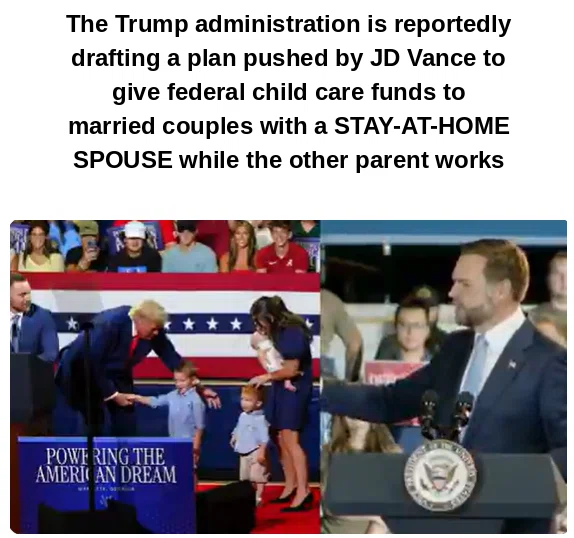
The Trump administration is drafting a plan that would allow married couples with a stay-at-home spouse to receive federal child care subsidies — a policy championed by Vice President JD Vance that would redirect money from a program originally created to help low-income parents afford care while they work or attend school .
WASHINGTON – In what would be a significant shift in federal child care policy, the Trump administration is moving to open the $12 billion Child Care and Development Fund (CCDF) to families where one married parent stays home while the other works at least 35 hours per week . The change could provide up to $9,000 per child annually to qualifying families and would mark the first federal subsidy specifically designed to pay parents to stay home and raise their children .
The plan, which does not require congressional approval, is being pushed by Vice President JD Vance as a top priority and incorporates policies originally drafted by Secretary of State Marco Rubio when he was a senator from Florida .
How the Policy Would Work
Under the draft rule, married couples who meet income requirements — typically below 85% of their state's median income, though some states set the bar at 60% — could receive CCDF assistance when one spouse stays home to care for their child while the other works at least 35 hours per week . Unmarried couples and single parents who are not working would not qualify .
The program currently serves about 1.3 million children and primarily supports low-income families who need child care to maintain employment or pursue education . Approximately 80% of the 870,000 families receiving subsidies are headed by single working parents, most of them mothers .
The administration has already signaled its direction on this issue. In May 2026, the Administration for Children and Families (ACF) issued a "Dear Colleague Letter" clarifying that faith-based providers and family caregivers can play a larger role in federally supported child care, and encouraged states to use TANF funds to support married two-parent families where one parent stays home .
Vance's Longstanding Advocacy
Vance has been a vocal proponent of policies that encourage parents — particularly mothers — to stay home with young children. In a 2021 Wall Street Journal op-ed, he argued that "young children are clearly happier and healthier when they spend the day at home with a parent" . He also wrote that "normal Americans" want a "family policy that doesn't shunt their kids into crap daycare so they can enjoy more 'freedom' in the paid labor force" .
The vice president's personal life has aligned with his policy advocacy. His wife Usha, a former corporate lawyer, gave birth to their fourth child in July 2026 . Vance has previously joked that he used his "good persuasion skills" to convince his wife to have a fourth child while he was running for vice president .
The policy also echoes proposals in Project 2025, the Heritage Foundation blueprint, which suggested that funding should "go to parents either to offset the cost of staying home with a child or to pay for familial, in-home child care" . Roger Severino, who wrote the child care section of Project 2025, called the proposed change "equal treatment" for stay-at-home parents .
The Controversy and Criticism
Critics have raised multiple concerns about the proposal, arguing that it would redirect funds away from the working families who currently depend on them and could worsen what experts describe as a national child care crisis .
Joshua McCabe, director of social policy at the Niskanen Center, a centrist think tank, expressed support for helping stay-at-home parents but criticized the approach: "I am a big proponent of more support for stay-at-home parents. But this is not how I would choose to do it. Expanding the eligibility without increasing funding would mean more parents competing for the same dollars, and leaving more parents — particularly single working parents — worse off" .
Policy analyst Madeline Summerville told GB News that the policy "is actually functioning less as evening things out and more as giving a bonus to people who decide to stay home," describing it as a "ploy" to "push the traditional family and to create more detriments for those who are the poorest in our society" .
Some lawyers within the administration have reportedly raised questions about whether conditioning the benefit on marriage is lawful, while others flagged fraud risks because the subsidy would go directly to individual recipients rather than licensed providers .
The Political Landscape
The proposal comes amid broader conservative efforts to promote what the administration describes as "pro-family" policies. In May 2026, the administration launched moms.gov, offering advice on diet, pregnancy, and health center access, as well as information on setting up "Trump Accounts" for children who are U.S. citizens .
However, critics have noted that the administration's pro-family rhetoric has been accompanied by cuts to programs that support families, including food assistance, healthcare, and rental assistance . The Trump administration has also increased reporting burdens on states to access CCDF funds, raising fears of payment delays and disruptions for child care providers .
What Happens Next
The rule change could take effect as soon as next year but still requires White House sign-off and a public comment period . The administration can implement the change without congressional approval .
The White House, Vice President Vance's office, and the Department of Health and Human Services have not publicly commented on the draft plan .
| Key Details | What's Proposed |
|---|---|
| Program | Child Care and Development Fund ($12B/year) |
| Current Beneficiaries | 1.3 million children, 870,000 families |
| Current Eligibility | Low-income parents who work, attend school, or receive training |
| Proposed Change | Married couples with stay-at-home spouse while other works 35+ hrs/week |
| Maximum Benefit | ~$9,000 per child per year |
| Qualifying Families | Income below 85% of state median income (some states lower) |
| Unmarried Couples | Would not qualify |
| Congressional Approval | Not required |
| Implementation | Possible in 2027 |
Comments (0)
Loading comments...
May You Like

gfnhgmnghnmfgnbvvvvvvvvv


OBAMA STUNS ON INSTAGRAM: MESSAGE MARKING 34-YEAR MILESTONE SPARKS A BUZZ












