Trump Administration Expands ‘Public Charge’ Rule as Viral Post Misstates Who Could Lose Benefits
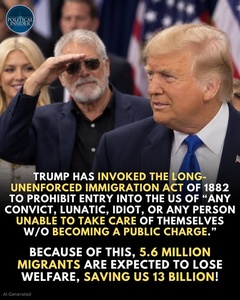
A new Trump administration immigration rule broadens how federal officers evaluate reliance on public assistance, but viral claims involving an 1882 law, 5.6 million migrants and $13 billion require important context.
The Trump administration’s new public-charge rule took effect September 18, expanding immigration officers’ discretion when deciding whether certain visa or green-card applicants are likely to depend on government assistance.
The policy rescinds a 2022 Biden-era regulation that more narrowly defined which benefits and circumstances officers could consider when applying the public-charge ground of inadmissibility under federal immigration law.
Under the new framework, U.S. Citizenship and Immigration Services can weigh a broader range of facts, including certain means-tested public benefits, as part of an applicant’s overall financial and personal circumstances.
The rule does not simply revive the Immigration Act of 1882. Instead, today’s authority comes from the Immigration and Nationality Act, whose public-charge provision traces its historical roots to nineteenth-century immigration law.
The 1882 statute did exclude several categories of immigrants, including people considered likely to become a public charge, but that original law has long since been superseded by later federal immigration statutes.
That distinction matters because viral posts describe Trump as suddenly invoking an unenforced 1882 law, when the administration is actually changing how an existing modern statutory public-charge standard is applied.
The administration argues the change restores congressional intent, promotes immigrant self-sufficiency and protects taxpayers by giving officers greater flexibility to consider whether applicants may rely on public resources.
Opponents, including a coalition of Democratic-led states and major cities, sued on September 14, arguing the rule is unlawfully vague, exceeds federal authority and could discourage eligible families from seeking assistance.
The lawsuits were filed only days before the rule’s effective date and seek to overturn the policy, while state and local officials warned of consequences for health coverage, food assistance and housing support.
The viral graphic’s claim that 5.6 million migrants are expected to lose welfare is not supported by the federal rule’s own economic analysis or by the research behind that figure.
KFF estimates that about 5.6 million U.S.-citizen children are enrolled in Medicaid or CHIP while living in households containing at least one noncitizen, making them potentially vulnerable to chilling effects.
Those children are not accurately described as 5.6 million migrants, and KFF does not predict that all of them will lose benefits under the new public-charge policy.
KFF instead modeled several possible disenrollment rates, estimating that between roughly 1.4 million and 4.1 million Medicaid or CHIP enrollees in mixed-status households could leave coverage under different assumptions.
The Department of Homeland Security produced a separate estimate, projecting about 1.27 million people could disenroll from or forgo enrollment across several benefit programs because of the rule.
DHS estimated that reduced federal and state transfer payments could total about $13.05 billion annually, including effects involving Medicaid, CHIP, SNAP, housing assistance and other programs examined in its analysis.
That $13 billion figure represents estimated reductions in government transfer payments, not a straightforward calculation showing that taxpayers will receive $13 billion in net savings without offsetting costs.
DHS itself acknowledged that lower benefit participation could create downstream effects for state and local governments, businesses, healthcare systems and individuals, making the broader economic impact more complicated.
The policy also should not be confused with a general welfare ban on undocumented immigrants, who are already barred from most federal public benefits under a separate 1996 federal law, subject to limited exceptions.
Public-charge determinations primarily affect certain people seeking admission to the United States or adjustment to lawful permanent resident status, while numerous immigration categories and circumstances are treated differently or exempted.
The most accurate summary is that Trump’s administration broadened the modern public-charge test effective September 18, while viral claims about invoking an 1882 law and 5.6 million migrants losing welfare overstate the policy.

Comments (0)
Loading comments...
May You Like

Obama Steps Back Into the Political Spotlight as Democrats Target Trump’s
TRUMP’S OHIO WARNING UNDER THE SPOTLIGHT
OBAMA STUNS ON INSTAGRAM: MESSAGE MARKING 34-YEAR MILESTONE SPARKS A BUZZ