Trump Administration Weighs $9,000 Child-Care Subsidy for Stay-at-Home Parents
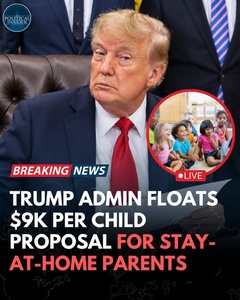
WASHINGTON — The Trump administration is considering a significant change to federal child-care subsidies that could allow some married families with a stay-at-home parent to receive roughly $9,000 per child annually.
A New Direction for Child-Care Assistance
The proposal, reported by The New York Times and other outlets, would redirect money from an existing child-care program toward families where one spouse works and the other provides care at home.
The plan has not been formally announced or finalized, meaning eligibility rules, payment amounts and implementation details could still change before any regulation takes effect.
Under the draft described by The Times, the program would cover certain married couples meeting income requirements when one spouse works at least 35 hours weekly and the other stays home.
The proposed benefit would come through the Child Care and Development Fund, or CCDF, a federal program historically designed to help low-income families afford care while parents work, study or train.
CCDF assistance is administered through states, which determine eligibility within federal guidelines and generally distribute support through vouchers or payments connected to child-care services.
Why the $9,000 Figure Matters
The Government Accountability Office reported in 2025 that CCDF is the primary federal funding source for child-care subsidies, supporting low-income families so parents can work, attend school or receive training.
The same report found that about 1.8 million children received subsidies in 2021, representing roughly 15 percent of children considered eligible under federal criteria.
The administration's proposed expansion therefore raises questions about how existing funds would be divided if families using formal child-care providers must compete with newly eligible stay-at-home parents.
Reporting by The Times said about 80 percent of families currently receiving subsidies are single working-parent households, most of them mothers, based on Health Department data.
Support and Opposition
Supporters of the proposed change argue that parents providing full-time care at home should be able to receive public assistance rather than being excluded simply because they do not purchase commercial child care.
The approach has also been associated with a broader conservative policy argument favoring greater flexibility for families to choose between paid employment, relatives providing care and parents raising children at home.
Vice President JD Vance has previously advocated policies supporting stay-at-home parents, although a White House official told Fox News that Vance has not specifically pushed this reported proposal.
The idea has precedent in conservative policy circles. Project 2025 called for directing child-care funding toward parents who stay home or provide care through relatives and other family arrangements.
Critics argue that expanding eligibility without substantially increasing funding could spread limited resources across more households, potentially reducing assistance available to working parents who already depend on child-care subsidies.
Some conservative economists and commentators have also questioned whether using government benefits to encourage particular family arrangements fits traditional conservative arguments for limiting government involvement in private household decisions.
The Broader Child-Care Debate
The debate comes as federal policymakers continue addressing high child-care costs, limited availability and workforce shortages, issues that can influence whether parents remain employed or leave jobs to provide care.
has noted that states have substantial flexibility in administering CCDF, so the practical effect of any federal eligibility change could vary significantly across states and household circumstances.
If the administration proceeds through a new rule, it would generally need to publish the proposal and allow a period for public comment before finalizing the policy. The Times reported that the measure could potentially take effect next year if finalized.
Until those steps occur, the reported $9,000 figure should be understood as an estimated typical subsidy under the existing program, not a guaranteed payment that every stay-at-home parent would receive.
Sources: The New York Times, Fox News, Deseret News, U.S. Government Accountability Office, and U.S. Department of Health and Human Services materials.
Comments (0)
Loading comments...
May You Like

South Korea–Ukraine Rift Deepens Over North Korean POW Transfer as PURL Draws New Scrutiny

Obama Steps Back Into the Political Spotlight as Democrats Target Trump’s