
Federal Judge Restricts Trump Administration’s Voter Investigations in Nine States, Citing Faulty Data and Intimidation Concerns
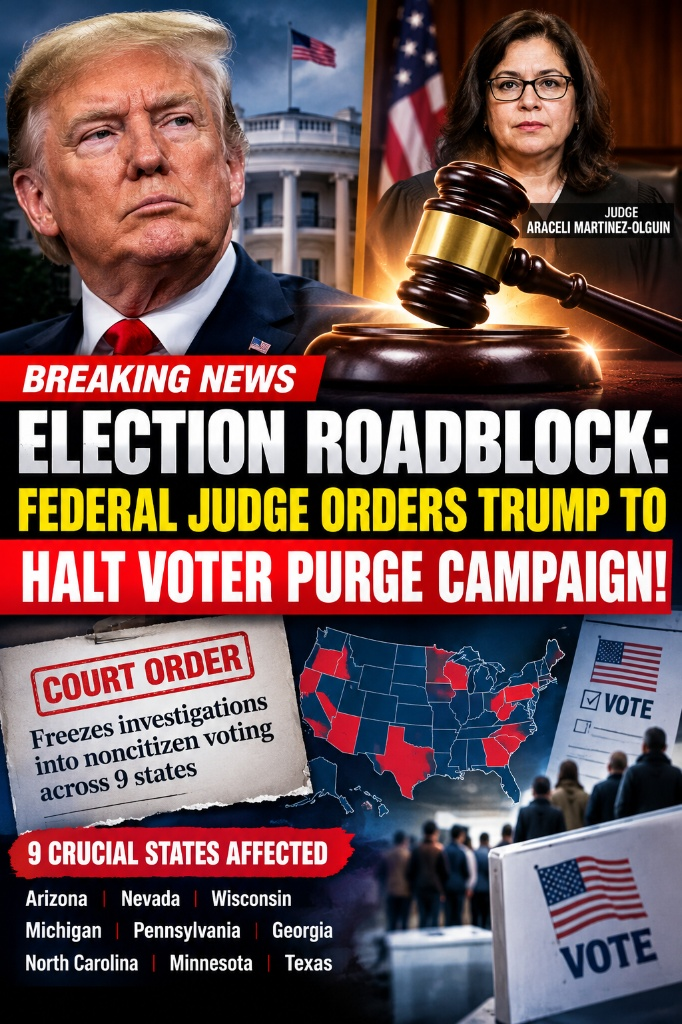
A federal judge in California has ordered the Trump administration to restrict election-related investigations targeting suspected noncitizen voters in nine states, raising fresh questions about the accuracy of the government’s voter-matching methods and the potential impact of enforcement operations on eligible voters ahead of the November 3, 2026, midterm elections.
U.S. District Judge Araceli Martínez-Olguín, based in Oakland, issued the ruling on October 21 after concluding that the administration’s investigative effort relied on data sources with a high risk of error and had contributed to fears of intimidation among groups working to encourage voter participation. The order was initially placed on hold until 5 p.m. Friday, October 23, to give the administration an opportunity to appeal.
The decision does not amount to a blanket prohibition on every federal investigation into election violations. Rather, it restricts specified field operations and interviews involving, or likely to involve, U.S. citizens under the administration’s voter-investigation initiative. The distinction is important: noncitizens are generally prohibited from voting in federal elections, but U.S. citizens may not be wrongly targeted or deterred from participating because of unreliable records.
The case comes amid a wider dispute between the administration and state and local election officials over access to voter-registration records, the identification of potentially ineligible registrants and the federal government’s role in election administration. The judge’s ruling focuses on the methods used in the challenged investigation and the risks they pose—not on a determination that every person flagged by the government was wrongly identified.
The nine states affected by the ruling


The court’s order applies to investigations in these nine states:
California
Connecticut
Georgia
Missouri
Nevada
New York
Pennsylvania
Washington
Wisconsin
An important correction to the supplied graphic: the states listed in the image—Arizona, Michigan, North Carolina, Minnesota and Texas—are not the nine states named in the reporting on this particular order. The correct list is California, Connecticut, Georgia, Missouri, Nevada, New York, Pennsylvania, Washington and Wisconsin.
The investigation is part of the Department of Homeland Security’s Unlawful Voter Initiative, a federal effort to identify people suspected of registering or voting when they were not eligible to do so. The administration has defended its work as an effort to protect election integrity, while the organizations challenging the initiative argue that the methods risk sweeping eligible citizens into investigations and discouraging lawful voter participation.
Why the judge questioned the government’s data


A central issue in the case is how federal investigators compiled lists of people they suspected might be noncitizens.
According to court filings described by The Associated Press and The Washington Post, the government drew on multiple sources, including official state voter rolls, commercial voter databases and a collection of approximately 48.2 million records whose origins the judge regarded as questionable. The administration also used artificial-intelligence tools to help process information and identify people for further review.
The judge identified a fundamental problem: there is no comprehensive federal database that definitively records the citizenship status of every U.S. resident. As a result, matching voter-registration information against other records can produce errors, particularly when the underlying databases contain outdated, incomplete or inconsistent information.
The court also focused on the pace of the investigative operation. According to the filings, officers working during an intensified phase were instructed to complete at least 40 reviews, with no more than 12 minutes to assess each flagged person using commercial databases. The judge concluded that those constraints further increased the risk of mistaken identifications.
That concern is especially significant when an inaccurate match leads to an in-person visit or questioning by armed federal agents. A database entry can serve as a lead for further investigation, but it does not necessarily establish that someone is a noncitizen, registered unlawfully or cast an illegal ballot.
The judge’s reasoning therefore centered on the potential consequences of combining uncertain records with rapid screening and field operations in the run-up to a major election.
The legal challenge: voter protection versus federal enforcement
The lawsuit was brought by the California Nurses Association, National Nurses United, the Voto Latino Foundation, the city and county of San Francisco, and Santa Clara County. The plaintiffs argued that the administration’s approach was interfering with their ability to encourage, educate and assist eligible voters during the election period.
The judge found that the plaintiffs had presented substantial evidence that the government’s conduct was directly interfering with their members’ efforts to promote voter participation. She concluded that the combination of unreliable data and intimidating investigative practices created a reasonable fear that citizens could be wrongly targeted.
The legal issue is not simply whether the government may investigate potential election violations. Federal authorities have a legitimate role in enforcing federal election law. The dispute is whether the specific investigative methods challenged in this lawsuit cross legal boundaries by creating an unreasonable risk of intimidation or interfering with lawful efforts to help citizens participate.
The judge did not conclude that every investigation into suspected noncitizen voting was unlawful. Instead, the ruling places limits on specified operations under the initiative, particularly those involving people whom authorities know, suspect or reasonably should suspect are U.S. citizens.
How the Trump administration responded


The Department of Homeland Security has defended the initiative, saying its objective is to prevent unlawful voting and protect the ballots of eligible American citizens. In a statement reported by the Associated Press, the department said it had no plans to question or investigate people it believed to be U.S. citizens.
That position highlights the central disagreement. The administration says it is pursuing suspected violations and protecting election integrity. The plaintiffs contend that the government’s data and field tactics risk identifying citizens incorrectly and discouraging people from participating in lawful election-related activities.
The administration also had an opportunity to challenge the ruling through an appeal. The judge initially delayed implementation until Friday evening, October 23, to allow time for that step. The sources available for this report establish that deadline, but do not independently confirm the final status of any appeal or subsequent modification of the order.
Why the midterm timing matters
The ruling arrives as states prepare for the November 3 midterm elections, when voters will decide congressional races and other contests with implications for the balance of power in Washington. Early voting is already underway in parts of the country, making the practical effects of election-related investigations a particularly sensitive issue.
For voter-assistance organizations, the concern is that citizens may avoid campaign events, decline to volunteer as poll monitors or hesitate to seek help with registration if they fear that their personal information could trigger a federal investigation. The judge cited evidence that the challenged practices had created such concerns among people involved in voter mobilization.
At the same time, the legal dispute does not mean that noncitizen voting is lawful. Noncitizens generally cannot vote in federal elections, and the government may investigate credible evidence of violations. The question before the court is whether this particular initiative, as carried out, uses sufficiently reliable methods and respects legal protections for citizens and lawful voter-assistance activity.
That distinction matters in a polarized election environment: protecting election integrity and preventing wrongful intimidation are both legitimate concerns, and evidence is needed to assess whether enforcement methods achieve the former without undermining the latter.
What happens next?
The immediate questions concern the scope and enforcement of the judge’s order, whether the administration has appealed, and whether a higher court will leave the restrictions in place before Election Day.
The case could also influence the broader legal battle over federal access to state voter records. The Justice Department has pursued separate litigation seeking access to detailed voter-registration information from states, while state officials and voting-rights advocates have challenged aspects of the federal government’s approach. Those cases are related to the larger debate, but they are legally distinct from the specific order issued by Judge Martínez-Olguín.
Ultimately, the next stage will depend on the court record and any subsequent rulings. The administration may argue that its investigative methods are necessary and lawful; the plaintiffs will continue to contend that the challenged practices create an unacceptable risk of error and intimidation.
The bottom line: A federal judge has restricted parts of the Trump administration’s investigation into suspected noncitizen voting across nine states, citing unreliable data and evidence of potential intimidation. The order does not prohibit all investigations into election violations, and the final legal outcome remains subject to further proceedings. The key question is whether federal enforcement can identify genuine violations without wrongly targeting citizens or chilling lawful voter participation.
Comments (0)
Loading comments...
May You Like


EAST COAST MEGASTORM—2 MILLION HOUSES DAMAGED, 5 MILLION AT RISK OF BLACKOUTS, WATER FAILURES!









Popular Posts





