
Trump and Obama Take Their Midterm Messages to Different States as Battle for Congress Intensifies
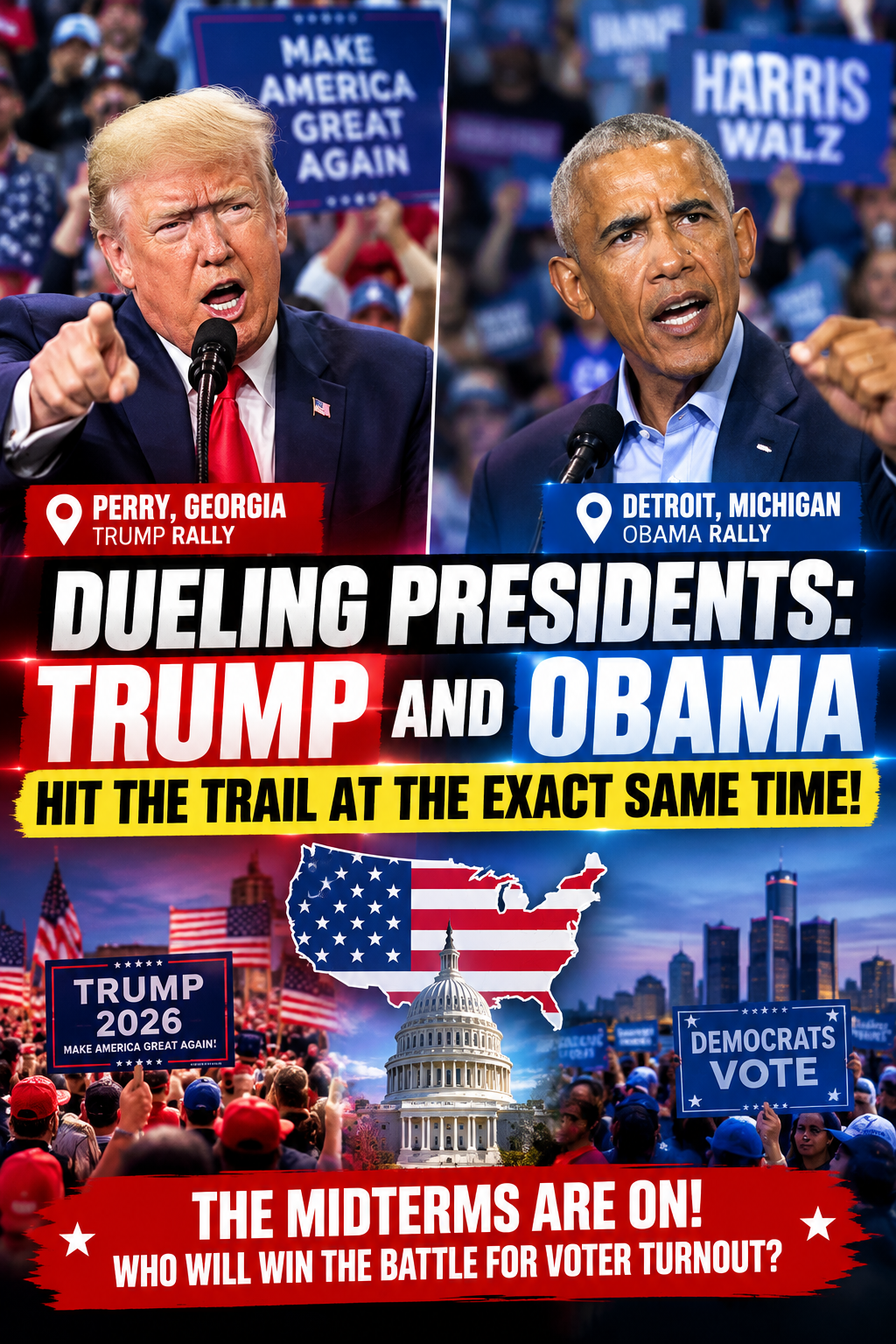
President Donald Trump and former President Barack Obama are taking their competing political messages to voters in the final stretch of the 2026 midterm elections, highlighting the stakes for congressional control as Republicans and Democrats prepare for the November 3 vote.
The two presidents are not competing against each other on the ballot. Instead, they are using their political influence to support candidates whose results will shape the balance of power in Washington for the remaining two years of Trump's second term.
Obama's scheduled appearances in Ohio and Michigan on October 24 place him at the center of Democratic efforts to strengthen support in competitive statewide races. Trump, meanwhile, has been campaigning for Republican candidates in states including Florida and Georgia, emphasizing immigration, the economy and his administration's governing priorities.
The contrast offers a compelling political image: two presidents, two parties and competing visions of the country's direction.
But one central detail in the viral graphic accompanying this story needs verification. Its claim that Trump is speaking in Perry, Georgia, at the exact same hour Obama is campaigning in Detroit cannot be established from the image alone. Confirming simultaneous appearances requires official schedules or reliable reporting with matching event times.
The broader competition, however, is real. Both parties are turning to their most recognizable political figures as they seek to mobilize supporters, persuade undecided voters and determine who will control the House and Senate after Election Day.
The schedules now confirm that both men are due to campaign on the same day, although their principal speeches are not scheduled for the exact same hour.
Trump's rally is set for 7 p.m. Eastern Time at the Guardian Centers in Perry, Georgia. The event itself is scheduled to begin at 5:30 p.m., with doors opening at 3:30 p.m. Obama's Detroit event is scheduled to begin at 5 p.m. Eastern Time. The events therefore overlap in their broader schedules, but the announced starting times differ by two hours. Obama's precise speaking time has not been independently established.
Saturday, October 24 — Scheduled events
DONALD TRUMP
7:00 PM
Perry, Georgia
BARACK OBAMA
5:00 PM
Detroit, Michigan
The timing illustrates the urgency of the campaign. With just ten days until Election Day, Republicans and Democrats are deploying high-profile political figures in states where Senate, gubernatorial and congressional contests have national significance.
In Georgia, Trump is returning to a state that has become an important battleground for both parties. The president's appearance follows a rally in Dalton on October 16 and comes as early voting continues across the state.
The Perry event was originally planned for Macon before being relocated to the Guardian Centers at 600 Perry Parkway. Local news outlets confirmed the change on October 20.


Trump is campaigning in support of Republican candidates, including Senate nominee Mike Collins. Georgia's Republican gubernatorial nominee Rick Jackson has also received Trump's endorsement.
The state's Senate contest is especially consequential. Democratic Senator Jon Ossoff is seeking another term, while Collins is attempting to win the seat for Republicans. The outcome will contribute to the national struggle over control of the Senate.
The gubernatorial race is also attracting attention, with Jackson facing Democratic nominee Keisha Lance Bottoms.
The presence of national political figures has intensified scrutiny of both contests, although their appearances alone do not establish how voters will respond.
A Georgia Public Broadcasting report published October 21 examined the possible effects of presidential campaign visits. Georgia State University political scientist Amy Steigerwalt explained that visits by national figures can signal the importance of an election to voters who do not participate regularly.
She also noted that the locations selected for campaign events may reveal whether a party is concentrating on mobilizing its established supporters or reaching voters outside its traditional coalition.
That distinction is relevant to Trump's Perry appearance. Central Georgia contains communities with strong Republican voting traditions, making the region an important setting for the party's turnout efforts.
But political enthusiasm at a rally should not be confused with a reliable measure of statewide electoral support. A large crowd may demonstrate organizational strength and enthusiasm among attendees without indicating how the broader electorate will vote.
Obama's appearance in Detroit reflects a different set of campaign priorities.
The former president is supporting Abdul El-Sayed, the Democratic Senate nominee challenging Republican Mike Rogers for the seat being vacated by retiring Senator Gary Peters. He is also appearing with Democratic gubernatorial nominee Jocelyn Benson, who faces Republican John James.
Detroit is a major center of Democratic support in Michigan, and Obama's appearance coincides with the beginning of statewide early in-person voting. That timing gives the rally a practical purpose beyond generating television coverage: it provides an opportunity to encourage eligible voters to participate while voting is underway.


Obama's involvement is notable because El-Sayed has previously criticized elements of his presidency. During the Democratic primary, El-Sayed argued that Obama's administration had fallen short of certain progressive expectations.
Nevertheless, El-Sayed has acknowledged Obama's political influence, and the two are appearing together in support of the Democratic ticket.
The arrangement illustrates the coalition-building challenges facing Democrats. Candidates with different ideological perspectives must work together while appealing to voters whose priorities may include economic affordability, healthcare, foreign policy and concerns about government accountability.
Obama's political influence is rooted partly in his successful presidential campaigns in 2008 and 2012, when he won Michigan and built a coalition that included younger voters, Black voters, suburban communities and organized labor.
His current campaign activity is designed to support candidates facing a different political environment. The economy, the conflict involving Iran, immigration and the administration's domestic policies are all contributing to the 2026 debate.
The former president's return to Detroit also has symbolic importance because the city has played a central role in Democratic presidential and statewide campaigns for decades.
But the significance of Obama's presence should not be overstated. His appearance does not establish that Democratic candidates have secured additional votes or that any particular demographic group will respond uniformly.
The real effect of the rally will depend on whether campaign organizers translate attention into participation and whether voters find the candidates' policy arguments persuasive.
The competition between Trump and Obama will soon become even more direct geographically.
Obama is scheduled to campaign in Georgia on October 28 alongside Ossoff and Bottoms, four days after Trump's Perry appearance. Former Vice President Kamala Harris is also expected to attend a Democratic fundraising event in Fulton County on October 30.


These visits demonstrate how much attention both parties are directing toward Georgia in the final campaign period.
The state has become a closely watched political battleground after years of competitive statewide elections. Its electorate includes large metropolitan communities, expanding suburbs, smaller cities and rural areas with differing political priorities.
Campaign strategies must therefore address several constituencies at once.
Republicans are emphasizing the Trump administration's record and their arguments about immigration, taxation and public safety. Democrats are focusing on affordability, healthcare, the economic consequences of administration policies and the role of Congress in overseeing the executive branch.
Both parties also face the challenge of persuading voters who are dissatisfied with economic conditions but do not necessarily identify strongly with either party.
The economy has become a central issue in that debate.
A Reuters report published October 22 described how rising energy prices and the continuing war involving Iran were complicating Trump's efforts to persuade voters that his administration's policies were improving household finances.
The report cited a Reuters/Ipsos survey finding that 78% of Americans believed Trump's policies bore at least some responsibility for rising prices. That result measures public opinion about responsibility; it does not independently determine the economic causes of every price increase.
The distinction matters because the economic pressures facing voters have multiple sources, including energy supply disruptions, international conflicts, domestic production costs and government policy decisions.
Republican candidates have defended the administration's approach and argued that its policies are intended to strengthen economic security over time. Democratic candidates have questioned those claims and focused on the immediate effects of higher household expenses.
The contest is also about institutional power.
Control of the House determines which party organizes the chamber, controls committees and sets much of its legislative agenda. Control of the Senate affects legislation, oversight and the confirmation of executive and judicial nominees.
A divided Congress could produce a different governing environment from one in which the president's party controls both chambers. That is why races in Georgia, Michigan, Ohio and other states are attracting attention far beyond their borders.


The competing rallies also reflect a familiar feature of American politics: former presidents often remain influential within their parties long after leaving office.
Obama's role differs from Trump's because he is no longer exercising presidential authority. His influence comes through endorsements, fundraising, speeches and his relationship with Democratic voters.
Trump, by contrast, combines his position as sitting president with his role as a central figure in Republican electoral politics. His campaign appearances can draw attention both to the candidates he supports and to his administration's record.
Those differences shape how the public evaluates each appearance.
For Obama, the immediate political questions concern whether his involvement increases voter engagement and strengthens the visibility of Democratic candidates.
For Trump, the questions include whether voters support his administration's priorities and whether that support translates into votes for Republican candidates.
Neither rally, considered alone, can answer those questions.
The two events are scheduled to take place on October 24, but they should not be described as simultaneous presidential speeches without confirmation of Obama's actual speaking time. Nor is there evidence that either appearance has already determined the outcome of a Senate or gubernatorial race.
What the schedules do establish is that both presidents are devoting significant political attention to the final days of the midterm campaign.
Trump's evening rally in Perry and Obama's earlier event in Detroit place two of the country's most prominent political figures before different audiences on the same day, offering competing arguments about the direction of the United States.
The next stage will bring Obama to Georgia, where the parties' competing messages will be delivered to voters in the same state within days of one another.
For now, the contest remains one of political organization, public persuasion and voter participation—not a direct election between Trump and Obama.
On November 3, voters will decide which candidates represent them in Congress and state government. The results, rather than the size of either president's rally audience, will determine the political consequences of this final campaign push.
Comments (0)
Loading comments...
May You Like

DAVENPORT AIRBNB HORROR — “SHOTS AT THE DOOR” GAME, 1 DEAD, 6 INJURED!

EAST COAST STORM CRISIS—5 MILLION AT RISK OF BLACKOUTS, WATER, AND HEATING FAILURES!

WWE BRONSON REED—INSPIRED—SUDDEN COLLAPSE, MYSTERIOUS STIMULANTS, DEAD AT 38!








Popular Posts




