
Trump Announces $500 Obamacare Refunds for 1 Million Americans
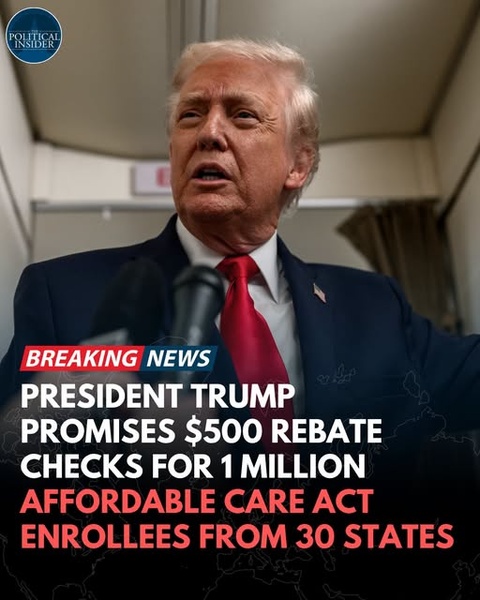
WASHINGTON — President Donald Trump has announced plans to send $500 rebate checks to nearly 1 million Americans enrolled in Affordable Care Act plans across 30 states, portraying the payments as a refund for what his administration says were excessive fees passed on to consumers during the Biden administration.
The announcement, made Sept. 10, comes less than two months before the Nov. 3 midterm elections, when the cost of health care and household expenses are expected to be major issues for voters. The White House says eligible recipients will begin receiving the checks in October 2026.
But the proposal has already triggered a political fight over who was responsible for the underlying costs, where the money is coming from and whether a one-time $500 payment will make a meaningful difference for Americans facing rising insurance premiums.
White House Says Americans Were Overcharged
Trump's administration describes the payments as the “Working Families Obamacare Refunds.”
According to a White House fact sheet, the federal government collected exchange “user fees” from insurers operating through the federal ACA marketplace. Those fees are ultimately reflected in the premiums consumers pay.
The administration argues that the fees collected under Biden were higher than necessary to operate the federal exchange, creating a surplus that should now be returned to consumers. Trump has characterized the situation as an example of his predecessor's mismanagement of Obamacare.
The White House says approximately 1 million people will receive $500 per person, with payments beginning in October.
The 30 states involved are Alabama, Alaska, Arizona, Arkansas, Delaware, Florida, Hawaii, Indiana, Iowa, Kansas, Louisiana, Michigan, Mississippi, Missouri, Montana, Nebraska, New Hampshire, North Carolina, North Dakota, Ohio, Oklahoma, Oregon, South Carolina, South Dakota, Tennessee, Texas, Utah, West Virginia, Wisconsin and Wyoming.
Most of those states use the federal Healthcare.gov marketplace rather than operating their own ACA exchanges.
Who Is Eligible for the $500 Payment?
The program is not a $500 payment to every Obamacare enrollee.
The White House says the refunds are primarily aimed at people who purchased ACA coverage through the federal exchange but did not receive federal premium assistance. Reuters reported that the targeted group includes people earning more than 400% of the federal poverty level, as well as some people between 100% and 400% who did not receive subsidies.
That distinction is important because roughly 19 million Americans currently obtain health insurance through ACA exchanges, meaning the proposed rebate would reach only a fraction of marketplace enrollees.
The administration has said eligible Americans do not need to submit a new application for the refund.
The Money Comes From ACA Exchange Fees
The White House's description has also become a point of dispute.
The administration portrays the money as essentially being returned to people who were “ripped off” through excessive Obamacare fees. But health-policy experts have questioned whether the existence of excess exchange-fee revenue necessarily means individual consumers were improperly overcharged.
Reuters reported that the fees are paid by insurers that participate in Healthcare.gov and are incorporated into premiums. The surplus accumulated in federal accounts after spending on exchange operations was lower than the fees collected.
That makes the issue more complicated than a straightforward refund of a specific overpayment made by each recipient.
The administration has also not provided a calculation showing that every recipient was individually overcharged by exactly $500.
Democrats Call the Plan an Election-Year Stunt
Democrats and health-care advocates immediately attacked the announcement.
They argue that the $500 payment is small compared with the much larger increases many Americans are facing in insurance premiums and other household expenses.
The timing has also attracted scrutiny. Trump announced the rebates shortly after promising a separate $5,000 “dividend” for every adult American if Republicans retain control of both chambers of Congress in November. That much larger proposal would cost well over $1 trillion and would require congressional action.
The $500 ACA payments are different from that proposal and are being presented by the administration as refunds rather than a new nationwide entitlement.
Still, the two announcements have created a broader pattern: Trump is increasingly emphasizing direct financial relief as Republicans prepare for a difficult midterm campaign.
Health-Care Costs Are Becoming a Major Political Problem
The rebate announcement comes at a particularly sensitive moment for the ACA.
Federal premium assistance that had helped millions of marketplace customers expired after Congress did not extend the enhanced subsidies. The result has been substantially higher insurance costs for many consumers, with some people reportedly downgrading coverage or leaving the marketplace altogether.
That creates an awkward political environment for Republicans.
Trump has repeatedly criticized Obamacare, but his administration is now using the existing ACA system to deliver a direct financial benefit to some of its customers.
At the same time, the administration has promoted a broader health-care agenda that includes lower prescription-drug prices, greater price transparency and changes to how Americans receive health-care assistance.
The $500 May Not Go Very Far
Even for those who receive the payment, the financial impact is limited.
The rebate is a one-time $500 payment, while health insurance premiums represent a recurring monthly expense.
MarketWatch reported that ACA premiums are expected to rise substantially for many consumers, meaning a $500 payment could cover only a portion of a year's additional insurance costs.
That distinction is central to the political debate.
Supporters can point to a concrete payment arriving directly in people's mailboxes. Critics argue that the payment does little to address the underlying cost of insurance.
Questions Remain Over the Program
Several details surrounding the refunds remain unclear.
Among the biggest questions is whether the $500 represents an actual calculation of how much each recipient was overcharged or simply a standardized payment drawn from accumulated exchange-fee funds.
The Associated Press reported that it was also unclear whether congressional approval would be required for the disbursement and precisely where the money for the refunds would come from.
The administration says the checks will begin going out in October, but additional details about implementation have not yet been fully disclosed.
A New Political Battle Over Obamacare
Trump's announcement represents an unusual evolution in the political fight over the Affordable Care Act.
For years, Republicans campaigned on repealing or replacing Obamacare. Trump himself repeatedly promised to dismantle the law during his first presidency.
Now, his administration is promising to send money directly to a portion of the people who use the ACA marketplace.
That shift reflects a broader political reality: health-care affordability remains one of the most immediate concerns for American voters, particularly as the 2026 midterms approach.
For Trump, the $500 refunds provide an opportunity to argue that his administration is putting money back into Americans' pockets.
For Democrats, the announcement provides an opportunity to argue that Republicans are offering a one-time payment after allowing broader health-care assistance to expire.
And for nearly 1 million Americans who qualify, the political argument may ultimately matter less than the practical question: When will the $500 actually arrive, and how much of their health-care bill will it cover?
Comments (0)
Loading comments...
May You Like

gfnhgmnghnmfgnbvvvvvvvvv

Jack Smith Defends His Integrity as Trump Investigations Face Renewed Political Firestorm














