
Trump Announces $8.4 Billion Oil Project With South Korea — Seoul Pushes Back
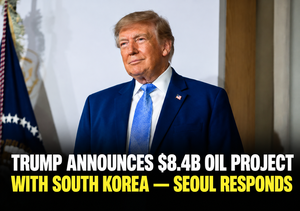
WASHINGTON — President Donald Trump says a U.S.-South Korea trade deal now includes an $8.4 billion enhanced oil recovery project, but Seoul says the project was not part of their agreement.


Trump announced the investment on Truth Social, describing the project as a way to increase oil and gas production and strengthen what he called American energy dominance and future energy security.
The announcement came as Washington and Seoul work to implement a broader trade agreement under which South Korea pledged hundreds of billions of dollars toward investments in the United States.
South Korea’s industry ministry, however, said the reported oil recovery project came as a surprise and was not included among the strategic investments formally agreed by the two governments.
A ministry official told Yonhap that the bilateral investment agreement is limited to provisions contained in the joint fact sheet and related documents released by Seoul and Washington in November 2025.
Enhanced oil recovery, or EOR, refers to techniques used to extract additional crude from existing oil fields after conventional production has declined, often by injecting carbon dioxide or other substances.
Trump did not identify the oilfield involved, provide a project timetable, or explain whether a specific South Korean company had committed funds to the initiative announced on Friday.
The disagreement follows another dispute over Alaska LNG, after Trump presented South Korean investment in the long-planned project as settled while Seoul emphasized that commercial and legal reviews remained necessary.
On Wednesday, Trump announced plans involving roughly $200 billion in South Korean investment, including eight nuclear power plants, a Texas gas-fired facility and the Alaska LNG development.
South Korean officials subsequently clarified that the Alaska project remained subject to commercial viability and domestic procedures, creating questions about how firmly the investment commitments announced publicly had been finalized.
The broader package originated in a 2025 trade agreement under which Seoul committed to $350 billion in U.S. investment while Washington agreed to reduce tariffs on Korean goods.
Of that $350 billion commitment, $150 billion was designated for shipbuilding, while another $200 billion was allocated for strategic investments under arrangements developed by the two governments.
The 2025 joint fact sheet also said South Korean investments would proceed within sustainable economic limits and would focus on commercially viable projects rather than projects unable to recover their capital.
Seoul and Washington have since highlighted cooperation in shipbuilding, nuclear power, semiconductors, artificial intelligence, critical minerals and energy as parts of a broader economic and strategic partnership.
The latest oil announcement arrives as energy markets remain sensitive to geopolitical disruptions, with the conflict involving Iran contributing to higher fuel prices and increasing political pressure over energy security.
Trump has increasingly emphasized energy production while campaigning ahead of the November midterm elections, presenting investment announcements as evidence of progress on his administration’s economic and industrial agenda.
South Korea’s response does not necessarily rule out future discussions over enhanced oil recovery, but officials have indicated that the reported $8.4 billion project requires clarification with Washington.
The episode also highlights differences in how Washington and Seoul communicate major investment initiatives, particularly when political announcements precede final commercial agreements, government approvals or legally binding commitments.
For U.S. energy producers, an eventual Korean-backed EOR project could provide capital for mature oilfields, while also supporting domestic production without requiring development of entirely new reserves.
For now, the central question is whether the $8.4 billion project becomes part of the bilateral investment framework or remains a proposal announced by Trump before Seoul formally agrees.
Comments (0)
Loading comments...
May You Like

Barack Obama Draws Attention With New Literary Podcast

Shocking news from Ohio: an unexpected development ahead of Trump's rally

South Korea–Ukraine Rift Deepens Over North Korean POW Transfer as PURL Draws New Scrutiny












