
Trump Approval Falls to 32% in Reuters/Ipsos Poll as Cost-of-Living Concerns Deepen
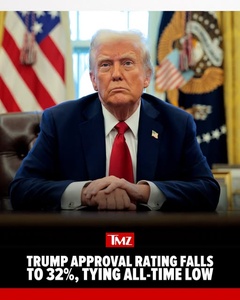
The president has reached the lowest approval level recorded by Reuters/Ipsos across his political career, while Republican support also declined sharply ahead of November’s midterm elections.
WASHINGTON — President Donald Trump’s job approval has fallen to 32%, according to a new Reuters/Ipsos survey showing growing dissatisfaction with the economy and cost of living ahead of November’s midterms.
The poll, conducted September 17–20, represents Trump’s lowest approval measurement in Reuters/Ipsos polling across both his first and second presidencies, according to Ipsos.
Trump’s overall approval declined three points from 35% one week earlier, while his standing has fallen considerably from the 47% Reuters/Ipsos measured around the beginning of his second presidency.
The survey collected responses from 1,277 U.S. adults nationwide through Ipsos’ probability-based KnowledgePanel and carried an overall margin of sampling error of approximately three percentage points.
The most striking deterioration involves the cost of living, an issue respondents identified as particularly important when considering their votes in the November 3 congressional elections.
Only 17% of Americans approved of Trump’s handling of the cost of living, according to Reuters, putting his rating on household affordability considerably below his overall job approval.
That economic dissatisfaction is now appearing even within Trump’s own party, where the president historically has maintained substantially stronger approval than among the broader American public.
Trump’s overall approval among Republicans fell to 73%, down from 82% in the previous Reuters/Ipsos poll and from 86% in January 2026.
On the cost of living specifically, Republican approval has fallen even more dramatically, declining from 70% in January to 44% in the September survey.
For the first time in this Reuters/Ipsos series, Republicans disapproving of Trump’s handling of living costs outnumbered those approving, 51% to 44%.
Republican assessments of Trump’s broader economic management have weakened as well. Ipsos reports approval within his party falling from 80% in January to 56% currently.
The Iran conflict forms another important part of the political environment surrounding the poll, with rising fuel costs contributing to Americans’ broader concerns about household expenses.
Reuters reported that only 24% of respondents approved of Trump’s handling of the Iran war, while approximately 34% supported the military campaign itself.
Trump has defended his Iran strategy as necessary for American and international security, while critics have challenged its costs, duration and consequences for global energy markets.
The administration has also argued that current economic problems cannot be understood without considering policies inherited from former President Joe Biden and disruptions produced by international conflicts.
Polling, however, measures public perceptions rather than independently determining which president or policy is economically responsible for particular prices.
The new numbers arrive as gasoline and diesel costs have become increasingly visible political issues, adding pressure to an administration that entered office promising substantial reductions in household expenses.
Trump’s position on immigration remains stronger among Republicans. Reuters/Ipsos found 79% of Republicans approve of his handling of immigration, substantially higher than their assessments of his economic performance.
National opinion on the administration’s deportation policies is more divided. The survey found 55% disapproval of Trump’s approach to deportations, illustrating the large partisan differences surrounding immigration policy.
The findings also contain potentially important information about congressional voting intentions, although individual House and Senate races will ultimately determine control of Congress.
Among registered voters in the Reuters/Ipsos survey, 43% preferred Democratic congressional candidates and 35% preferred Republicans, Reuters reported, producing the largest Democratic advantage in that polling series this year.
That measurement describes voter preferences at the time of the survey. It does not determine which party will control Congress after November, because congressional elections are decided district by district and state by state.
Other current polls also produce different measurements of Trump’s approval, illustrating why the 32% figure should not be presented as though every national survey produces exactly the same result.
For example, a recent NBC News poll measured Trump at 41% approval and 56% disapproval, considerably higher than the Reuters/Ipsos approval figure.
CBS News/YouGov measured Trump at 39% approval earlier this month, while Reuters/Ipsos itself recorded 35% during its September 11–14 survey.
Marquette Law School measured him at 37% earlier in September, while another survey from Focaldata had previously produced a 32% reading.
That means the graphic’s phrase “tying all-time low” requires clarification. Reuters describes the latest 32% measurement as the lowest of Trump’s political career within its Reuters/Ipsos series.
It does not mean 32% is necessarily Trump’s lowest result ever recorded by every polling organization using every methodology and population.
Polls differ because organizations survey different populations, conduct interviews through different methods, weight respondents differently and ask questions during different periods.
A polling average can therefore provide a broader view of public opinion than any individual survey, although averages also vary according to which polls and methodological adjustments are included.
The Reuters/Ipsos result nevertheless matters because it represents a substantial decline within the same polling series, allowing a more consistent comparison with previous Reuters/Ipsos measurements.
Trump stood at 47% approval at the beginning of his second presidency, compared with 32% today—a 15-point decline within that series.
The movement among Republicans may be especially notable because Trump’s political strength has historically depended upon exceptionally high approval within his own party.
A fall from 82% to 73% in a single week does not mean Trump has lost majority Republican support; nearly three-quarters of Republicans in the survey still approved of his performance.
Instead, the result suggests that dissatisfaction over affordability has begun reaching voters who otherwise remain considerably more supportive of Trump than Democrats or independents.
Whether that movement persists is unknown. Approval ratings can change rapidly in response to economic conditions, military developments, major legislation and other events before Election Day.
Comments (0)
Loading comments...
May You Like

South Korea–Ukraine Rift Deepens Over North Korean POW Transfer as PURL Draws New Scrutiny














