
Trump Assassination Attempt in Butler
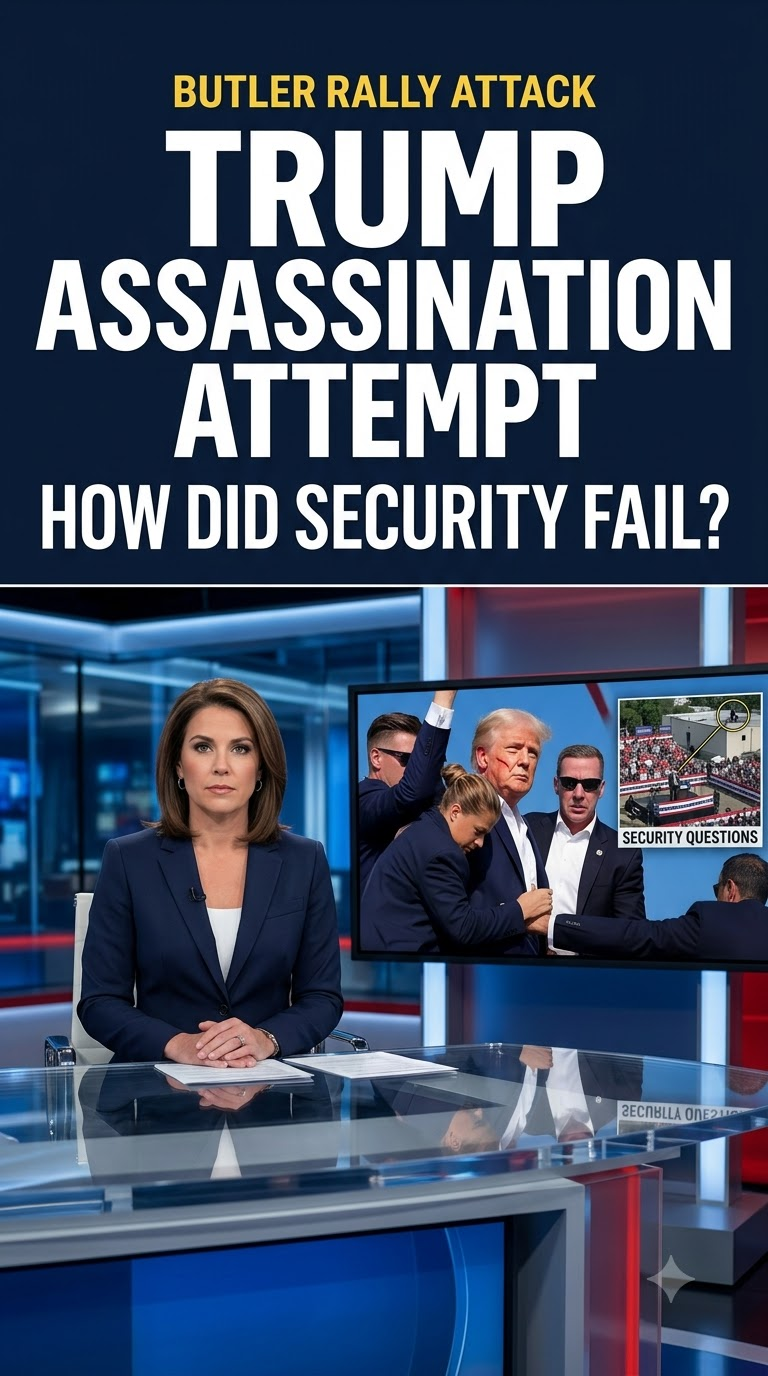
The assassination attempt against Donald Trump at a campaign rally in Butler, Pennsylvania, became one of the most heavily scrutinized security failures in recent U.S. political history.
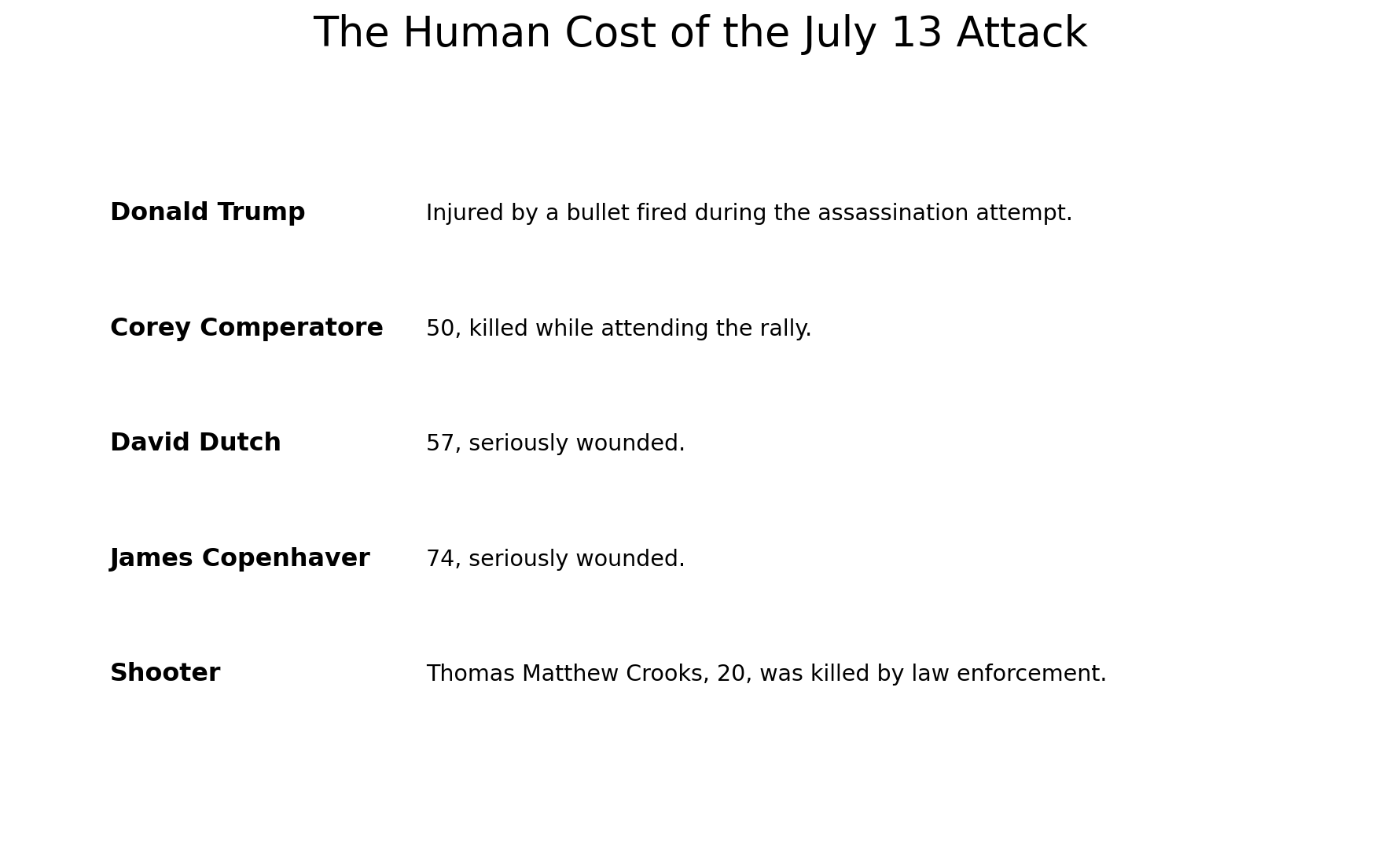
On July 13, 2024, a gunman opened fire while Trump was speaking at the Butler Farm Show grounds. Trump was struck by a bullet. Rally attendee Corey Comperatore was killed, while David Dutch and James Copenhaver were seriously wounded.
Secret Service personnel moved Trump from the stage, and the shooter, Thomas Matthew Crooks, was killed by law enforcement.
In the months that followed, the central question shifted from what happened to how it had been allowed to happen at all.
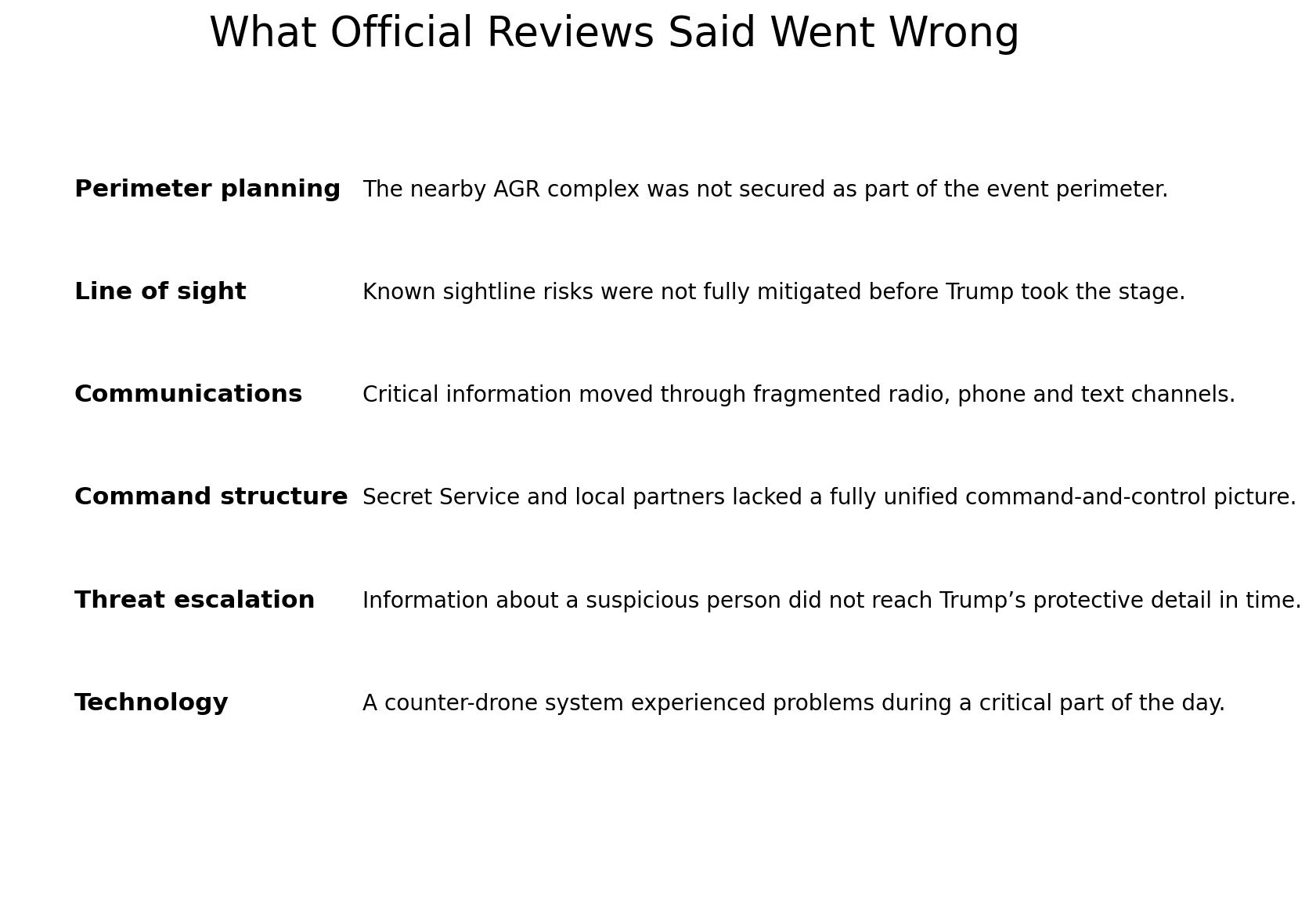
Multiple official investigations ultimately reached the same broad conclusion: there was no single failure that explains the attack. A series of planning, communication and leadership breakdowns combined to create the conditions in which the shooter was able to act.
The Nearby AGR Complex Was the Biggest Planning Failure
One of the clearest findings involved the American Glass Research complex near the rally site.
The bipartisan House task force said the failure to secure that area created one of the most important vulnerabilities of the day.
The complex sat outside the formal secure perimeter, even though it had clear sightlines toward the rally stage and had been discussed as a potential security concern before the event.
That decision mattered because the area was not controlled in the same way as the space inside the protected venue.
Official reviews later concluded that responsibility for the area was not clearly understood among the agencies involved.
A Known Line-of-Sight Problem Was Not Fully Solved
The Secret Service’s own internal review also identified failures involving line-of-sight protection.
Agents and planners knew that nearby structures created potential sightlines toward the stage.
Some expected physical obstructions or equipment to be used to reduce that exposure, but those measures were not fully in place when Trump arrived.
The agency later acknowledged that personnel incorrectly judged some of those risks as acceptable.
That gap meant a hazard recognized during planning was not completely eliminated before the event began.
Communication Broke Down at the Worst Possible Time
The problems were not limited to the physical layout.
Secret Service and local law enforcement were operating with fragmented communications systems rather than one fully unified network.
Important information about a suspicious individual moved through radios, phone calls and text messages in pieces.
The Secret Service later said some critical information was not broadcast across its own radio channels to all personnel who needed it.
That was especially important because Trump’s protective detail did not receive the full picture of how seriously local officers were searching for a suspicious person near the rally.
The Protective Detail Did Not Get the Warning in Time
The DHS independent review panel highlighted a particularly serious failure: information about the developing threat did not reach the leaders responsible for Trump’s immediate protection before the attack.
That meant the people deciding whether Trump should remain onstage did not have the same information available to some officers elsewhere at the site.
Official reviews did not describe one single moment when the entire attack could be reduced to one missed radio call.
Instead, they described a system in which information moved too slowly and through too many disconnected channels.
By the time the threat became unmistakable, the margin for intervention had largely disappeared.
There Was No Truly Unified Command Picture
Another recurring finding was confusion over command and responsibility.
The Secret Service remained responsible for the overall protection mission, but local, county and state agencies were also assigned important roles around the venue.
Investigators found that those responsibilities were not always understood in the same way by everyone involved.
Local sniper teams, for example, had a narrower understanding of what areas they were expected to watch.
House investigators said the planning lacked enough detail, cohesion and clarity about who had responsibility for specific zones outside the formal perimeter.
The Shooter Had Been Seen Before the Attack
The FBI’s timeline showed that law enforcement personnel noticed Crooks before the shooting.
He had been observed around the rally area well before he opened fire, and his behavior later drew increasing attention.
That fact became central to public criticism after the attack.
But the official reviews emphasized that spotting a suspicious person is not the same as establishing an immediate threat.
The failure was in how the information escalated, how the area was controlled and how the developing situation was communicated to the people responsible for the protectee.
A Counter-Drone System Also Had Problems
The Secret Service had deployed a counter-unmanned-aircraft system for the event.
That system experienced technical difficulties during part of the day.
The agency later said that if it had been functioning properly during a critical period, it might have detected Crooks operating a drone near the event site earlier.
That does not mean the drone system alone would have prevented the attack.
It was one more example of how several different protective layers were weaker than intended on the same day.
The Attack Had a Human Cost Beyond the Security Debate
The investigations into procedure can make the event sound like a technical case study.
It was not.
Corey Comperatore, a 50-year-old firefighter and father, was killed while attending the rally.
David Dutch and James Copenhaver were both seriously wounded.
Trump was also injured by a bullet fired during the attack.
Those facts remained central to the congressional and agency reviews, which repeatedly described the Butler failure as a tragedy that should not have occurred.
The House Task Force Called the Attack Preventable
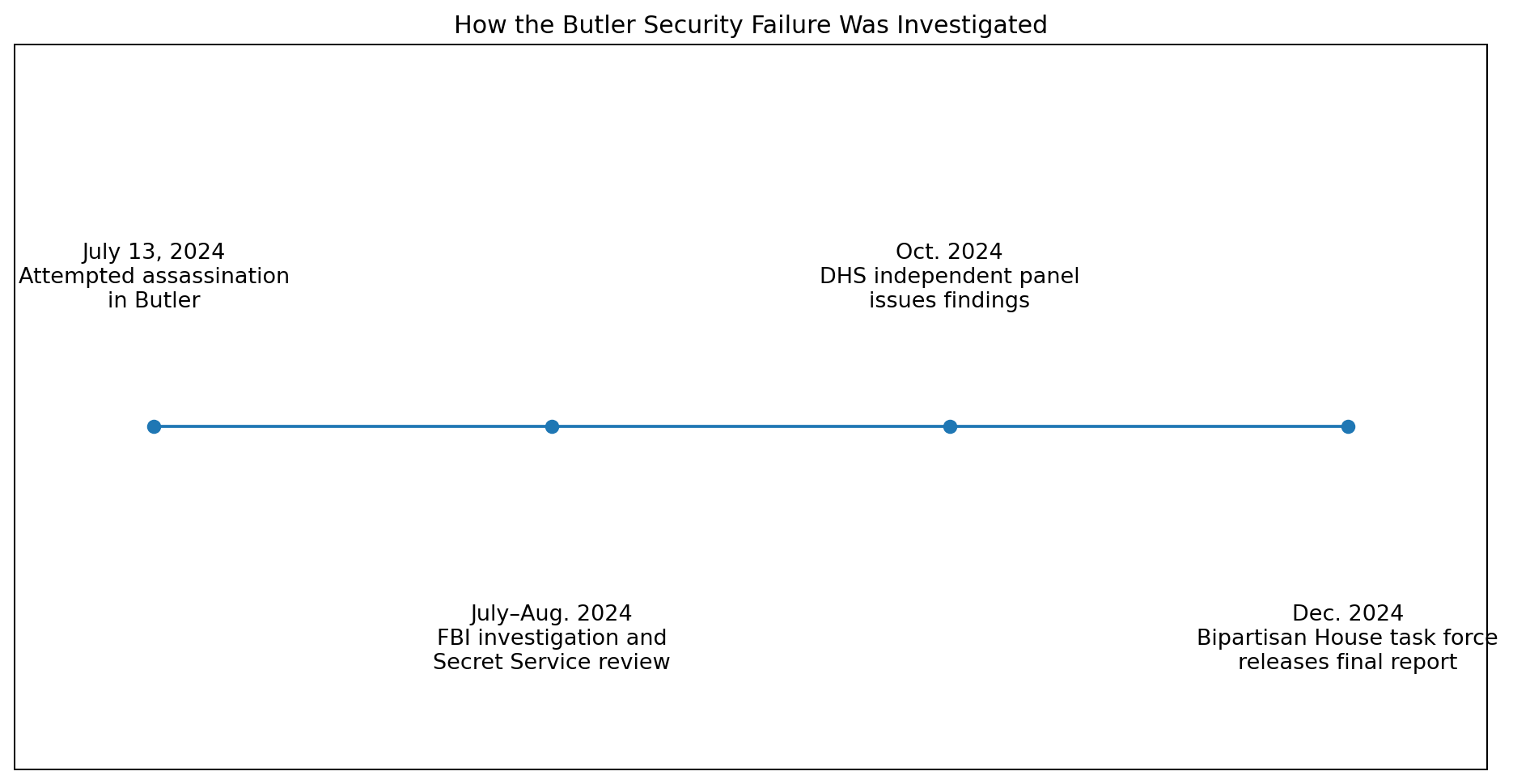
In December 2024, the bipartisan House task force released its final report after months of interviews, document reviews, site visits and hearings.
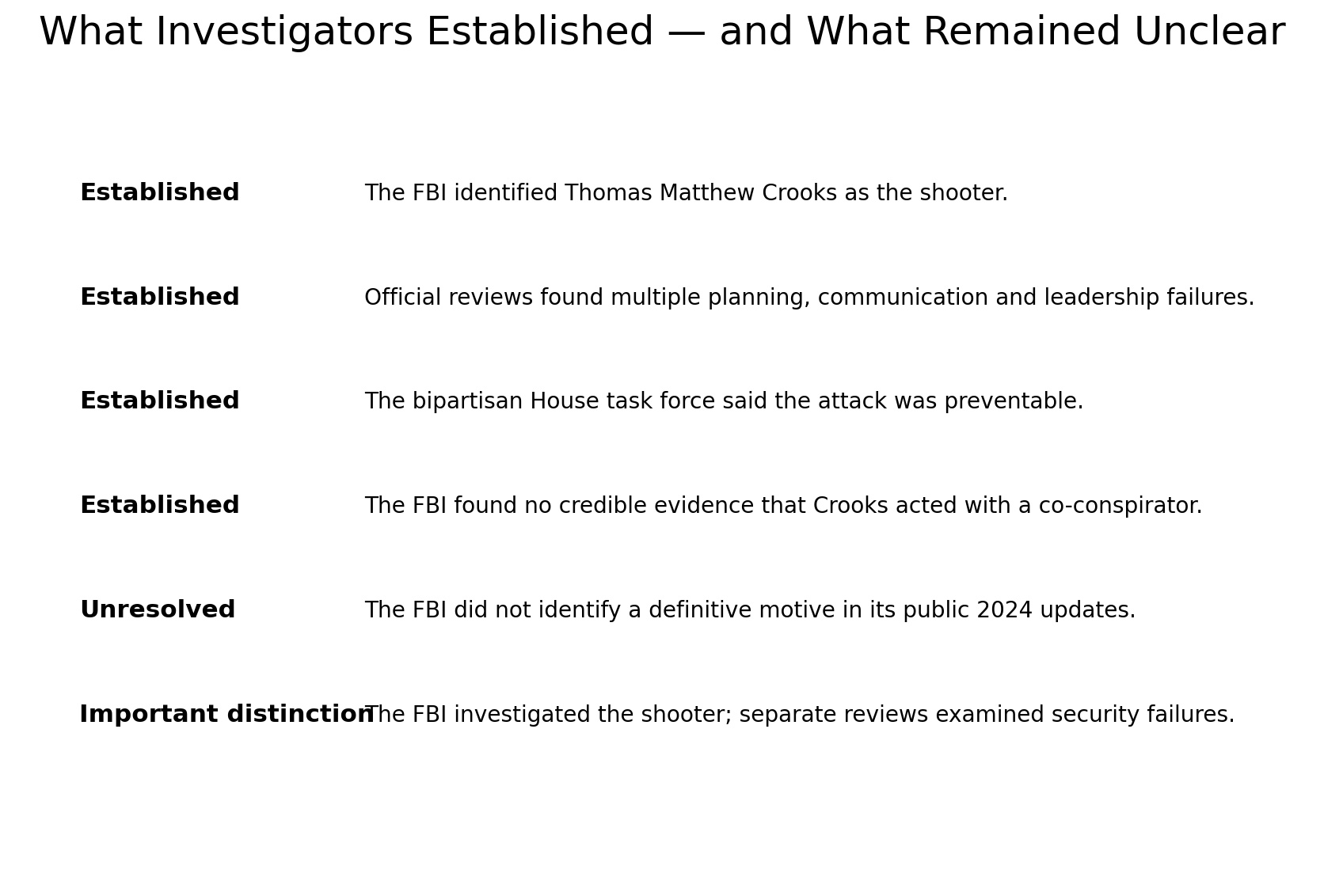
The task force said the attack was preventable.
It identified failures in planning, execution and leadership and issued dozens of recommendations intended to strengthen future protective operations.
The report did not say one person or one agency decision caused the entire event.
Its conclusion was broader: multiple weaknesses that should have been corrected instead lined up at the same time.
The Secret Service Reached Similar Conclusions
The Secret Service’s own mission-assurance review identified many of the same categories of failure.
It cited communication problems, inadequate line-of-sight mitigation, command-and-control weaknesses and poor coordination with outside agencies.
The agency also acknowledged that critical information about the threat was not shared widely enough through Secret Service radio channels.
Those findings mattered because they came from the agency responsible for the protection mission itself.
The reviews did not simply blame local police or one tactical unit. They described a wider failure of planning and coordination.
The FBI Focused on the Shooter, Not the Security Plan
The FBI’s role was different.
Its investigation focused on Thomas Matthew Crooks: his planning, movements, digital activity and whether he had help.
The bureau said its investigation had not uncovered credible evidence that Crooks acted with a co-conspirator.
In its public updates, the FBI also said it had not identified a definitive motive.
That distinction is important because questions about why Crooks acted and questions about why security failed were handled by different investigations.
What the Reviews Changed
The Butler attack led to immediate changes in protective operations and broader scrutiny of Secret Service practices.
Subsequent events used stronger planning around sightlines, perimeter security and specialized counter-surveillance assets.
Congressional investigators also pushed for clearer command structures and better communications with local law enforcement.
The broader lesson was not that one piece of technology or one additional officer would solve every problem.
It was that protective security depends on several layers working together — and that one weak layer becomes far more dangerous when several others are also failing.
Why the Butler Failure Still Matters
The July 13 attack remains important because the official reviews produced a rare level of agreement across institutions.
The Secret Service, a bipartisan House task force and an independent DHS review all identified serious failures.
They differed in emphasis, but the central picture was consistent: planning was incomplete, responsibilities were unclear, communication was fragmented and a known vulnerability was not fully secured.
That is the clearest answer to the question of how security failed.
Not because no one saw any warning signs — but because the protective system failed to turn those warning signs into one coordinated response before the shooting began.
Comments (0)
Loading comments...
May You Like

OBAMA STUNS ON INSTAGRAM: MESSAGE MARKING 34-YEAR MILESTONE SPARKS A BUZZ

South Korea–Ukraine Rift Deepens Over North Korean POW Transfer as PURL Draws New Scrutiny

Shocking news from Ohio: an unexpected development ahead of Trump's rally












