
Trump Blames Biden for Rising Prices — But the Numbers Tell a More Complicated Story
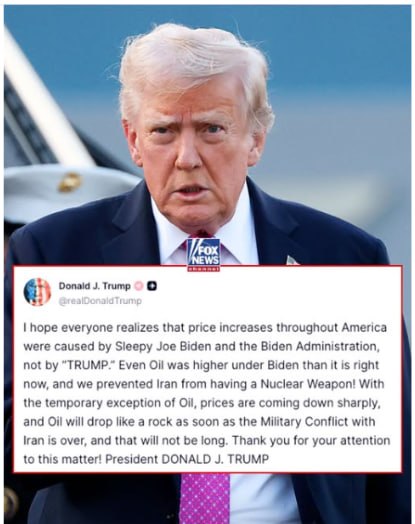
In a Truth Social post, President Donald Trump insisted that price increases throughout America were caused by "Sleepy Joe Biden," and that gasoline prices will "drop like a rock" once the conflict with Iran ends. But data from the Bureau of Labor Statistics and AAA tell a different story: inflation remains elevated at 3.4%, and gasoline prices have climbed for 36 straight days in some parts of the country.
WASHINGTON – President Donald Trump took to Truth Social on September 20, 2026, to address rising prices across the United States, placing the blame squarely on his predecessor.
"I hope everyone realizes that price increases throughout America were caused by Sleepy Joe Biden and the Biden Administration, not by 'TRUMP,'" the president wrote. "Even oil was higher under Biden than it is right now, and we prevented Iran from having a Nuclear Weapon! With the temporary exception of Oil, prices are coming down sharply, and Oil will drop like a rock as soon as the Military Conflict with Iran is over, and that will not be long. Thank you for your attention to this matter! President DONALD J. TRUMP"
The post, which was shared widely on X and other platforms, has reignited a fierce debate over who is responsible for the current state of the economy — and whether the president's claims hold up against the data.
What the Data Shows
According to the Bureau of Labor Statistics, the annual inflation rate in the U.S. stood at 3.4% in August 2026, unchanged from July but still well above the Federal Reserve's 2% target .
Gasoline prices were a major driver of that inflation. Gasoline rose 27.4% year-over-year in August, and on a monthly basis, gasoline prices rose 3.9%, accounting for more than one-third of the total monthly increase in the Consumer Price Index .
The national average for a gallon of regular gasoline was **$4.43** on September 17, according to AAA — more than $1 higher than a year earlier . In Southern California, prices have climbed for 36 consecutive days, with Los Angeles County hitting $6.25 per gallon, the highest level since October 2023 .
Diesel prices have been even more alarming. The average diesel price broke its previous record high of $5.81 a gallon set in 2022 and has continued to climb to a fresh high of **$6.51** .
The Biden Comparison: More Nuanced Than It Appears
Trump's claim that "gas prices were much higher under Biden" is technically accurate in raw dollar terms — but the comparison requires context.
During Biden's presidency, gas prices spiked to an all-time record of $5.01 per gallon** in June 2022, driven largely by Russia's invasion of Ukraine and disruptions to global energy markets . By the end of Biden's term, however, prices had fallen to around **$3.09–$3.12 per gallon .
Today's national average of $4.43 is indeed below the 2022 peak. But there are two important caveats:
First, timing matters. The 2022 spike was temporary — prices fell steadily in the second half of that year. By contrast, the current price surge has been more persistent. As of late September 2026 — 205 days into the Iran conflict — prices had risen for two straight weeks and were approaching their 2026 high of $4.51, according to Investopedia .
Second, inflation adjustment changes the picture. When adjusted for inflation, the 2022 Biden-era average of $4.52 per gallon is actually slightly higher than today's $4.37 (at the time of that analysis). But the trajectory is different: prices under Biden were falling by this point in his term, while prices today are still rising .
The Iran War Factor
The primary driver of the current price surge is the U.S. military conflict with Iran, which began in February 2026. The war has disrupted oil supplies through the Strait of Hormuz and damaged energy infrastructure in the Middle East .
Trump has consistently framed the price spike as a temporary cost of preventing Iran from obtaining a nuclear weapon. "Oil will drop like a rock as soon as the Military Conflict with Iran is over, and that will not be long," he wrote .
However, economists warn that the longer the conflict drags on, the greater the risk to the broader economy. "While the U.S. economy has been amazingly resilient (so far), there's no guarantee that it can continue to shake off the impact of the oil supply disruption caused by the war with Iran," forecaster Robert Fry wrote in a commentary .
The Energy Information Administration projected in early September that gasoline would retail for $3.95 at the end of the year — a forecast that assumes the conflict winds down . Patrick De Haan, head of petroleum analysis at GasBuddy, noted that the outlook remains "deeply uncertain" .
Political Implications Ahead of Midterms
The price surge comes at a politically perilous moment for the president, with the midterm elections just weeks away.
GasBuddy had forecast average gas prices of **$4.03 per gallon** over Labor Day — 87 cents higher than in 2025 and above the previous record high of $3.83 set in 2012 .
Voter backlash to rising gas prices, combined with the deeply unpopular war, could have disastrous effects on the GOP in November, The Daily Beast reported .
Trump met with U.S. refiners and fuel distributors in early September as he scrambled to find ways to expand domestic refining capacity and increase energy production to bring down gasoline prices .
The Bottom Line
| Trump's Claim | What the Data Shows |
|---|---|
| "Price increases were caused by Sleepy Joe Biden" | Inflation is 3.4%; gas prices have risen 27.4% year-over-year under Trump |
| "Gas prices were much higher under Biden" | True in raw terms — the 2022 peak was $5.01 — but prices had fallen to ~$3.12 by the end of Biden's term |
| "Oil will drop like a rock once the Iran conflict ends" | Analysts agree relief is possible, but the timing remains uncertain |
| "Prices are coming down sharply" | Gas prices have risen for 36 straight days in Southern California; diesel has hit record highs |
The president's post reflects a political strategy that has defined his career: blame your predecessor, promise swift relief, and frame short-term pain as a necessary cost for long-term security. Whether voters accept that argument will be determined at the ballot box in November.
For now, the data tells a more complicated story than the post suggests — and the American people are paying the price at the pump.
Comments (0)
Loading comments...
May You Like

Obama Steps Back Into the Political Spotlight as Democrats Target Trump’s Senate Majority

Russian Drone Strikes Kyiv Bridge as German Chancellor Arrives in Ukraine













