
Trump Blocked Again: Judge Extends Ban on Mail-In Voting Restrictions
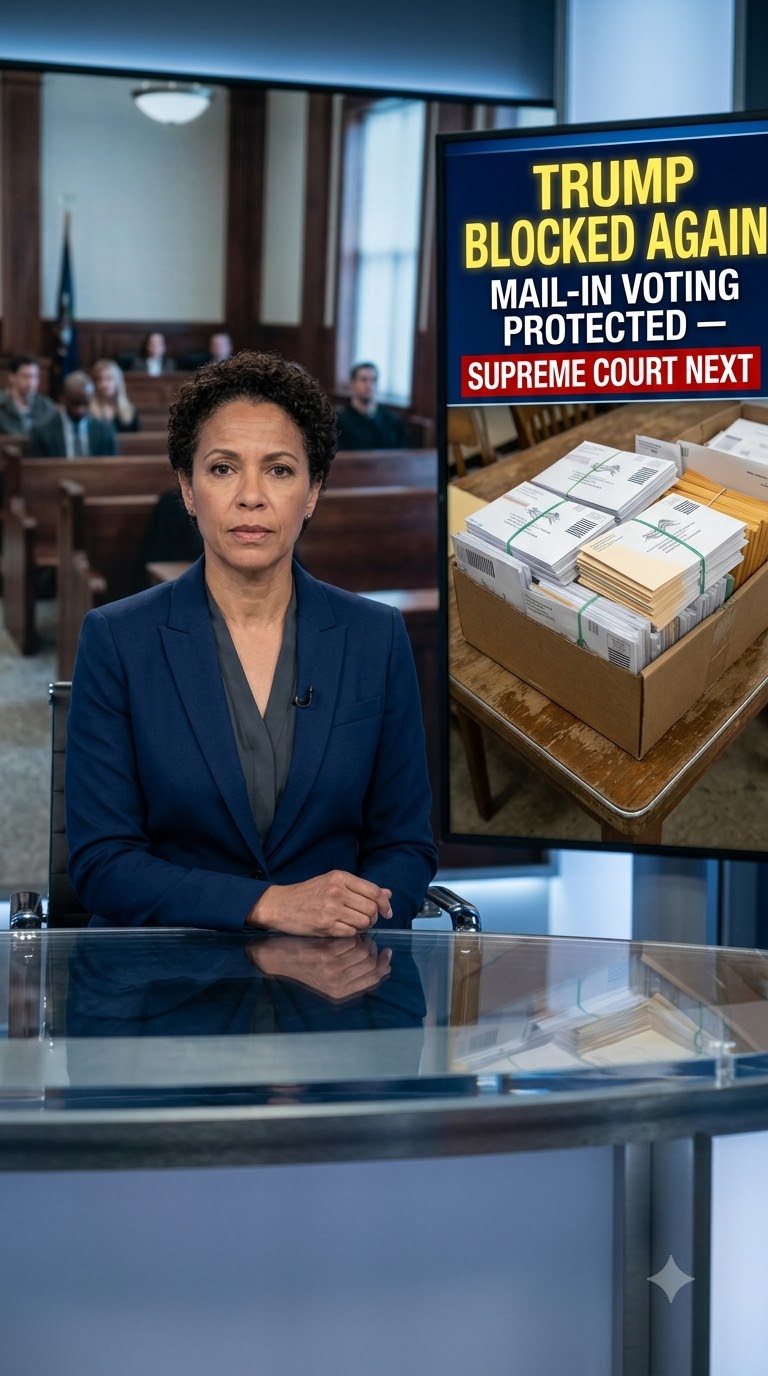
A federal judge has once again halted President Donald Trump's executive order targeting mail-in voting, dealing a significant blow to the administration's efforts to tighten voting rules ahead of the November midterm elections. The Trump administration has already asked the Supreme Court to intervene.
BOSTON – U.S. District Judge Indira Talwani on Friday extended her block on the Trump administration's new U.S. Postal Service (USPS) rule that sought to impose sweeping restrictions on mail-in voting . The preliminary injunction, which effectively stops the rule from taking effect for the duration of the 2026 midterm election cycle, comes as states begin the process of mailing out ballots to voters .
The Trump administration has already filed an emergency appeal with the Supreme Court, marking its third attempt in less than six weeks to clear the way for the restrictions . The legal battle could have major ramifications for the midterm elections, where control of both chambers of Congress is at stake .
The Blocked Rule: What It Would Have Done
The controversial USPS rule, which stemmed from a March 2026 executive order signed by President Trump, would have required state and local election officials to comply with several new federal mandates :
| Requirement | Description |
|---|---|
| Ballot Envelope Approval | States would need to submit mail-ballot envelope designs to USPS for federal review |
| Unique Barcodes | Outbound and return envelopes must carry individual barcodes |
| Voter Data Portal | Each voter's name, address, and barcode info must be uploaded to a federal portal |
| Delivery Denial | USPS can refuse to send ballots that don't meet new standards |
The USPS rule would have effectively given the Postal Service authority to refuse to transmit ballots that did not meet the new, complex standards .
Why the Judge Blocked It — Again
Judge Talwani, an Obama appointee, issued the preliminary injunction after finding that the Postal Service exceeded its constitutional authority by attempting to regulate the "time, place, and manner" of elections — a power reserved for states and Congress under the U.S. Constitution .
In her 49-page ruling, Talwani warned that forcing states to redesign envelopes and upload voter data to an unproven digital portal weeks before the Nov. 3 election would cause "inevitable" disenfranchisement of millions of voters . She also noted that many small rural jurisdictions lack the technology to print the required specialized barcodes, and the government's digital portal is not yet operational .
"Plaintiff States are required under state law to mail millions of ballots to voters on a prescribed timeframe," Talwani wrote. "They are unable to pivot this late in the election cycle, nearly guaranteeing significant disenfranchisement for eligible voters" .
The judge also found that the record contained "no evidence relating to fraudulent mail voting" to justify the sudden policy shift .
Back-and-Forth in the Courts
The legal battle over the mail-in voting rule has been marked by confusion and rapid reversals.
In August, the Supreme Court had cleared the way for the administration to implement the rule, ruling that an earlier challenge by 23 states was "premature" because the Postal Service had not yet finalized its implementation rules . The conservative majority pointedly did not say Trump's move was legal, only that the lawsuits were filed too early .
Just one day after the Supreme Court's ruling, Talwani issued a temporary restraining order blocking the rule for 14 days . On Friday, she replaced that order with a more permanent preliminary injunction .
The Administration's Appeal
The Trump administration has already appealed Talwani's ruling to the U.S. Court of Appeals for the First Circuit — and has asked the Supreme Court to intervene directly .
Solicitor General D. John Sauer argued that the judge's order "nullif[ies] the Postal Service's efforts to address the risk that the federal mails will be used to perpetrate voter fraud" . He contended that the order is "materially identical" to the temporary restraining order and that its rationale is "simplistic" .
The administration emphasized that North Carolina has already begun mailing ballots (as of Sept. 4), Alabama will begin on Sept. 9, and at least five additional states will begin mailing ballots on Sept. 13 .
"Once those ballot envelopes enter the mailstream, there is no retrieving them," the Justice Department told the Supreme Court in its filing .
Impact on the Midterms
Nearly 30% of voters in the U.S. cast mail ballots in the 2024 elections, and the number is expected to remain significant in 2026 . Democrats are more likely than Republicans to vote by mail, according to the MIT Election Data & Science Lab .
Election officials across the country have warned that changing voting rules at this stage could confuse voters and prevent some from receiving or returning their ballots on time . The order allows states to voluntarily adopt the Postal Service's new system, but not a single state has announced plans to do so .
What the Ruling Does (and Doesn't) Do
| What It Does | What It Doesn't Do |
|---|---|
| Blocks USPS from requiring states to comply with the new rule indefinitely | Settle the constitutional question — Supreme Court likely to have final word |
| Prevents the administration from refusing to transmit ballots based on the new requirements | Prevent states from voluntarily adopting the new system (none have) |
| Keeps Oregon and 22 other states in control of their own elections | Resolve the legal battle — administration has already appealed |
The Supreme Court is now expected to weigh in once again on the administration's latest appeal, and its decision could determine the fate of mail-in voting for the Nov. 3 midterm elections. For now, the preliminary injunction remains in place — protecting millions of voters who depend on mail-in ballots from what the judge called "inevitable" disenfranchisement .
This is a developing story. The Supreme Court has not yet responded to the administration's latest appeal.
Comments (0)
Loading comments...
May You Like

OBAMA STUNS ON INSTAGRAM: MESSAGE MARKING 34-YEAR MILESTONE SPARKS A BUZZ

gfnhgmnghnmfgnbvvvvvvvvv

Obama Steps Back Into the Political Spotlight as Democrats Target Trump’s












