
Trump Called the Iran Conflict ‘Small Potatoes’ After 18 U.S. Service Members Died
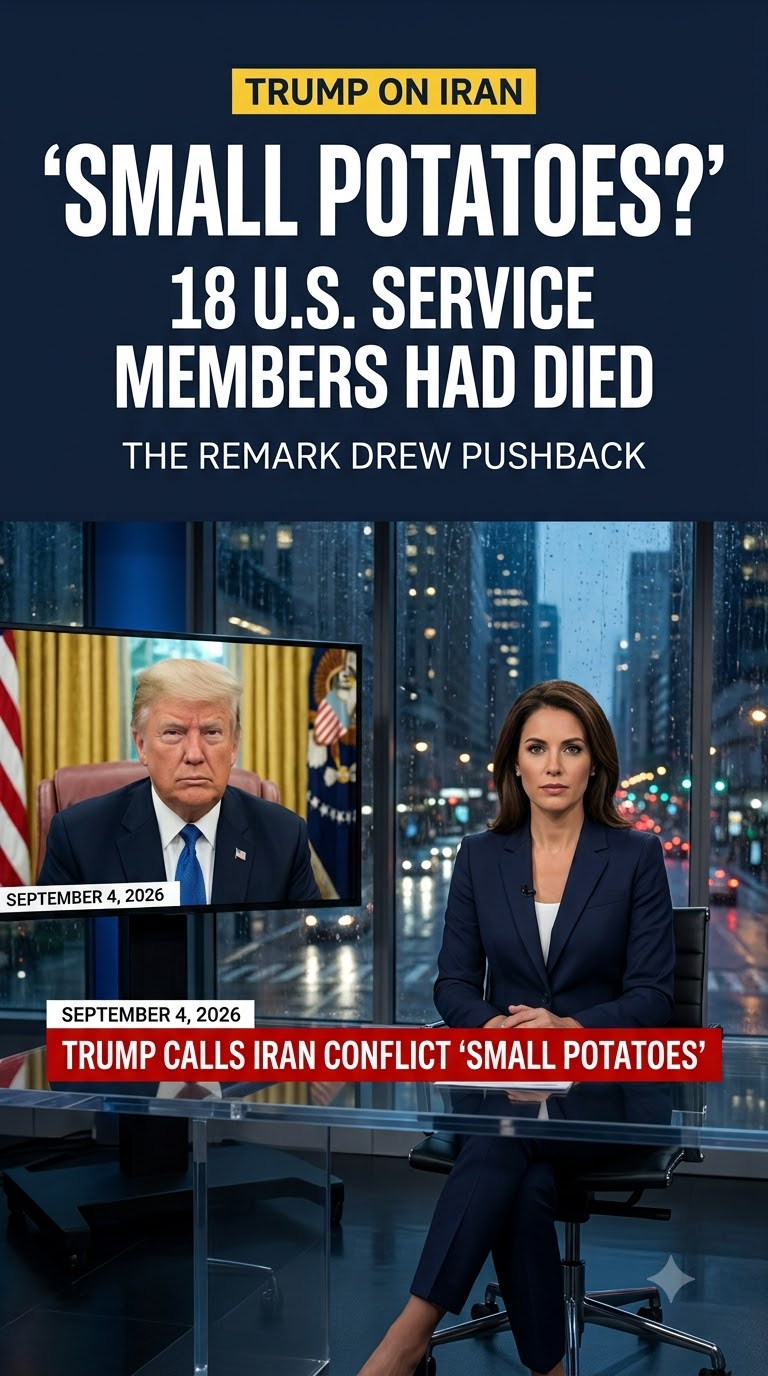
President Donald Trump drew renewed attention to the language his administration was using for the U.S. conflict with Iran when he described the fighting as “small potatoes” during an Oval Office exchange on September 4, 2026.
At the time, 18 U.S. service members had been killed in the conflict and hundreds more had been wounded.
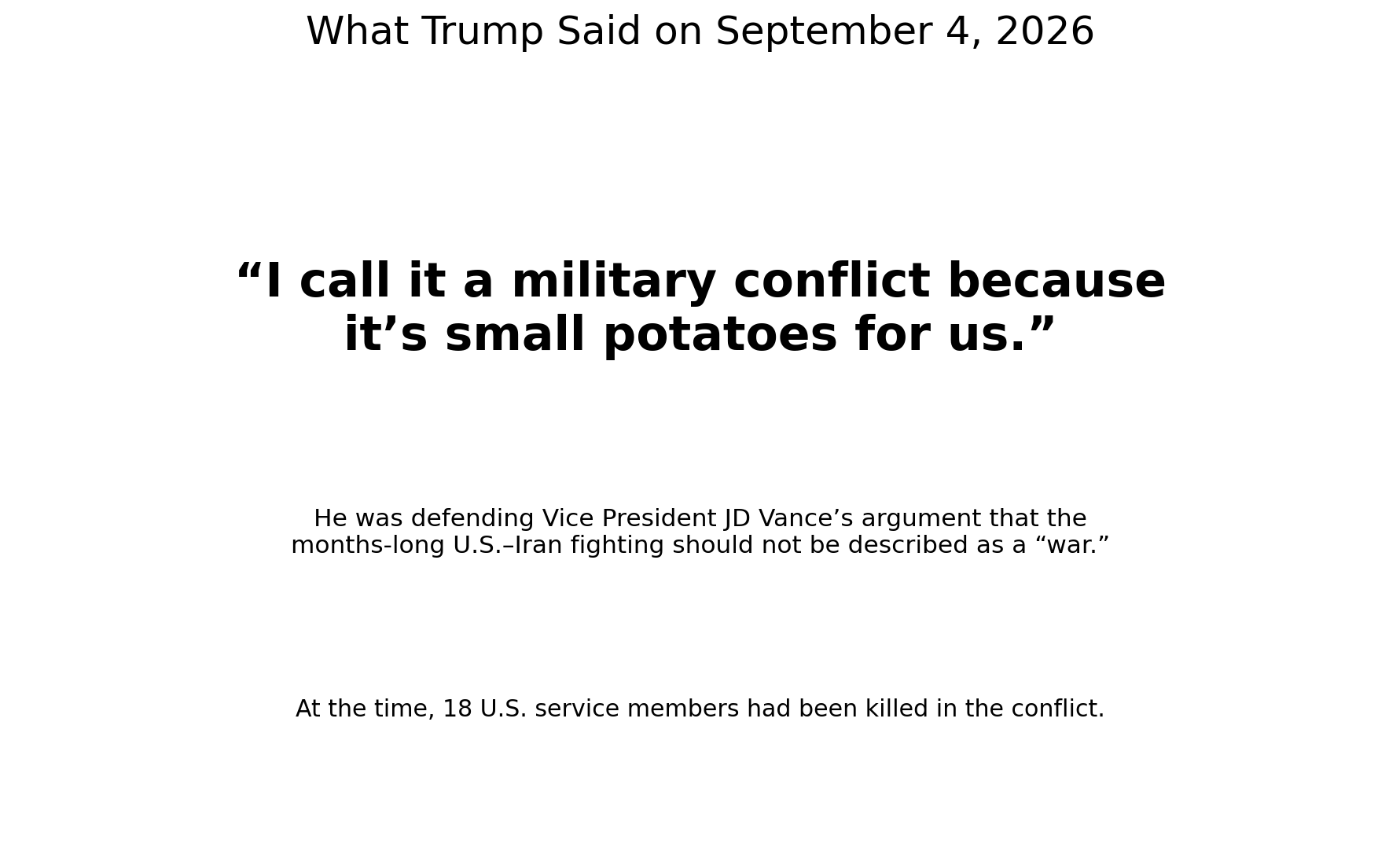
Trump’s comment did not come as a stand-alone assessment of those deaths. It came while he was defending Vice President JD Vance, who had said a day earlier that he would not describe the months of U.S. and Iranian military action as a “war.”
That distinction — between how the administration described the conflict and what American forces had already experienced — is why the exchange quickly drew scrutiny.
Trump Was Responding to Vance’s Description of the Conflict
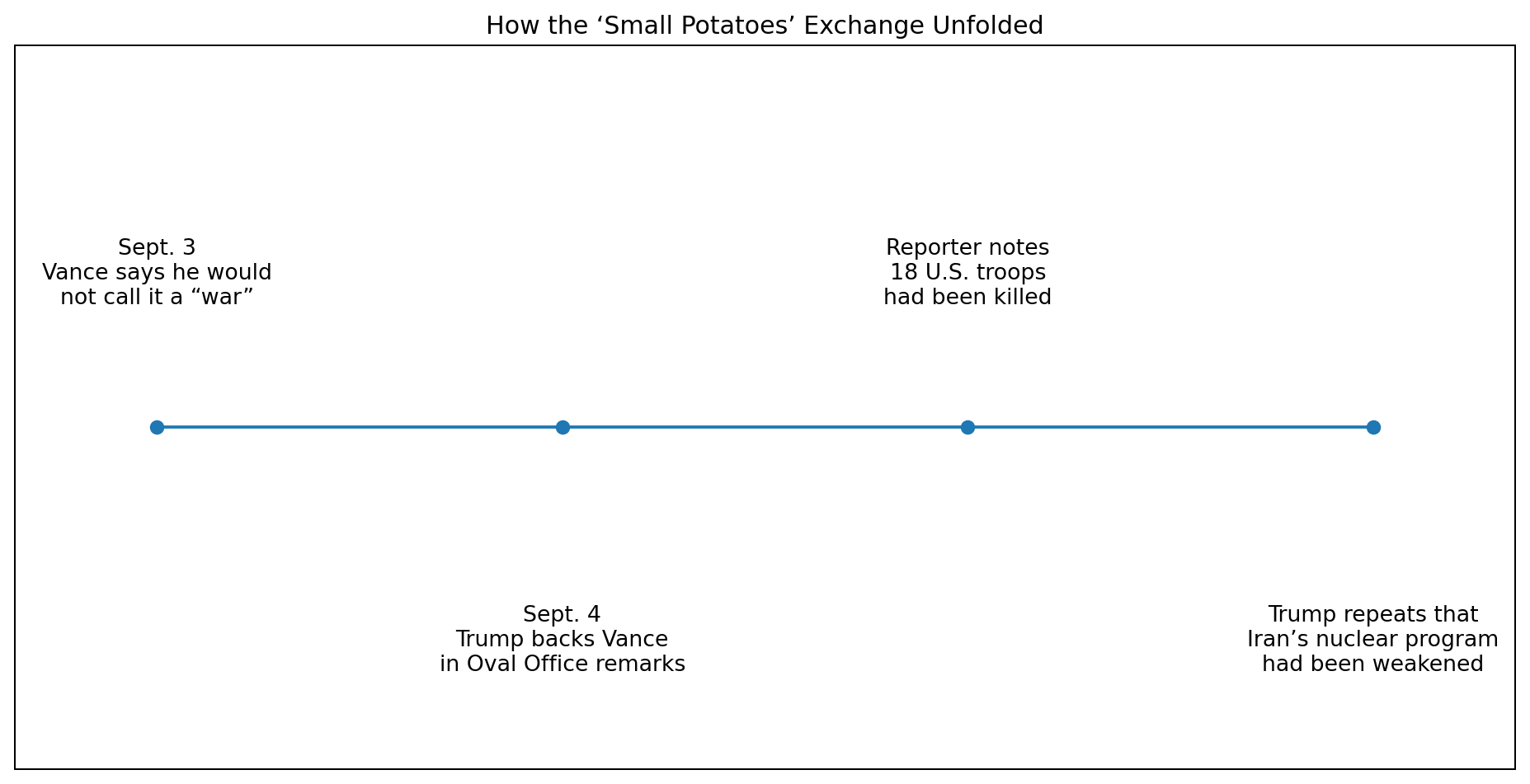
During a White House briefing on September 3, Vance was asked whether the fighting with Iran could end before the November midterm elections.
He said he would not call the situation a war and noted that, at that particular moment, there was no active shooting.
The statement came even though U.S. and Iranian forces had traded attacks for months and Iran had recently launched strikes connected to the wider conflict.
The next day, reporters asked Trump whether he agreed with Vance’s description.
Trump said he understood Vance’s position and argued that U.S. military action had become intermittent rather than a continuous ground campaign.
Then Came the ‘Small Potatoes’ Line
Trump told reporters that “a lot of people don’t call it a war.”
He then said: “I call it a military conflict because it’s small potatoes for us. It’s not a big thing.”
The phrasing immediately became the focus of coverage.
A reporter challenged Trump by pointing out that 18 U.S. service members had already died and that some deployments had become unusually long.
Trump responded by comparing the conflict with larger U.S. wars and again argued that the Iran operation was limited in scale.
Trump Compared the Toll With Vietnam
In defending his description, Trump compared the Iran conflict with the Vietnam War and other major U.S. military campaigns.
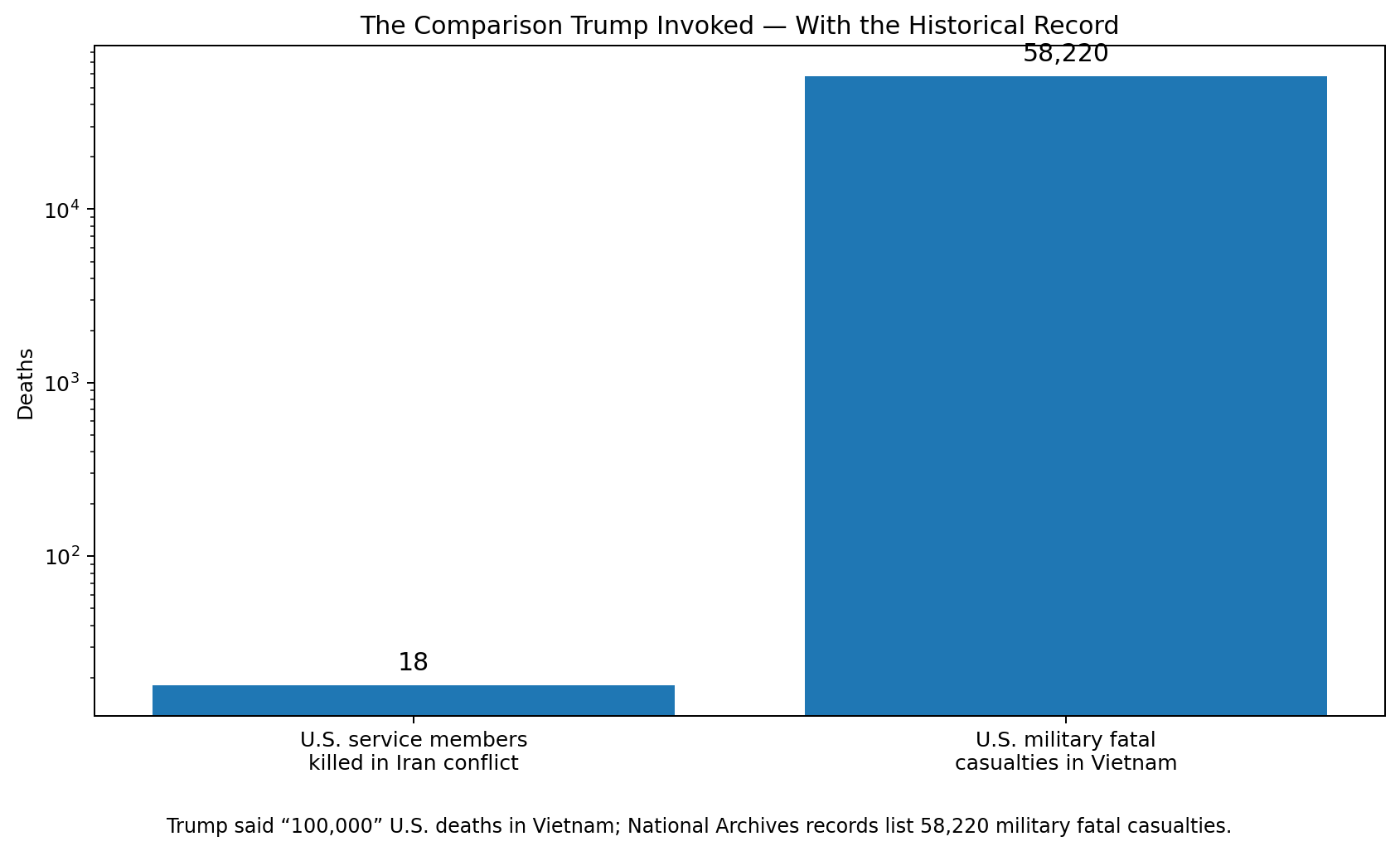
He said the United States had lost 18 people in the Iran conflict and then said 100,000 Americans had died in Vietnam.
That Vietnam figure was inaccurate.
The National Archives lists 58,220 U.S. military fatal casualties associated with the Vietnam War.
Trump’s broader argument was that the Iran conflict had produced a far lower American death toll than major wars of the past.
Why the Comparison Did Not End the Debate
The comparison answered one question — relative scale — but raised another.
A conflict can be smaller than Vietnam while still carrying significant human, military and economic costs.
By early September, the fighting had already killed 18 American service members and wounded hundreds of others.
The United States had also carried out repeated airstrikes against Iranian targets, while Iran and aligned forces had launched retaliatory attacks across the region.
Critics of the “small potatoes” phrasing argued that those facts made the language sound dismissive even if Trump intended only to compare the conflict with larger wars.
Trump’s Defense Focused on Iran’s Nuclear Program
When pressed about the deaths, Trump shifted to what he described as the strategic result of the military campaign.
He argued that U.S. action had badly weakened Iran’s nuclear program and said Tehran would not be allowed to obtain a nuclear weapon.
That has been one of the administration’s central justifications for its military pressure on Iran.
Trump has repeatedly framed the campaign as a way to reduce a long-term security threat without committing large numbers of American ground forces inside Iran.
His supporters have pointed to that limited-ground-force approach as evidence that the conflict is fundamentally different from Iraq, Afghanistan or Vietnam.
But the Fighting Had Already Lasted for Months
The conflict began on February 28, 2026, with U.S. and Israeli attacks on Iran and expanded into months of strikes, retaliation and disruption across the Middle East.
By the time of Trump’s September 4 comments, the confrontation had lasted roughly half a year.
The fighting had affected U.S. bases, regional allies, shipping routes and global energy markets.
American forces had not launched a large-scale ground invasion of Iran, but they remained deeply involved in air and maritime operations.
That created a dispute not only about military strategy, but about what language accurately described the situation.
The White House Preferred ‘Military Conflict’ to ‘War’
Trump’s phrase reflected a broader administration effort to draw a distinction between the Iran campaign and a traditional large-scale war.
Vance emphasized the absence of sustained active shooting at the moment he spoke.
Trump emphasized intermittent strikes and the lack of a major American ground deployment.
Those points describe real differences from conflicts such as Vietnam or the 2003 invasion of Iraq.
At the same time, critics noted that U.S. forces were still conducting lethal operations and suffering casualties, making the debate over terminology more than a semantic exercise.
The Death Toll Made the Words More Sensitive
Presidents are often judged closely on how they speak about military casualties.
For the families of service members, national statistics represent individual losses rather than abstract numbers.
That is why the reporter’s immediate follow-up focused on the 18 Americans who had died rather than on the technical definition of war.
Later commentary from veterans and other critics also focused on whether “small potatoes” was an appropriate way to characterize a conflict with American fatalities.
The administration’s position remained that Trump was describing the overall military scale of the conflict, not the value of the lives lost.
The Remark Also Landed in a Midterm Election Year
The timing added another political dimension.
The United States was approaching the November 2026 midterm elections, with control of Congress at stake.
The Iran conflict had become tied to debates over defense policy, executive war powers and the economic effects of instability in the Middle East.
Vance had been asked specifically whether the conflict might end before voters went to the polls.
That made the administration’s choice of words relevant not only to foreign policy but also to domestic political messaging.
What the Quote Does — and Does Not — Establish
Trump clearly used the phrase “small potatoes” to describe the U.S.–Iran military conflict.
He also explicitly acknowledged that 18 American service members had died.
What the quote does not establish is that Trump called the dead service members themselves “small potatoes.”
His words referred to the scale of the conflict as he compared it with larger wars.
That distinction does not settle whether the phrasing was appropriate, but it is important for accurately describing what he actually said.
Why the Exchange Still Matters
The September 4 exchange captured a larger argument that had been developing for months.
The administration wanted to portray the Iran campaign as limited, controlled and strategically successful.
Critics focused on the length of the conflict, the casualties and the economic and regional consequences.
Both sides were looking at the same military confrontation but emphasizing different measures of its seriousness.
That is why one short phrase carried so much weight.
“Small potatoes” was not simply a comment about battlefield size. It became a debate about how a president talks about war, military risk and the Americans sent into harm’s way.
Comments (0)
Loading comments...
May You Like

Obama Steps Back Into the Political Spotlight as Democrats Target Trump’s Senate Majority

Shocking news from Ohio: an unexpected development ahead of Trump's rally

OBAMA STUNS ON INSTAGRAM: MESSAGE MARKING 34-YEAR MILESTONE SPARKS A BUZZ












