Trump Calls Canada a 'Greater Threat' Than Russia and China — Critics Fire Back: 'You're the Biggest Threat to America'
In a stunning statement that has drawn widespread condemnation, President Donald Trump declared that Canada poses a greater threat to the United States than Russia or China, dismissing America's closest northern neighbor and longtime ally as a more pressing adversary. The remark comes amid an escalating trade war and increasingly hostile rhetoric between Washington and Ottawa — but critics say the real danger to American security lies closer to home.
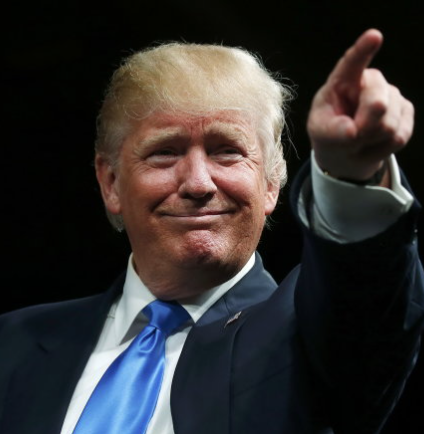
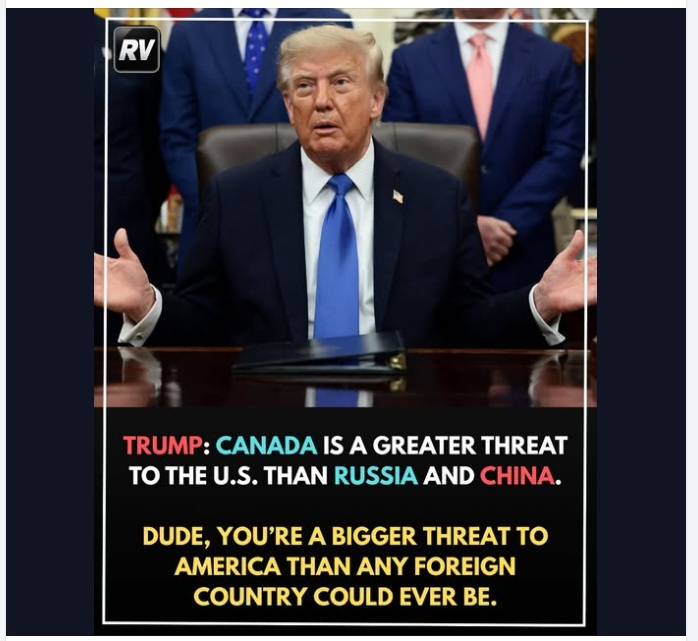
WASHINGTON – A dramatic exchange captured in a viral image shows President Trump making an explosive claim about Canada's threat level, followed by a scathing rebuttal: "Dude, you're a bigger threat to America than any foreign country could ever be." While the image's exact origin remains unclear, it perfectly encapsulates the surreal state of U.S.-Canada relations in September 2026, as the two nations find themselves locked in an unprecedented confrontation.
The context for Trump's remark emerged during an escalating trade and rhetorical war that has seen the president repeatedly attack Canada, threatening tariffs, renaming natural landmarks, and mocking Canada's sovereignty. At a recent White House press event, Trump reportedly amplified these attacks, describing Canada as a "great economic threat" to the United States — a country whose total economy is roughly one-tenth the size of America's . When a reporter pressed him to compare this to the strategic challenges posed by China and Russia, Trump did not back down .
The Background: A Trade War Turns Hostile
The latest escalation began in August 2026 when Trump announced 50% tariffs on certain Canadian goods, effectively blowing up the United States-Mexico-Canada Agreement (USMCA) — a deal he himself negotiated during his first term . In response, Canadian Prime Minister Mark Carney declared that the tariffs represented a "strategic miscalculation" and vowed to retaliate with counter-tariffs targeting American products .
Trump's response on social media was immediate and combative, branding Carney an "enemy" and suggesting Canada was pushing the U.S. toward a breaking point . On September 3, Trump posted: "The Canadian Prime Minister says he will 'fight back' against the United States. Great — that will cause their economy to collapse. Nobody needs Canada. They need us. They've taken advantage of us for years. Now we're fighting back" .
'The 51st State' — From Joke to Threat
The president's rhetoric has moved far beyond traditional trade disputes. Trump has repeatedly floated the idea that Canada should become America's 51st state, a proposal he has framed as a natural solution to the U.S.'s trade imbalance. Last week, the White House posted an image on Truth Social showing Trump and Carney playing hockey, with Trump appearing to say: "Get up, Governor" — a direct taunt suggesting Carney is merely a subordinate American official .
The administration has also renamed Lake Ontario to "Lake America" in official White House communications, a move Carney called "unproductive" and "unserious" . "Stop making memes, stop with the insults, and stop with the tough talk," Carney pleaded .
The Political and Security Implications
Trump's Canadian comments come as his administration continues to project strength against traditional rivals. Both U.S. intelligence assessments and public statements have continued to name China as the primary long-term strategic competitor — a country with a military budget roughly equal to the next dozen countries combined, and an economy that has consistently challenged American manufacturing dominance .
Trump's decision to elevate Canada to a status comparable to China and Russia in terms of threat severity has puzzled analysts. World Bank President Robert Zoellick condemned the approach, writing in the Financial Times: "Trump's hostility toward Canada only inflames Canadian anger. There is no domestic constituency for this fight" .
Even some Republican lawmakers expressed unease. One Senate aide, speaking anonymously, told CNN: "Canada is our ally. We have fought alongside them for over a century. They are more integrated into our military supply chains than any other country. Treating them like North Korea is not just bad policy; it's madness."
Military Concerns: 'What If Trump Ordered an Attack?'
The tense atmosphere has prompted uncomfortable questions about the military implications of Trump's rhetoric. During a recent joint military conference in Canada, a journalist asked U.S. Pacific Command Admiral Samuel Paparo: "If President Trump ordered an attack on Canada, in what scenario would you follow that order?" .
According to transcripts, Paparo hesitated: "I... I think that question is absurd. I obey my commander-in-chief, but this is a highly emotional and unnecessary hypothetical."
The non-answer was widely criticized. One commentator noted: "A commander who can't immediately say he wouldn't attack Canada is either unwilling to stand up to Trump or genuinely believes such an order could come." .
When asked for clarification, the Pentagon did not provide an on-the-record response, instead pointing to previous statements about the importance of the U.S.-Canada defense relationship. That tepid response further worried allies, as NATO's Article 5 commitments guarantee mutual defense for all member states — including Canada and the United States. An attack on one is treated as an attack on all .
Are There Any Policy Realities Behind the Rhetoric?
Despite the saber-rattling, analysts note the U.S. and Canadian economies remain deeply intertwined, with approximately $900 billion in annual two-way trade . Additionally, Canada is a vital transit route for U.S. energy imports and a critical partner in NORAD, the joint aerospace defense command that protects North American airspace.
Critics argue that sabotaging this relationship over tariffs is counterproductive. Former U.S. Ambassador to Canada Bruce Heyman warned: "When Ronald Reagan negotiated the first free trade agreement with Canada, he understood that an integrated North America was a strong North America. Undermining that relationship weakens America's position globally."
Even some of Trump's own allies have been forced to offer explanations. One anonymous senior administration official insisted that Trump's "enemy" comments were a negotiation tactic designed to push Carney to the negotiating table. But the official admitted: "It's a very aggressive tactic, and some of us are uncomfortable with it."
The Bottom Line
| What the graphic shows | What the data confirms |
|---|---|
| Trump calls Canada a greater threat than Russia and China | The president has repeatedly elevated rhetorical attacks on Canada to the level of national security threats |
| A critic fires back: "You're the biggest threat to America" | Critics, including former U.S. officials, have argued that Trump's rhetoric damages American credibility and security |
| Canada, a traditional ally, is treated as an adversary | The administration has imposed 50% tariffs, renamed U.S.-owned lakes, and taunted Canada's prime minister |
For Trump, the fight with Canada appears to be as much about image as trade. He has long portrayed himself as a tough negotiator who can "win" against anyone — even an ally. But the costs of alienating America's second-largest trading partner and a neighbor with which the U.S. shares a 5,500-mile border could be far higher than the tariffs themselves .
For now, Canadians remain steadfast: "We will not be the 51st state," Carney reaffirmed. "And we will not be bullied."
That unity, combined with the anger and disbelief in Washington, reflects the most serious fracture in U.S.-Canada relations since the War of 1812. The question is whether either side can step back from the precipice before the damage becomes irreversible.
Comments (0)
Loading comments...
May You Like
Shocking news from Ohio: an unexpected development ahead of Trump's rally
OBAMA STUNS ON INSTAGRAM: MESSAGE MARKING 34-YEAR MILESTONE SPARKS A BUZZ
South Korea–Ukraine Rift Deepens Over North Korean POW Transfer as PURL Draws New Scrutiny